When Intellectuals “Discover God” — What’s Missing?

Some elite “returns to faith” stop at a safe, abstract Creator—missing humility, reverence, and the surrender that makes faith real. —Joseph C. Kunz, Jr.
Why “Religion Is Useful” Is Not the Same as “God Is True”
By Joseph C. Kunz, Jr.
Synopsis
In an age where elite opinion makers once treated faith as a private quirk, religion is suddenly becoming “respectable” again. Not always as truth—but as a stabilizer. In this essay, Joseph C. Kunz, Jr. argues that many intellectual “returns to God” stop at a safe, abstract Creator and never reach the heart of real belief: humility, reverence, repentance, and surrender.
He explains why “religion is useful” can be a subtle insult, why a Creator who never interrupts you is not the God of serious faith, and why claiming a “perceptual deficit” can sometimes be a polished excuse for decades of cultivated dismissal. Kunz offers a clear standard—the Respect Test—and ends with a sober distinction: if faith is treated like an instrument, it will always be optional. If it is received as truth, it becomes a throne.
A God you find ‘useful’ is still under your control. A God who is true demands your surrender. —JCK
I. Introduction: When the Educated Rediscover God—But Refuse to Kneel
There is a peculiar modern habit—one that has infected the educated class like a fashionable cold. It is the habit of treating the most serious questions as if they were optional, and the most sacred realities as if they were merely interesting.
For decades, religion was placed in a small box marked private preference. It was tolerated like a quaint accent or an eccentric uncle: harmless, perhaps even endearing, but not to be taken seriously by grown men with credentials. Faith, we were told, belonged to the simple.
Then the modern world did what the modern world always does when it cuts itself off from moral roots: it began to rot.
Families weakened.
Communities thinned.
Meaning evaporated.
Freedom turned into appetite.
And the human soul—starved for purpose—went looking for substitutes.
Now, with the wreckage plainly visible, some of the very people who once treated faith as a joke have begun to speak of God again. They do not always say they believe. They do not always kneel. But they have found religion “interesting,” “useful,” “necessary,” “worthy of reconsideration.”
In one sense, this is good news. Better to reconsider than to sneer. Better to read than to smirk.
But there is a problem that a believer is not allowed to mention without being accused of being “judgmental”: the educated return to God often seems to be missing the one thing that makes the return meaningful.
It is missing humility—the kind that does not merely revise an opinion, but repents.
II. The New Respectability of Religion
When fashionable people change their mind, they rarely admit that they were wrong. They say instead that “new evidence has emerged” or that “the conversation has evolved.”
But the evidence for religion’s importance did not suddenly appear last week. Faith has always formed human beings. It has always built families, produced courage, restrained vice, and kept men from dissolving into indulgent animals.
The new thing is not the evidence.
The new thing is the desperation.
The modern experiment—life without God, without moral authority, without sacred obligation—has not made us free. It has made us fragile. And now even some skeptics can see it.
So, religion is welcomed back into polite society, not as truth, but as a stabilizer. Not as a throne, but as a tool.
And this is the first missing thing: the intellectual class often wants what religion does without granting what religion is.
III. The Danger of “Useful” Religion
A man may admire religion the way he admires a well-designed bridge. He may say, “Society needs this,” and he may even mean it. But admiration is not worship.
If God is merely useful, then God is not God.
He is a mechanism.
This is the subtle insult buried inside so much elite religious appreciation: faith is treated as a social technology. It keeps marriages together. It reduces crime. It gives people meaning. It makes them less anxious. It produces community.
All of that may be true. But if it is true, it is true only because faith is not primarily a human invention. Faith is man responding to something real.
If religion is merely useful, then it is optional.
If it is optional, then it has no authority.
If it has no authority, then it is not religion—it is therapy.
And therapy, no matter how well marketed, cannot command the human soul.
IV. The “Creator” Who Never Interrupts You
Here is where the modern intellectual often feels most comfortable: conceding a Creator.
A Creator is safe because He can remain abstract. He can be discussed in a lecture hall and treated as an interesting possibility. He can be approached as a metaphysical explanation.
Why is there something rather than nothing?
Well, perhaps a Creator.
Fine. Perhaps.
But a Creator in the abstract does not require the one thing the modern mind most resists: submission.
A Creator who never judges, never commands, never convicts, never interferes—this is a God tailored for the autonomy-worshiper. He explains the universe and leaves you alone.
But the God of serious faith is not a polite hypothesis. He is not a concept you explore.
He is an authority you answer to.
A man may accept a Designer and remain unchanged.
A man cannot accept a King and stay the same.
This is why so many elite rediscoveries of God stop at the doorway. They are willing to call God plausible. They are not willing to call Him Lord.
V. The “Perceptual Deficit” Excuse
Another common modern move is to speak of spiritual blindness as if it were a neutral personality trait.
I have a perceptual deficit.
I’m not wired for faith.
I don’t have that spiritual sense.
Perhaps. People differ. Temperaments differ. Some men feel spiritual reality with immediacy; others must be dragged toward it by reason. I can grant that.
But here is the honest problem:
When a man has spent his entire life presenting himself as a serious intellectual—an interpreter of human nature, culture, morality, society—and only late in life admits he treated religion as irrelevant, we are allowed to ask:
Was this truly a deficit… or was it a cultivated dismissal?
Because the educated world trains people to dismiss faith. It trains them to associate belief with weakness and skepticism with sophistication. It rewards the smirk. It punishes reverence. It gives status to the man who can explain away the soul.
So yes—some people have a deficit.
But many have something worse: a habit.
They were trained not to see. They practiced not seeing. And they were applauded for it.
When they later turn and say, I am now taking religion seriously, a believer may feel not mocked, but quietly insulted. As if faith were only legitimate once it has been endorsed by a man with a bibliography.
VI. The Respect Test
There is a simple test for whether an intellectual is truly taking faith seriously. It is not whether he agrees with every doctrine. It is not whether he can recite arguments.
It is whether he can represent faith honestly.
Not as superstition.
Not as coping.
Not as tribal identity.
Not as social glue.
But as believers understand it:
Faith is a relationship with God.
Faith is obedience to moral authority.
Faith is a discipline of courage.
Faith is restraint when indulgence is easy.
Faith is love when bitterness would be justified.
Faith is gratitude when suffering would excuse resentment.
Faith is responsibility when excuses would be fashionable.
A serious mind can disagree with faith and still describe it accurately. But if he cannot describe it accurately—if he cannot acknowledge the virtues it forms—then he is not practicing reason.
He is practicing tribalism.
I don’t expect every agnostic to believe what I believe. But I do expect intellectual honesty. And if you can’t even describe faith accurately—if you can’t acknowledge why it produces courage, restraint, and love—then you aren’t a serious thinker. You’re a tribal performer with a degree.
That is not a personal insult. It is a moral standard.
VII. What’s Missing
So, what is missing when intellectuals “discover God”?
Often, it is the one thing modern sophistication cannot tolerate:
Humility.
Not the polite humility of I might be mistaken, but the hard humility of I was wrong. The humility that does not merely add religion to the list of interesting topics, but allows religion to judge the self.
It is missing repentance—because repentance is not an idea. It is a turning.
It is missing reverence—because reverence requires admitting you are not the center.
It is missing cost—because cost is where belief stops being a theory and becomes allegiance.
Faith is not a conclusion. It is not an upgrade. It is not an intellectual hobby.
Faith is a surrender.
And if the return to religion does not reach surrender—if it remains a polite appreciation for the social benefits of belief—then what has been discovered is not God as believers understand Him.
What has been discovered is religion as the elite can tolerate it: useful, optional, and safely under control.
VIII. Welcoming the Latecomer Without Losing Your Mind
Now let me say what must be said to keep cynicism from winning.
People can change. Profoundly. Even late. Even after decades of smugness. Even after years of contempt.
Grace does not check a man’s credentials before it knocks.
So, believers should not sneer at late seekers. We should not demand instant maturity. We should not confuse awkward beginnings with bad faith.
But we should also not pretend that every elite “return to religion” is the same thing.
Some men return because they have encountered truth.
Others return because the world is collapsing and religion looks useful again.
The difference is revealed by posture:
Does the man stand over faith as an evaluator…
or under God as a creature?
IX. Conclusion: God Is Not a Topic
The modern world has turned everything into a topic—marriage, children, morality, sex, death, meaning. We “discuss” what our ancestors would have trembled to handle carelessly.
But God is not a topic.
God is either real—or He is not.
Truth either governs you—or you replace it with preference.
Faith either forms you—or you use it as decoration.
If intellectuals are returning to religion because it is useful, they will treat it like an instrument.
If they are returning because it is true, they will treat it like a throne.
That is what is missing in so many refined rediscoveries of God—not intelligence, not reading lists, not clever arguments.
Humility.
The kind that finally stops explaining everything away.
The kind that says, without performance and without pride:
I am not the judge.
If you return to religion because it helps society, you’ll treat it like a tool. If you return because it is true, you’ll bow—because truth is a throne. —JCK
The Series: Faith That Holds Up
We’re living in an age where contempt is mistaken for intelligence and “God talk” is treated like an academic hobby. This series calls that bluff. These essays aren’t about sounding smart—they’re about truth that forms a soul: humility instead of ego, obedience instead of self-rule, courage instead of comfort addiction. If you’re tired of the sneer and ready for faith that actually holds up, start here.
1. Disbelief Isn’t the Offense — Contempt Is
Doubt can be honest, but the sneer is a moral posture that corrodes truth, decency, and the virtues that hold society together.
2. When Intellectuals “Discover God” — What’s Missing?
Many elite “returns” stop at a safe, useful Creator, but real faith requires humility, reverence, repentance, and surrender.
3. Religion as a Tool: The New Elite Bargain
The new respectability of religion often comes with a bargain: “give us the benefits, but don’t demand obedience.”
4. Nudged by God — or Managed by the Machine?
“Nudging” is the polite language of control, but faith isn’t behavior management—it’s moral allegiance to truth that forms the soul.
5. God as a Theory Isn’t Faith
A costless “First Cause” may impress the mind, but faith begins when God stops being an idea and becomes an authority you obey.
6. Faith Isn’t a Theory — It’s Training
Faith isn’t mainly about cosmology—it’s training that builds endurance, integrity, restraint, and courage when life gets hard.
Faith isn’t proven by sounding smart; it’s forged in real tests—marriage, temptation, suffering, duty, and responsibility.
8. Why Autonomy-First Men Flinch at Faith
Autonomy worship makes the self the judge, so faith feels threatening—because faith begins where self-rule ends.
Start at #1, or pick any title that hits your nerve and jump in.
The Book Behind This Essay: Don’t Let Them “Discover” God Without Bowing
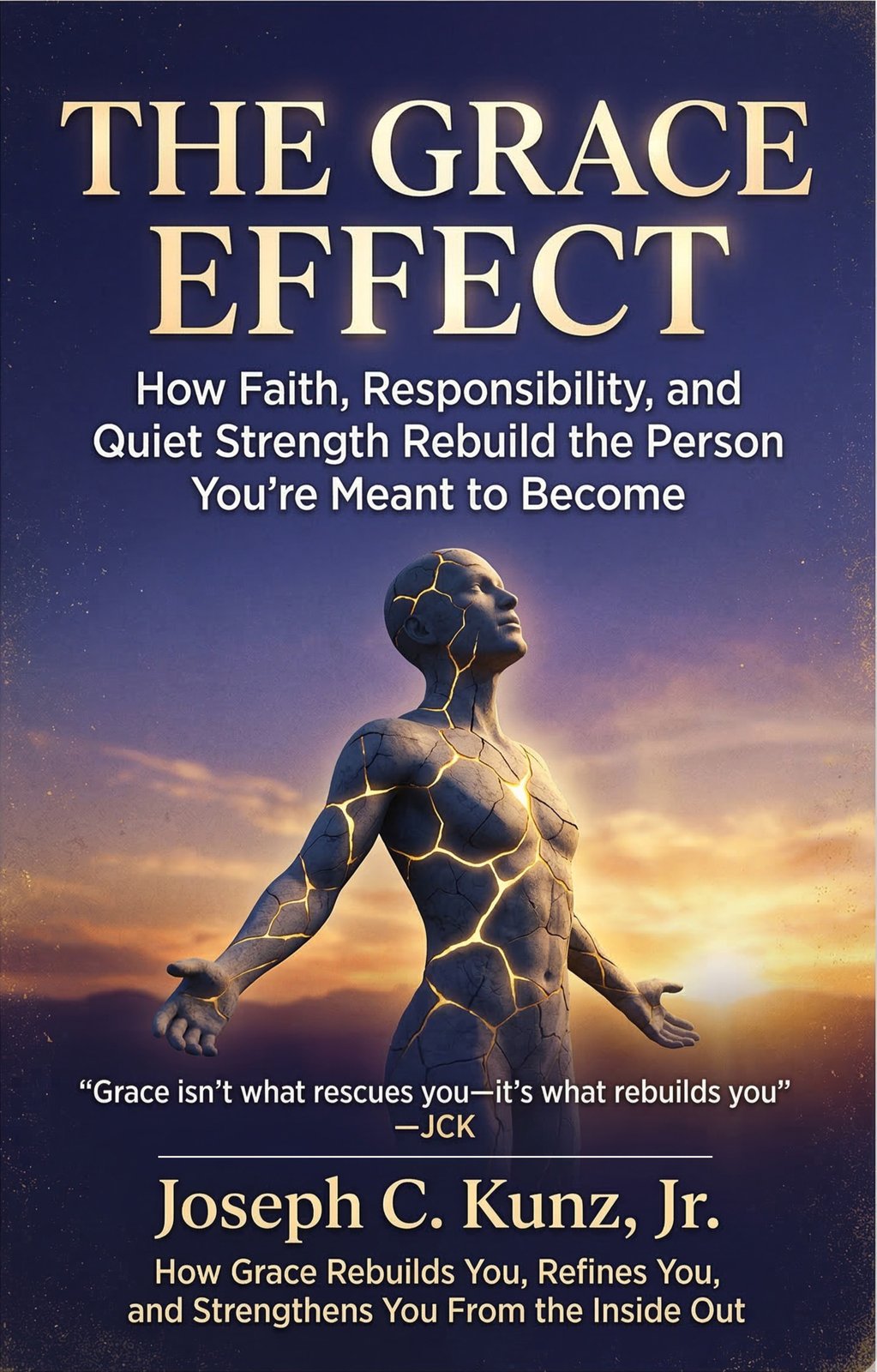
There’s a new trend in the educated class: religion is “interesting” again. God is “worth reconsidering.” Faith is “useful.” Tradition is “stabilizing.”
And on one level, fine. Better than sneering.
But here’s what most of these polished rediscoveries are missing:
Humility. Not the polite humility of “I might be wrong,” but the hard humility of “I was wrong.” The kind that stops evaluating faith like a consumer product and starts bowing like a creature.
Because a Creator you can discuss is easy. A God who commands is not. A “First Cause” costs nothing. A Lord costs everything.
And if a man spends decades mocking faith—then “returns” to God without admitting the sneer—believers aren’t crazy to feel suspicious. Not cynical. Suspicious. Because the question isn’t whether he’s curious.
It’s whether he’s surrendered.
That’s why I wrote The Grace Effect.
Not to win debates with intellectuals. To build people who stay steady when the world gets smug and mean. To form men and women with moral backbone, clean hearts, and the kind of strength that doesn’t need applause.
Because grace isn’t a vibe. Grace is power under control. Grace is truth without cruelty. Grace is courage without ego.
And when the world is full of “useful religion” and costless God-talk, you need the real thing.
Read The Grace Effect here: Grace isn’t an idea—it’s a way of life that holds up under pressure. Coming soon.