Faith Isn’t a Theory — It’s Training

Faith isn’t mainly about explaining the universe—it’s about forming the kind of man who stays steady under pressure. —Joseph C. Kunz, Jr.
What Faith Builds When Life Gets Hard
By Joseph C. Kunz, Jr.
Synopsis
Modern religion talk often sounds intelligent—but it rarely makes anyone stronger. Too many people treat God like a seminar topic: a theory to debate, a concept to explore, a conclusion to file away. But life doesn’t test your arguments. It tests your character. In this essay, Joseph C. Kunz, Jr. argues that faith isn’t primarily about solving cosmology questions. It’s about forming the kind of man who can endure suffering without becoming bitter.
It’s about resisting corruption when compromise is easy. And it’s about leading his family with courage instead of ego. He explains why “God as Creator” isn’t the same as real faith. He shows why the demand for laboratory-style proof misses the point. And he argues that the best evidence of belief is the fruit it produces over time: restraint, integrity, endurance, and love under pressure. If you want a faith that holds up when life gets hard, this is the standard.
God isn’t a concept to debate—He’s the foundation that keeps a man standing when life tries to break him. —JCK
I. Introduction: The “Smart” Way to Miss the Point
A lot of modern religion talk sounds intelligent… and accomplishes nothing.
It treats God like a topic. A concept. A debate. Something you can “explore” the way you explore a podcast series.
But life doesn’t grade you on how clever you sound. Life grades you on whether you can carry responsibility without collapsing into self-pity, compromise, or cowardice.
That’s why I keep coming back to one blunt truth:
The point of faith isn’t answering cosmology questions; it’s building a man who can endure suffering, resist corruption, and lead his family with courage.
You can argue about the origin of the universe for fifty years and still be a mess at home. You can be brilliant and still be weak. You can have a reading list and still have no backbone.
Faith is not for showing off. Faith is for holding up.
And in a culture that’s getting softer, angrier, and more fragile by the year, we need more men who can hold up.
And if that sounds too “practical” for the intellectual class, good. A lot of their religion talk is practical in the worst way—practical for protecting status, avoiding obedience, and keeping God at a safe distance.
This essay is about real practicality: the kind that holds your life together when the pressure shows up.
II. The Trap: Turning God Into a Seminar
There’s nothing wrong with big questions. They’re interesting. Some of them matter.
But big questions can also become a hiding place.
Because asking questions is safer than obeying truth.
A man can spend his whole life “exploring” God and never once face the things that actually ruin him:
• bitterness
• lust
• greed
• pride
• cowardice
• excuses
• comfort addiction
That’s why the educated class often prefers religion in the abstract. It lets them sound serious while staying in control.
Here’s what I mean by “seminar religion”:
Seminar religion loves definitions.
It loves clever objections.
It loves distance.
It loves “interesting.”
It loves saying, “I’m still working through it.”
But furnace life doesn’t care what you “work through.” It asks what you live out.
Furnace life asks: Are you reliable when it hurts?
Because while you’re “working through it,” your habits are working on you. Your temptations are working on you. Your excuses are building a life you will eventually have to live inside.
And God is not a topic.
God is either real—and therefore authoritative—or He’s just a mental hobby.
III. The Three Tests That Reveal What a Man Is Made Of
Let’s bring this down to earth. Here are the questions that matter far more than Who created matter?
A. Can You Endure Suffering Without Becoming Bitter?
Suffering exposes what you’re built on.
If your foundation is comfort, suffering will break you.
If your foundation is pride, suffering will harden you.
If your foundation is entitlement, suffering will make you furious.
This is why you can’t judge a man’s “belief” by his opinions alone. You judge it by his posture under pressure.
When life turns unfair, do you get better—or do you get ugly?
Faith doesn’t remove pain. Faith gives pain a frame.
Not “pain is good.”
But “pain is not pointless.”
And that matters because pointless pain turns into bitterness. Pointless pain turns into self-pity. Pointless pain turns into the kind of anger that poisons everyone around you.
Faith builds a man who can carry hardship without turning ugly.
Not perfect. Not always smiling. Not pretending it doesn’t hurt.
But steady. Grounded. Still able to love people while hurting.
B. Can You Resist Corruption When Compromise Is Easy?
Corruption usually doesn’t show up like a villain.
It shows up like this:
• “It’s just a small lie.”
• “Everyone does it.”
• “I earned this.”
• “Nobody will know.”
Most corruption is not dramatic. It’s gradual.
Corruption is usually a thousand tiny deals you make with yourself.
It’s the slow shift from:
• “I would never do that,” to
• “I’ll do it this once,” to
• “I had to,” to
• “It’s normal.”
This is where faith becomes practical.
Faith trains one word modern people hate:
No.
No to the shortcut.
No to the appetite.
No to the rationalization.
No to the lie you can justify.
Because a man who can’t say no is not “free.” He’s simply well-trained by his impulses.
And here’s the part people don’t like hearing: self-control is not oppression. Self-control is power.
A man ruled by his appetites is not living—he’s reacting.
C. Can You Lead Your Family With Courage—Not Mood or Ego?
Leadership isn’t domination. It’s responsibility.
It’s staying steady when life gets chaotic.
It’s telling the truth when it would be easier to dodge it.
It’s doing the hard thing first and not needing a parade.
Your family doesn’t need your theories.
They need your presence.
They need your restraint.
They need your steadiness.
They need your courage.
And here’s the reality most men eventually learn:
Your kids don’t learn courage from your speeches. They learn it from how you act when you’re tired, stressed, disappointed, and tempted to quit.
Your family can feel your fear even when you never say a word.
Your wife doesn’t need a philosopher. She needs a man she can trust—especially when life gets heavy.
That’s what faith is supposed to build.
IV. Why “God as Creator” Isn’t Enough
Here’s a major difference between “elite religion” and real faith:
Many people can accept a Creator because a Creator can stay theoretical.
A Creator can be a conclusion.
But a conclusion won’t change you.
Concepts don’t convict you.
Concepts don’t correct you.
Concepts don’t demand repentance.
Concepts don’t produce courage at the dinner table.
Real faith isn’t only believing someone made the world.
Real faith is allegiance.
The real question isn’t only Who made the world?
It’s Who rules me?
Modern people often want a God who explains—but not a God who interrupts.
A God who comforts—but not a God who commands.
A God who exists—but not a God who judges.
But a God you can keep in your pocket is not God.
He’s a mascot.
And if your “God” never challenges you, never corrects you, never calls you to repentance, never demands moral change—then what you have is not faith.
It’s a spiritual decoration.
V. The Evidence the Skeptical Mind Often Misses
Skeptics often demand proof the way a lab demands proof.
But the human soul isn’t a chemistry set.
You can’t spreadsheet your way into courage.
You can’t debate your way into integrity.
You can’t argue your way into self-control.
The strongest evidence of faith is what it produces over time:
• endurance under pressure
• restraint under temptation
• love under injury
• truth-telling under risk
• steadiness under responsibility
That’s not a clever argument. That’s fruit.
And fruit matters because life is lived, not theorized.
A man doesn’t need a cosmology answer when his mother dies, his marriage hits a hard season, his job disappears, or his own body fails him.
He needs a foundation.
Faith is that foundation—not because it gives you trivia, but because it gives you strength.
VI. The Objections People Raise (And Why They Don’t Change the Point)
Let me address two objections I hear all the time.
A. “Plenty of atheists are good people.”
True. Some atheists have strong character. Some show courage, generosity, and integrity.
But that doesn’t change the point of this essay.
This essay isn’t claiming faith is the only way to do good. It’s claiming faith is a powerful way to form a man—especially when life pressures him to compromise, quit, or collapse.
Faith offers more than moral preferences. It offers moral authority. It offers accountability beyond mood and social approval. It offers a reason to endure suffering without turning into a bitter person who needs everyone else to pay for his pain.
B. “Religion is just coping.”
If faith were just coping, it would always choose comfort.
But faith often demands the opposite:
• telling the truth when lying would be easier
• staying faithful when leaving would be easier
• forgiving when hatred would feel justified
• carrying responsibility when excuses would be popular
That’s not coping. That’s character.
VII. The Clean Challenge
A. To the Skeptic
You don’t have to believe what I believe to be honest about what faith is.
If you reduce faith to “coping,” you aren’t analyzing—you’re sneering.
At least acknowledge the obvious: faith has formed millions of men and women who carried suffering with dignity, resisted corruption when it was profitable, and held their families together when life got hard.
B. To the Believer
Don’t turn faith into a debate hobby.
Faith is not a badge you wear.
Faith is a discipline you live.
If your faith isn’t producing patience, restraint, courage, integrity, and love, it isn’t doing what it’s meant to do.
VIII. Conclusion: What Faith Is For
Cosmology questions can be fascinating.
But they are not where most men fail.
Men fail in the dark places: resentment, temptation, fear, comfort, pride.
That’s why faith matters.
Not mainly as a clever answer—but as training for the soul.
The point of faith isn’t answering cosmology questions; it’s building a man who can endure suffering, resist corruption, and lead his family with courage.
If your faith never touches your habits, it never touched you. —JCK
The Series: Faith That Holds Up
We’re living in an age where contempt is mistaken for intelligence and “God talk” is treated like an academic hobby. This series calls that bluff. These essays aren’t about sounding smart—they’re about truth that forms a soul: humility instead of ego, obedience instead of self-rule, courage instead of comfort addiction. If you’re tired of the sneer and ready for faith that actually holds up, start here.
1. Disbelief Isn’t the Offense — Contempt Is
Doubt can be honest, but the sneer is a moral posture that corrodes truth, decency, and the virtues that hold society together.
2. When Intellectuals “Discover God” — What’s Missing?
Many elite “returns” stop at a safe, useful Creator, but real faith requires humility, reverence, repentance, and surrender.
3. Religion as a Tool: The New Elite Bargain
The new respectability of religion often comes with a bargain: “give us the benefits, but don’t demand obedience.”
4. Nudged by God — or Managed by the Machine?
“Nudging” is the polite language of control, but faith isn’t behavior management—it’s moral allegiance to truth that forms the soul.
5. God as a Theory Isn’t Faith
A costless “First Cause” may impress the mind, but faith begins when God stops being an idea and becomes an authority you obey.
6. Faith Isn’t a Theory — It’s Training
Faith isn’t mainly about cosmology—it’s training that builds endurance, integrity, restraint, and courage when life gets hard.
Faith isn’t proven by sounding smart; it’s forged in real tests—marriage, temptation, suffering, duty, and responsibility.
8. Why Autonomy-First Men Flinch at Faith
Autonomy worship makes the self the judge, so faith feels threatening—because faith begins where self-rule ends.
Start at #1, or pick any title that hits your nerve and jump in.
The Book Behind This Essay: Stop “Thinking” About Faith—Start Living Like It’s True
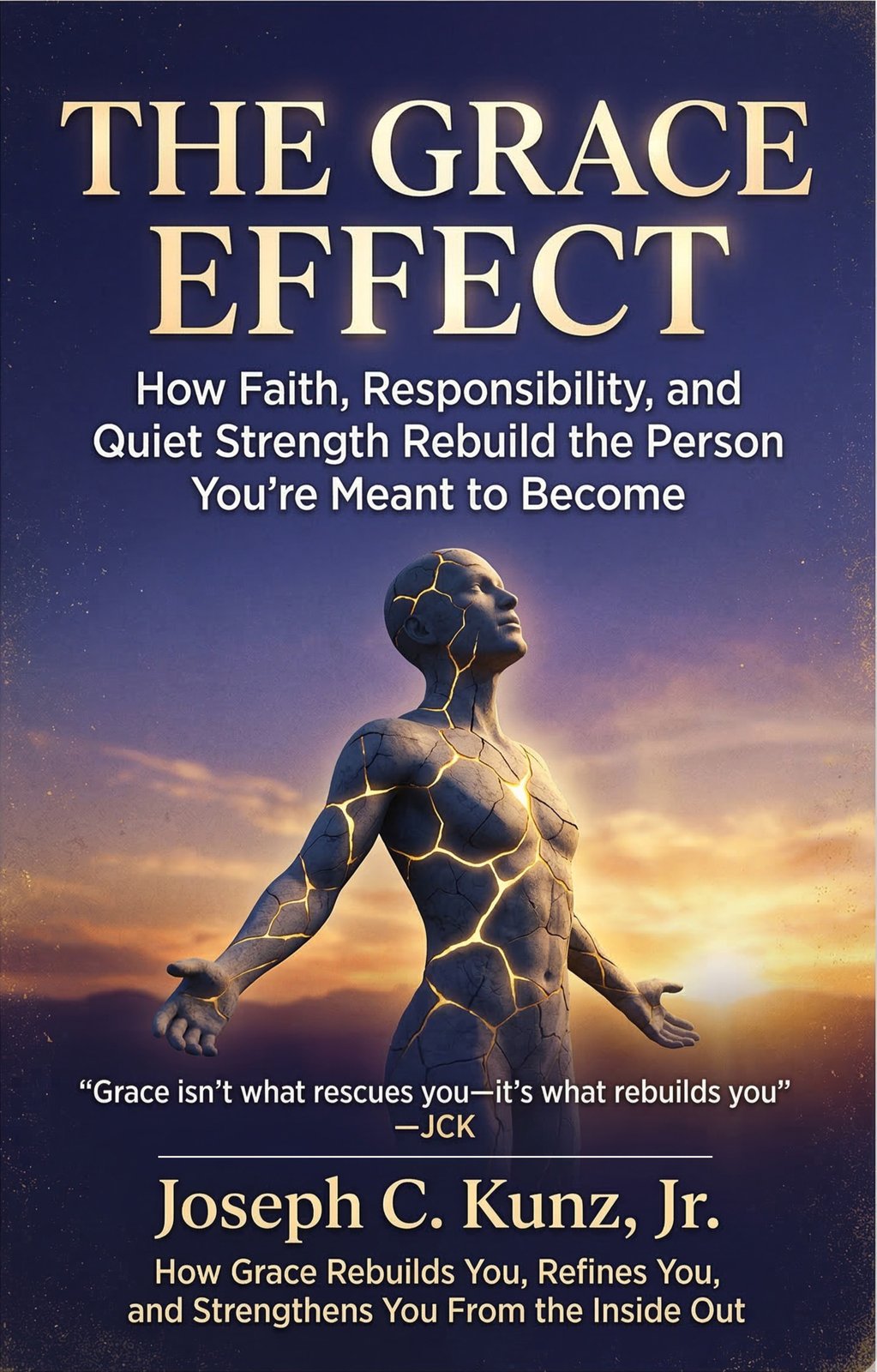
Modern people love a safe God. A God you can discuss. Analyze. “Consider.” A God who never interrupts your habits, never corrects your pride, and never demands anything more than a thoughtful shrug.
That’s not faith. That’s a book club with candles.
Because life doesn’t test your cosmology. Life tests your character.
It tests you at 2:00 a.m. when anxiety hits and nobody’s watching. It tests you when temptation offers a shortcut. It tests you when your ego wants revenge. It tests you when your marriage feels heavy. It tests you when your kid needs steadiness and you feel empty. It tests you when suffering shows up and you’re one bad day away from becoming bitter.
And here’s the brutal truth: if your “faith” can’t survive those moments, it wasn’t faith. It was a theory.
That’s why I wrote The Grace Effect.
Not to help you sound spiritual. To help you become strong. To train the kind of man who can endure pain without turning ugly, resist corruption when compromise is easy, and lead his family with courage instead of ego.
Because grace isn’t soft. Grace is strength under control. Grace is the power to do the right thing when every part of you wants to do the easy thing.
So if this essay hit you in the chest—good. Now don’t just agree with it. Don’t just highlight it. Train. Because the next test is coming, whether you’re ready or not.
Read The Grace Effect here: Faith that doesn’t train you won’t hold you. The Grace Effect — Build Strength With Grace
Coming soon.