Disbelief Isn’t the Offense — Contempt Is
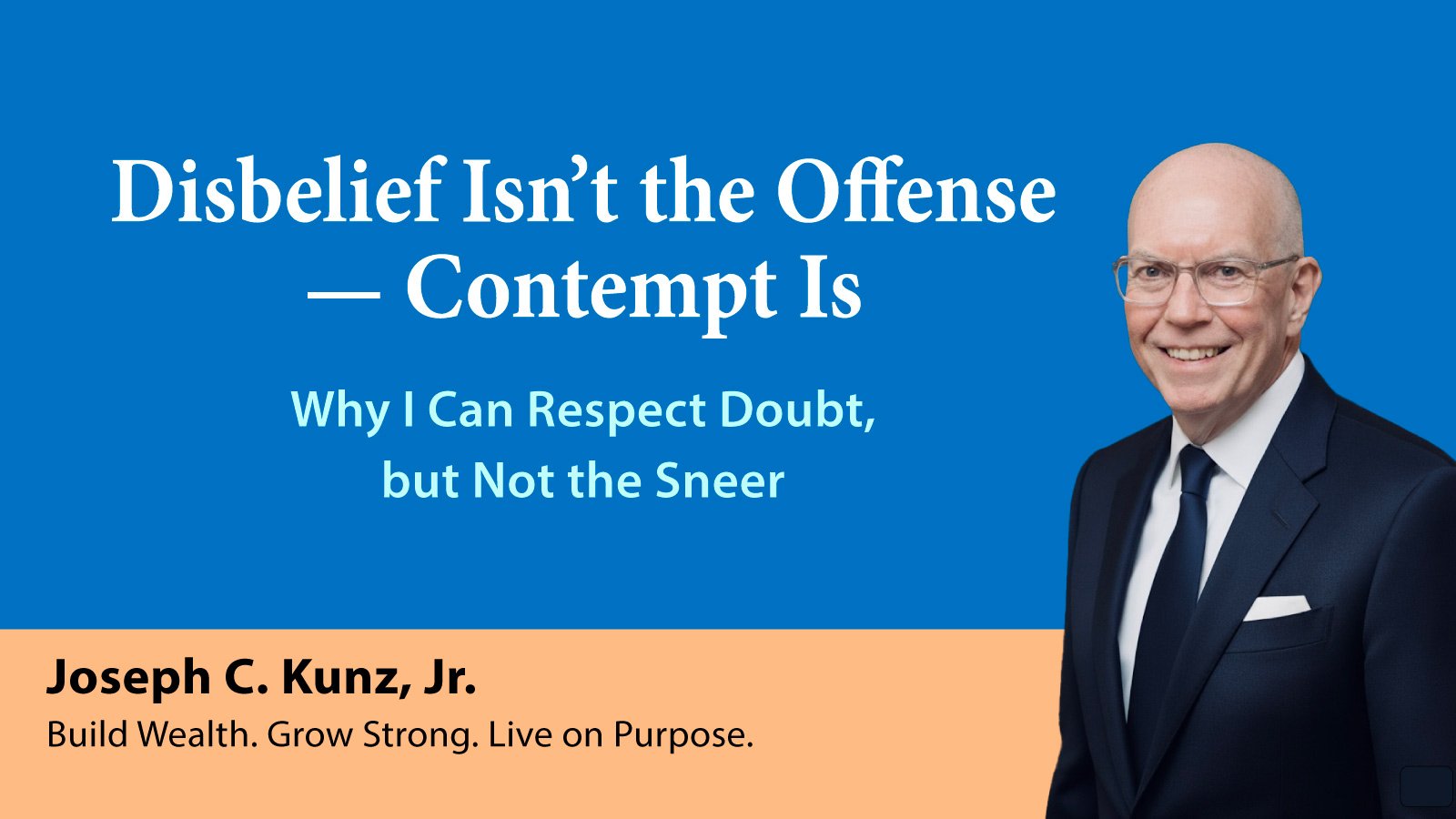
I don’t demand agreement from skeptics—I demand honesty, decency, and respect for what faith actually is and does. —Joseph C. Kunz, Jr.
Why I Can Respect Doubt, but Not the Sneer
By Joseph C. Kunz, Jr.
Synopsis
In a culture that celebrates skepticism as sophistication, the real problem isn’t disagreement—it’s contempt. In this essay, Joseph C. Kunz, Jr. argues that doubt can be honest and unbelief can be sincere, but the sneer toward faith is something else entirely: a moral posture that signals superiority and earns status inside the “enlightened” tribe. Kunz explains how contempt has become a kind of social currency.
He shows why believers are right to be wary of late-coming “respect” for religion that never admits past disdain. And he argues that secular certainty often refuses accountability for the cultural fallout that follows when faith is pushed out of the center. He ends with a clear standard—the “Respect Test”: you don’t need to believe to be serious, but you must represent faith honestly and acknowledge the virtues it trains. A society can survive doubt. It can’t survive contempt.
Certainty without humility isn’t enlightenment—it’s pride with better branding. —JCK
I .Introduction: Disagreement Is Fine — Disdain Is Not
Let me say this as plainly as I can, because this is where a lot of believers get misunderstood.
I don’t require unbelievers to share my faith in order to earn my respect. I’m not threatened by doubt. I’m not scandalized by questions. I can live with a man who says, “I don’t believe,” if he says it honestly and carries himself with basic decency.
What I cannot respect is contempt.
Because contempt isn’t skepticism. Contempt is a moral posture—one that says, I am above you. It is the impulse to treat believers as inferior, to treat religion as pathology, and to treat the moral tradition of the West as a childish crutch for weak minds. It’s not an argument. It’s a sneer wearing a suit.
And here’s why this matters so much: contempt is not merely a private attitude. In the modern world, it has become a kind of social currency. A man can gain applause, status, and fame by signaling that he belongs to the right tribe—the enlightened tribe—the tribe that “knows better” than the people who still kneel, still pray, still believe in moral limits and sacred obligation.
When that happens, the issue is no longer belief vs. disbelief. The issue becomes something deeper and uglier:
a cultivated pride rewarded by a cultivated audience.
That is why many faithful people struggle to receive the late-coming intellectual who now speaks of religion with a new tone. The problem is not that he changed his mind. People can change. In fact, the entire Christian story is built on that possibility.
The problem is that many of these shifts happen without the one thing that would make them credible:
humility.
Not the polite humility of I might be wrong, but the hard humility of I was wrong to sneer.
Not I’ve reconsidered religion, but I misrepresented it.
Not faith is useful, but faith is true—and I treated it with contempt.
Because if a man never confesses the sneer, the sneer remains—only redirected. And that’s the tell. He may now speak positively about religion, but he still stands over it as the evaluator. He still treats faith as something he has finally dignified with attention, rather than something he should approach with reverence.
So yes, I understand why believers get suspicious. Not cynical—suspicious.
If your public identity was built on being dismissive and certain—on treating everyone outside your tribe as backward—then a later “rediscovery of God” can sound less like repentance and more like repositioning. That doesn’t prove bad faith. But it does raise a fair question:
Has the posture changed—or only the topic?
II. Contempt as a Social Currency: How Sneering Became a Status Symbol
Here’s what makes contempt different from normal disagreement: it doesn’t just say, I think you’re wrong It says, You’re beneath me.
And in modern public life, that posture is often rewarded. Contempt becomes a credential. A signal. A way of telling the right people, I’m one of you.
It’s not enough to be secular. You’re expected to be secular and superior. Not curious, not careful, not modest—superior.
That’s why some believers don’t merely feel disagreed with; they feel insulted. They’re not being argued with. They’re being dismissed. And dismissal is not an intellectual move—it’s a moral one.
III. Certainty Without Accountability: When the “Enlightened” Refuse to See the Fallout
Here is another reason contempt feels so insulting: it is often paired with a strange kind of blindness.
The secular “enlightened” posture doesn’t just disagree with faith. It often refuses to acknowledge what happens when a culture pushes faith out of the center and replaces it with appetite, therapy-talk, and self-worship.
And this is where I lose patience with the smug certainty.
Because if your worldview becomes culturally dominant, you don’t get to take credit for every comfort it produces while refusing responsibility for the moral and social wreckage that follows.
You don’t get to call yourself enlightened while treating everyone outside your tribe as inferior.
You don’t get to call yourself compassionate while sneering at the people holding the moral line.
And you don’t get to call yourself an intellectual while refusing to see consequences.
When faith is reduced to “coping,” what grows in its place is not neutrality. What grows is confusion—about meaning, about morality, about marriage, about children, about the purpose of life itself.
And the result is not freedom. The result is often fragility: men without backbone, families without stability, and people medicating emptiness with noise, pleasure, and politics.
I’m not claiming every skeptic causes these outcomes. I’m saying a culture that treats faith with contempt shouldn’t act shocked when the virtues faith trains—restraint, duty, sacrifice, loyalty, courage—begin to disappear.
A person isn’t an intellectual because he can critique religion. He’s an intellectual if he can describe it accurately, acknowledge its fruits, and grapple honestly with what happens when a society loses it.
Contempt isn’t skepticism.
Disbelief isn’t the offense. Contempt is.
IV. The Difference Between Critique and Contempt: How to Disagree Without Becoming a Liar
Critique is not the enemy. Serious critique can be healthy. In fact, faith has survived critique for centuries—because truth does not fear examination.
But contempt is different.
Critique says, I think you’re wrong, and here’s why.
Contempt says, You’re beneath me, and you’re not worth understanding.
Critique is willing to define your position in a way you would recognize.
Contempt builds a cartoon version of your position—then mocks the cartoon.
Critique can admit strengths even while disagreeing.
Contempt can’t. It must pretend there’s nothing good there, because admitting any virtue would weaken the posture of superiority.
This is why the “Respect Test” matters. A serious skeptic doesn’t have to be religious. But he does have to be accurate. He has to show he understands what believers actually mean when they say faith—meaning not just “comfort,” but obedience; not just “community,” but conscience; not just “coping,” but repentance and moral restraint.
And here’s the hard truth: when a person can’t describe faith honestly, it’s usually not because he’s too smart. It’s because he’s too proud.
He doesn’t want to understand. He wants to win.
He doesn’t want truth. He wants status.
That’s not intellectual life. That’s performance.
V. The Respect Test: The Standard for a Serious Skeptic
I don’t expect every agnostic to believe what I believe. But I do expect intellectual honesty.
And if you can’t even describe faith accurately—if you can’t acknowledge why it produces courage, restraint, and love—then you aren’t a serious thinker. You’re a tribal performer with a degree.
That is not a personal insult. It is a standard.
Because the moment a man refuses to represent his opponent’s position fairly, he forfeits the right to call himself serious. And the moment he treats contempt as a substitute for argument, he proves what he really worships:
not truth, but superiority.
VI. Conclusion: A Society Can Survive Doubt — It Can’t Survive Contempt
A society can live with disagreement. It can even live with doubt.
What it can’t survive for long is contempt—especially when that contempt is aimed at the very traditions that trained restraint, duty, sacrifice, and moral seriousness.
If you don’t believe, say so. Ask your questions. Make your arguments. Do it honestly.
But don’t sneer at people of faith while benefiting from the moral capital they helped build. And don’t call yourself enlightened if you can’t see the human cost of tearing down what you refuse to understand.
Disbelief isn’t the offense.
Contempt is.
A society can survive disbelief. It cannot survive contempt for the virtues that built it. —JCK
The Series: Faith That Holds Up
We’re living in an age where contempt is mistaken for intelligence and “God talk” is treated like an academic hobby. This series calls that bluff. These essays aren’t about sounding smart—they’re about truth that forms a soul: humility instead of ego, obedience instead of self-rule, courage instead of comfort addiction. If you’re tired of the sneer and ready for faith that actually holds up, start here.
1. Disbelief Isn’t the Offense — Contempt Is
Doubt can be honest, but the sneer is a moral posture that corrodes truth, decency, and the virtues that hold society together.
2. When Intellectuals “Discover God” — What’s Missing?
Many elite “returns” stop at a safe, useful Creator, but real faith requires humility, reverence, repentance, and surrender.
3. Religion as a Tool: The New Elite Bargain
The new respectability of religion often comes with a bargain: “give us the benefits, but don’t demand obedience.”
4. Nudged by God — or Managed by the Machine?
“Nudging” is the polite language of control, but faith isn’t behavior management—it’s moral allegiance to truth that forms the soul.
5. God as a Theory Isn’t Faith
A costless “First Cause” may impress the mind, but faith begins when God stops being an idea and becomes an authority you obey.
6. Faith Isn’t a Theory — It’s Training
Faith isn’t mainly about cosmology—it’s training that builds endurance, integrity, restraint, and courage when life gets hard.
Faith isn’t proven by sounding smart; it’s forged in real tests—marriage, temptation, suffering, duty, and responsibility.
8. Why Autonomy-First Men Flinch at Faith
Autonomy worship makes the self the judge, so faith feels threatening—because faith begins where self-rule ends.
Start at #1, or pick any title that hits your nerve and jump in.
The Book Behind This Essay: Stop Letting the Sneer Win
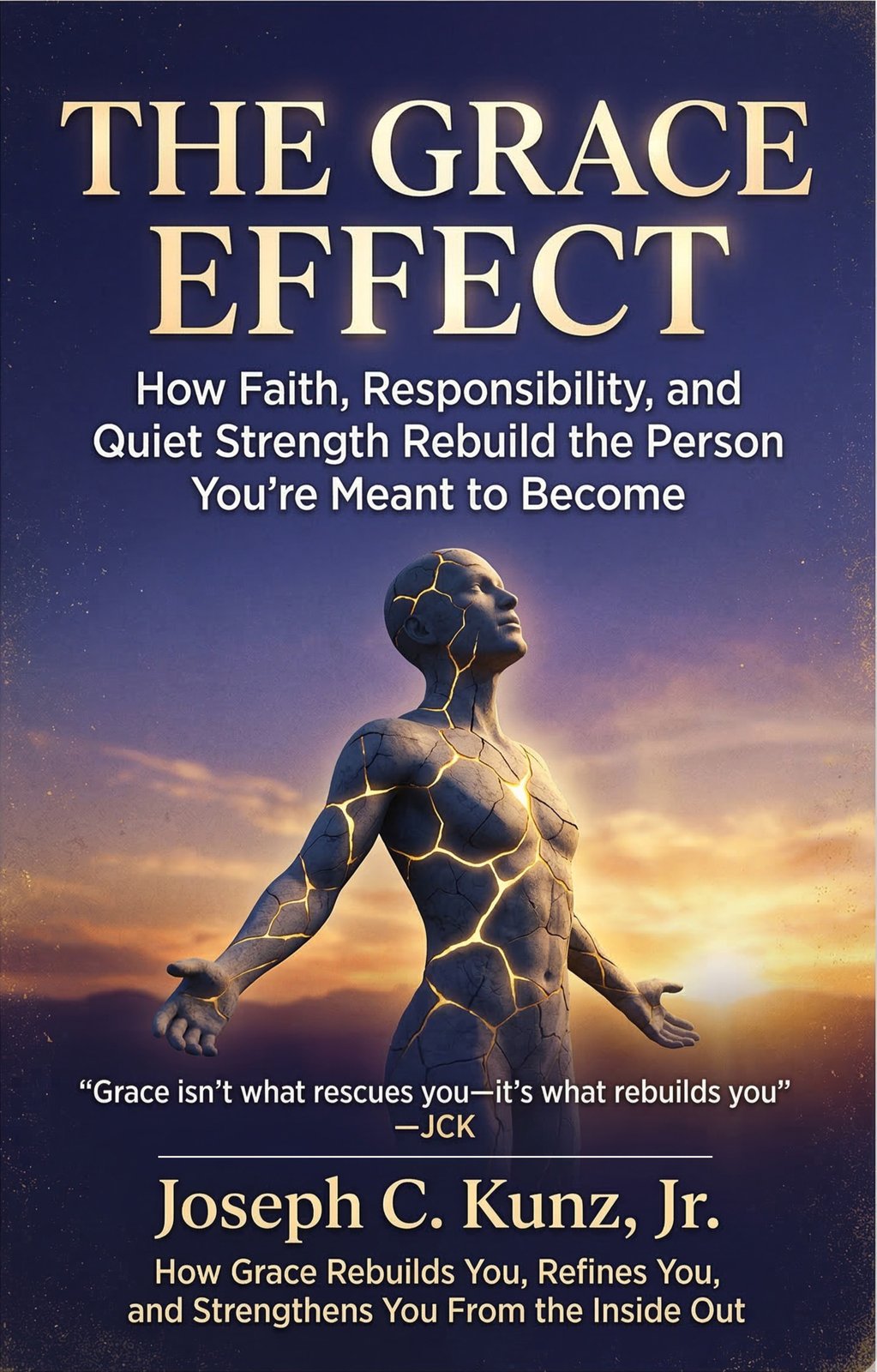
If you’ve ever felt that moment—someone smirking at faith like it’s a cartoon for weak people—you already know this isn’t “just a debate.” It’s an attempted demolition of decency.
Disbelief isn’t what breaks a culture. Contempt is. Contempt trains people to mock what they refuse to understand. It makes arrogance feel sophisticated. It turns cruelty into a personality trait. And it convinces good men to go quiet—because they don’t feel like fighting a sneer.
But here’s the part nobody tells you: your quiet integrity is not enough anymore. Not when contempt is fashionable. Not when the moral line gets treated like a joke. Not when your kids are being taught that conviction is “hate” and self-control is “repression.”
This is exactly why I wrote The Grace Effect. Not to win arguments. To build men who don’t collapse into bitterness, cowardice, or compromise. To build families that stay steady. To build lives that can absorb pressure and still choose truth, restraint, courage—and yes, grace.
Because grace isn’t softness. Grace is strength under control. And in a world that rewards contempt, you’re going to need that kind of strength on purpose.
Read The Grace Effect here: Grace beats contempt when you live it. Coming soon.