When Reality Gets Called Naive

When a culture starts calling clarity naive, it has already lost its grip on reality. —Joseph C. Kunz, Jr.
Why Clarity Sounds Childish in a Disordered World
By Joseph C. Kunz, Jr.
Synopsis
This isn’t an essay about nostalgia, political innocence, or longing for a simpler world that never existed. In this essay, Joseph C. Kunz, Jr. argues that one of the surest signs of cultural disorder is when plain moral clarity gets dismissed as childish, simplistic, or naive by people who have confused sophistication with surrender.
Kunz makes the case that reality does not become less true because disordered people find it inconvenient. Human nature, moral order, family, faith, responsibility, and freedom do not disappear because an ideology declares them outdated. But when a culture drifts far enough from truth, it must first mock clarity before it can replace it with confusion.
The conclusion is simple: calling reality naive does not make reality go away. It only proves that a person, institution, or civilization has become too fragile to face what is true.
When truth becomes uncomfortable, it isn’t refuted—it’s relabeled. —JCK
I. Introduction: The Old Trick of Calling Clarity Naive
There is a moment in the old film Never Let Me Go where the conflict is larger than the scene itself.
Clark Gable’s character confronts a Russian bureaucrat who has taken ordinary human need, goodwill, and love and dragged them into the machinery of the state. He refuses to argue on false terms. He refuses to pretend that harmless human needs are dangerous simply because a system has decided to treat them that way. He sees the inversion clearly.
Then he adds a final question—simple, direct, and open:
“Or am I confused?”
It is a good-faith question. An honest man leaving room for correction.
The bureaucrat does not answer it.
He does not engage the argument.
He does not clarify the facts.
He responds with a cold, efficient dismissal:
“Not confused, merely naive.”
That exchange captures something far more than a political disagreement. It reveals a pattern.
When reality becomes inconvenient, it is not argued against—it is downgraded.
Clarity is reframed as immaturity.
Truth is recast as oversimplification.
And the person who refuses to play along is relabeled.
That line is not limited to a film, a time, or a political system. It is the voice of any person or institution that has lost contact with reality but still wants to sound superior.
The man who sees clearly is called naive.
The man who recognizes human nature is called simplistic.
The man who refuses to rename disorder as wisdom is told he does not understand complexity.
That is how disorder protects itself.
It does not begin by proving truth false. It begins by making truth sound childish.
II. The Sophistication of the Lost
One of the defining traits of cultural disorder is that it presents itself as sophistication.
Confusion is reframed as nuance.
Cowardice is renamed compassion.
Moral surrender is recast as realism.
And plain truth—especially when it carries obligation—is treated as something only the unsophisticated still believe.
Say that fathers matter, and you will be called outdated.
Say that children need order, and you will be called rigid.
Say that freedom requires self-government, and you will be called severe.
Say that faith is foundational rather than decorative, and you will be called narrow.
Of course life is complicated.
That is precisely why clarity matters.
Complexity does not eliminate truth. It increases the need for it. A man walking through fog does not need someone to celebrate the fog. He needs direction. He needs orientation. He needs enough humility to admit that visibility is not the same as reality.
But disordered people often prefer fog.
Fog protects them from judgment. If nothing is clear, nothing can be required. If nothing is fixed, nothing can be violated. If truth is always negotiable, then appetite can always be justified.
That is why clarity sounds offensive in a disordered world.
It interrupts the excuse.
III. Reality Does Not Need Permission
Reality does not ask permission to be real.
Gravity does not wait for consensus.
Debt does not respond to sentiment.
Consequences do not negotiate.
A broken family does not become whole because the culture invents softer language.
A weak character does not become strong because it learns therapeutic vocabulary.
A society does not become free because it calls every appetite a right.
This is where the Four Pillars come into focus.
Faith is the foundation because it establishes that truth stands above the self. Responsibility is the frame because it teaches a person to govern himself before attempting to influence anything else. Work and wealth are the engine because competence, discipline, and stewardship translate belief into real-world strength. Legacy is the destination because the truth of a life is ultimately revealed by what it leaves behind.
A culture that calls reality naive is attacking all four at once.
It denies truth above the self.
It replaces self-government with grievance.
It disconnects effort from outcome.
It severs people from inheritance and consequence.
Then it wonders why the structure fails.
IV. Human Nature Is Not an Ideological Mistake
One of the most persistent illusions of modern life is that human nature can be redesigned.
It cannot.
Human beings still need love, order, belonging, meaning, discipline, sacrifice, family, faith, work, and a reason to carry weight. These are not preferences. They are conditions.
Call them outdated if you want. They will return.
Call them constructed if you want. They will still govern outcomes.
Call them naive if you want. They will still shape reality.
This is why systems that detach from truth eventually become hostile to normal life.
They cannot tolerate the stubbornness of the human heart. They cannot tolerate the father who wants to protect his family, the mother who wants to raise her children, the worker who wants dignity, the believer who answers to God before the state, or the individual who insists on self-government.
So normal life becomes suspicious.
Goodwill becomes dangerous.
Responsibility becomes judgmental.
Faith becomes extremism.
Independence becomes a threat.
And clarity becomes naive.
That is not progress.
That is regression with better branding.
V. The Courage to Be Clear
There is a kind of courage required to say simple things in a world that hides behind complication.
Not simplistic things. Simple things.
There is a difference.
Simplistic thinking ignores reality.
Simple truth names it.
A simplistic man says, “Nothing is hard.”
A clear man says, “Hard does not make something false.”
A simplistic man says, “Everything used to be better.”
A clear man says, “Some things were true before we became embarrassed by them.”
Clarity is not the enemy of depth. It is what depth looks like after it has been disciplined.
A man does not become wise by making everything sound complicated. He becomes wise when he has the courage to say what is true without distortion, without apology, and without the need for approval.
No. That is not true.
That sentence requires more courage today than most people admit.
VI. When “Naive” Means “Still Free”
The accusation of naivete is often directed at people who have not yet surrendered.
You still believe fathers matter? Naive.
You still believe faith belongs at the center of life? Naive.
You still believe freedom requires virtue? Naive.
You still believe responsibility is not oppression? Naive.
But what if “naive” is simply the word used to describe those who have refused to participate in the lie?
What if it is what the cynical call the morally awake?
There is such a thing as childish innocence. But there is also such a thing as cultivated cynicism pretending to be wisdom.
The cynic believes he sees more than everyone else.
Usually, he sees less.
He sees motives but not meaning. Power but not truth.
Systems but not souls.
Appetite but not dignity.
Suspicion makes him feel protected. But suspicion is not wisdom. It is often just fear with better language.
VII. The Public Square Is Downstream
Public disorder does not begin in public.
The public square is downstream.
A culture starts calling reality naive long before the consequences become visible. It begins in private compromise, private dishonesty, private disorder, and private surrender.
Homes lose their frame.
Churches lose their nerve.
Schools lose their purpose.
Individuals lose the habit of self-government.
Then the confusion rises.
By the time it becomes institutional, it is already established.
That is why your life matters—not sentimentally, but structurally.
An ordered life is a quiet resistance to organized confusion.
A faithful marriage matters.
A disciplined household matters.
A father with an inner frame matters.
A man or woman who can still say “that is true” and “that is false” without permission matters.
That is how reality re-enters a culture.
Not through slogans.
Through people who become strong enough to carry it.
VIII. Conclusion: Reality Always Gets the Last Word
A disordered world can mock clarity for a time.
It can call truth naive.
It can call responsibility harsh.
It can call faith primitive.
It can call self-government restrictive.
It can even call regression progress.
But reality does not yield.
It corrects.
The question is whether correction comes through humility or through collapse.
A person can learn reality through discipline, faith, and responsibility—or through consequences. A family can recover structure while there is still time—or after damage has compounded. A culture can return to truth before disorder hardens—or after the cost has already been paid.
Calling reality naive does not make anyone sophisticated.
It reveals the drift.
And the builder’s task is not to argue endlessly with that drift.
It is to stand on what is true, build what is sound, govern what is his to govern, and pass on what still holds.
Because when clarity starts sounding childish, the problem is not clarity.
The problem is the age.
The lie does not win by defeating reality. It wins by convincing weak people that reality is too simple to be trusted. —JCK
Related Reading: For Readers Who Still Believe Reality Matters
If this essay put words to something you’ve sensed but couldn’t yet name, these two pieces go deeper into the same fight: the battle between truth, formation, freedom, and the lies that weaken a life from the inside out.
A hard look at how false assumptions distort judgment, weaken freedom, and make moral confusion look like wisdom.
Reader Comment: This essay helped me see that the problem is not only what people believe, but the lens they use before they ever reach a conclusion.
2. Nothing Load-Bearing Is Built in Public
A serious reminder that visible strength always rests on private formation, hidden discipline, and the quiet work no audience ever sees.
Reader Comment: This one hit hard because it explains why public collapse almost always begins with private neglect.
The Book Behind This Essay: Where This Leads
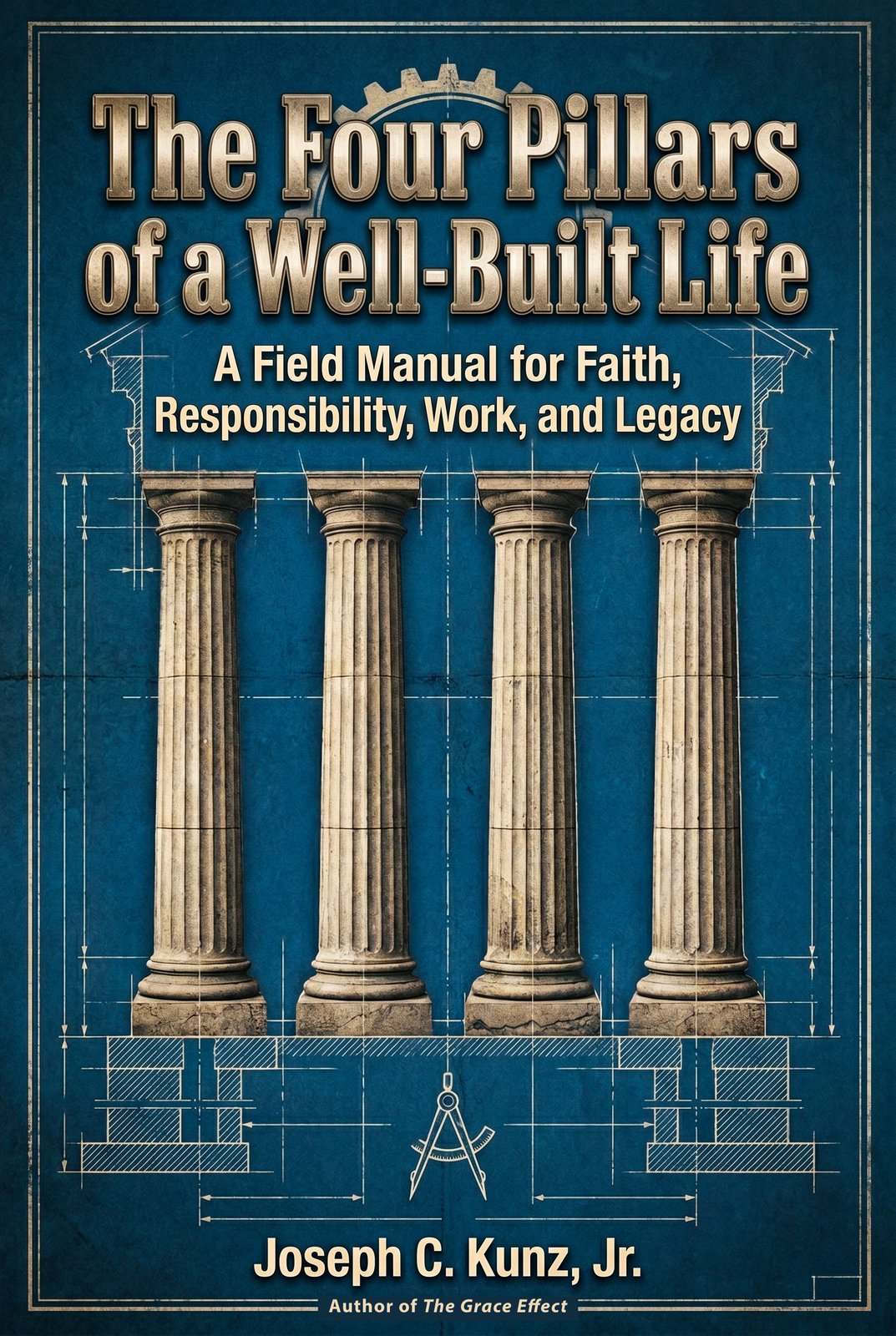
The Four Pillars of a Well-Built Life
A culture that calls reality naive is not confused by accident.
It has already lost its foundation.
That is why The Four Pillars of a Well-Built Life matters. This book is being built for readers who are tired of slogans, tired of noise, tired of watching people mistake confusion for depth and collapse for progress.
Faith. Responsibility. Work and Wealth. Legacy.
These are not decorative ideas. They are load-bearing realities. They are what hold a person together when pressure comes, when institutions fail, when culture lies, when money tempts, when family demands strength, and when the easy road starts whispering.
This book is not for people looking for softer language.
It is for builders.
For fathers. Mothers. Workers. Believers. Business owners. Young adults. Grandparents. Anyone who still believes a life should be built on truth, governed by responsibility, strengthened through work, and aimed toward something worth leaving behind.
Because when reality gets called naive, the answer is not to lower your voice.
The answer is to build a life so solid the lie cannot carry it away.
The Four Pillars of a Well-Built Life
Being Built to Hold