The Lens and the Lie
The most dangerous thing in modern life isn’t disbelief. It’s blindness that thinks it’s enlightened. —Joseph C. Kunz, Jr.
How Moral Blindness Destroys Self-Government Before It Destroys a Nation
By Joseph C. Kunz, Jr.
Synopsis
This isn’t another theatrical lament about cultural collapse or a political complaint dressed up as moral seriousness. In this essay, Joseph C. Kunz, Jr. argues that free societies do not fail first because of bad laws, bad leaders, or bad elections. They fail because citizens lose the ability to see clearly. When people can no longer interpret reality truthfully, they begin absorbing hidden assumptions that quietly redefine freedom, temptation, love, truth, responsibility, and even sanity itself. Liberty then becomes impossible to sustain because the inner restraints that make liberty livable have already been hollowed out.
Kunz makes the case that no one lives without a lens, and the most dangerous lenses are the ones people mistake for neutrality. He shows how moral blindness takes root not first in institutions, but in households, habits, screens, marriages, money, work, parenting, and the private renaming of appetite as identity, avoidance as compassion, and comfort as freedom. Political disorder, he argues, is not merely a policy problem. It is the public expression of private confusion scaled up across millions of lives. When self-government weakens in the home, external management eventually expands in the state.
The conclusion is simple: a free society depends on people who can still see. Not perfectly, but honestly. Recover moral sight, and you can begin rebuilding responsibility, strength, and durable freedom. Stay blind, and you will keep trading liberty for management while calling it progress.
The most dangerous thing in modern life isn’t disbelief. It’s blindness that thinks it’s enlightened. —JCK
I. Introduction: Freedom Usually Dies Quietly
A free society does not usually collapse in one dramatic moment. It decays the way a structure decays when the load-bearing beams start to rot behind finished walls. From the street, everything still looks normal. The paint holds. The windows shine. The sign out front still says freedom.
Then the floor starts to sag.
That is how liberty dies in real life. Not first with tanks. Not first with speeches. Not first with a tyrant kicking in the front door. It dies when enough people lose the inner structure required to govern themselves. It dies when moral sight goes soft, when language gets slippery, when appetites get renamed as rights, and when responsibility starts sounding cruel.
By freedom, I do not mean permission. I mean the capacity to live within truth without requiring constant outside management. I mean the ability to restrain yourself, tell the truth, honor limits, carry consequences, and act like your choices mean something. That kind of freedom is never automatic. It has to be formed.
And formed people do not appear by accident.
They are shaped by households, habits, beliefs, examples, duties, sacrifices, and a moral vocabulary sturdy enough to name what is actually happening. Once that vocabulary collapses, public freedom does not last very long. People may still use the old words, but the substance underneath them is gone.
A nation does not stay free because it keeps repeating the word freedom. It stays free because enough people still have the eyes and spine to live as if freedom has terms.
II. The First Lie Is Neutrality
One of the great lies of modern life is that people can live without a moral lens.
They say, “I’m not religious.”
They say, “I’m not political.”
They say, “I’m just living my life.”
They say, “I don’t like labels.”
Usually what they mean is not that they are free from a worldview. It means they do not want to examine the worldview already running them.
No one is neutral. No one simply drifts through reality untouched by assumptions. Every person lives inside some working definition of truth, the good, the self, suffering, desire, duty, authority, love, justice, freedom, and meaning. Even the man who claims to hate dogma has already adopted one. He just prefers not to call it that.
That matters, because what remains unexamined soon becomes authoritative.
The most dangerous beliefs in a society are not always the loud ones. Often they are the ambient ones, the invisible ones, the ones absorbed through entertainment, slogans, schoolrooms, advertising, social media, therapeutic clichés, and the quiet pressure to keep life comfortable and morally frictionless.
A worldview is not only what you say you believe. It is the interpretive system you use without noticing. It is the mental lens through which you decide what counts as harm, what counts as love, what counts as oppression, what counts as discipline, what counts as success, what counts as sin, and what counts as freedom.
And if your lens is crooked, your life will be crooked before your politics ever are.
III. Christianity as a Lens, Not a Label
Christianity is often treated now as either a private comfort system or a tribal identity marker. Wear the label, use the vocabulary, keep the rituals, cast the right vote, and call it faith.
That is far too small.
Christianity, rightly understood, is not merely a badge. It is a way of seeing. It tells you that reality is not morally weightless. It tells you that man is dignified, but not innocent. It tells you that desire is real, but not self-justifying. It tells you that sin is not an outdated word for bad manners, but a rupture in the soul that distorts sight before it distorts conduct. It tells you that grace is real, but grace is not permission to lie about what wounds us. It tells you that judgment exists, which is another way of saying actions are not meaningless.
That lens does not merely make a person more “religious.” It makes a person more alert, more sober, more honest about the fact that some choices strengthen a life and some choices hollow it out.
This is where modern people get impatient. They hear moral language and assume repression. They hear restraint and assume shame. They hear limits and assume cruelty. Why? Because they have already been trained by another creed: if a desire is strong, it must be authentic; if it is authentic, it must be honored; if it must be honored, anyone who questions it is oppressive.
That is not enlightenment. That is moral illiteracy with better branding.
A Christian lens does not deny complexity. It simply refuses to surrender clarity.
IV. The Real Battlefield Is Domestic Before It Is Political
Most people want to talk about freedom at the level of slogans, rights, elections, courts, constitutions, and political tribes. Those things matter. Laws shape incentives. Institutions restrain power. Public corruption is real.
But the first battlefield is not legislative. It is domestic.
Freedom is won or lost first in kitchens, bedrooms, schedules, bank accounts, screens, and private habits. It rises or falls in the ordinary places where people either practice self-government or avoid it.
Watch a household long enough and its governing assumptions become visible.
You see them in how a husband speaks when he is irritated.
You see them in whether a wife can tell the truth without walking on glass.
You see them in how children are corrected, or not corrected.
You see them in whether money is handled as stewardship or anesthesia.
You see them in whether work is treated as dignity or grievance.
You see them in what the family watches, laughs at, excuses, buys, hides, and normalizes.
That is where a worldview stops being theory and starts becoming architecture.
If the hidden assumption is “my feelings are authoritative,” then correction becomes violence.
If the hidden assumption is “comfort is my highest good,” then discipline becomes oppression.
If the hidden assumption is “my desires define me,” then any limit feels like an attack on identity.
If the hidden assumption is “my past explains me,” it soon becomes “my past excuses me.”
If the hidden assumption is “peace means no friction,” then honesty disappears and resentment becomes the house language.
People rarely notice that these are theological claims in street clothes. But they are. They are claims about man, truth, suffering, authority, meaning, and moral order. And once those claims settle into the daily structure of a home, they do not stay there. They scale.
V. The Renaming of Reality
Civilizations do not fall only by open rebellion. They also fall by euphemism.
A society starts getting stupid when it loses the courage to call things by their right names.
Lust becomes self-expression.
Cowardice becomes compassion.
Indulgence becomes self-care.
Envy becomes justice.
Bitterness becomes discernment.
Irresponsibility becomes authenticity.
Weakness becomes victimhood theater.
Dependence becomes safety.
Control becomes care.
And eventually management becomes freedom.
This is not wordplay. This is how blindness spreads.
Once language detaches from reality, character follows. A man who cannot name his vice cannot fight it. A woman who has been taught to call every boundary oppressive will eventually lose the ability to distinguish love from surrender. Parents who refuse to name disobedience as disobedience will not raise free children. They will raise children who think every limit is illegitimate until the real world humiliates them.
It is fashionable to sneer at “just semantics.” But language is never just language. Definitions are load-bearing. Weak words create weak judgments. Weak judgments create weak habits. Weak habits create lives that cannot carry freedom without abusing it.
This is one reason clarity matters so much. Not because clarity is a stylistic preference. Because clarity is a moral duty.
People who cannot define reality can be managed by whoever can define it for them.
VI. Wounds Are Real. That Still Does Not Cancel Responsibility
A weaker version of this essay would ignore pain, injustice, trauma, addiction, family damage, manipulation, and institutional corruption. That would be dishonest.
Some people really were handed crooked patterns, mixed signals, moral confusion, broken homes, predatory leaders, and deep injury. Some institutions really do reward vice and punish virtue. Some children inherit chaos they did not choose. Some adults carry scars they did not earn.
All of that is true.
But here is the line modern culture refuses to hold: being wounded does not eliminate the need for formation. It makes formation more urgent.
Pain explains many things. It does not sanctify drift.
Trauma deserves compassion. It does not turn appetite into wisdom.
Injustice should be named. It does not make self-government optional.
A hard story may soften our judgment. It cannot erase moral reality.
This is where the therapeutic age has done real damage. It has trained people to narrate themselves endlessly while excusing themselves strategically. It has replaced examination with explanation. It has made interior life feel deep while leaving character underbuilt.
A person can become incredibly fluent in his wounds and still remain blind to his habits.
That is not healing. That is refined avoidance.
Real compassion does not help a person lie about cause and effect. Real compassion helps him rebuild truthfully.
VII. Why Free Societies Require Self-Governed People
A free society is not held together by slogans about liberty. It is held together by a sufficient number of people who can be trusted with choice.
That trust is not sentimental. It is moral.
A society remains free only when enough people can delay gratification, keep promises, honor contracts, tell the truth, restrain impulse, raise their children, work without theatrical self-pity, and absorb correction without collapsing into self-defense or rage.
Once that kind of character erodes, liberty starts becoming unbearable.
Not because freedom itself failed, but because undisciplined people use freedom to make life harsher. Families fracture. Debt grows. Addiction spreads. Trust thins out. Schools become disorderly. Neighborhoods become less stable. Employers compensate for weakness. Institutions expand to manage the fallout. Surveillance increases. Bureaucracies thicken. Experts multiply. Rules spread.
Then the same people who could not govern themselves begin demanding more governance from above.
That is one of the oldest patterns in the world.
When self-restraint weakens, outside restraint expands.
When moral authority disappears, administrative authority rushes in.
When citizens cannot carry liberty, managers volunteer.
Most people do not trade freedom for tyranny because they love tyranny. They trade it because chaos is exhausting, and they have lost the moral equipment to do better.
That is why the fight for freedom is never merely political. It is anthropological. It is spiritual. It is domestic. It is about what kind of person a society is producing.
VIII. Your Politics Follow Your Habits
People love pretending politics begins in ideology. It usually begins much lower than that.
Politics follows anthropology. Anthropology follows theology. And theology, whether admitted or denied, eventually shows up in habit.
If you believe human beings are mostly appetite with better public relations, then politics becomes an exercise in managing appetite.
If you believe man is morally serious and morally fallen, then politics becomes an exercise in restraining power, distributing responsibility, and defending institutions that form character.
If you believe truth is negotiable, public life becomes a contest of narrative control.
If you believe freedom means self-definition without limit, then any durable structure — family, church, duty, inherited norms, even biology — starts looking like oppression.
This is why public rhetoric so often feels detached from actual life. People want to debate systems while refusing to examine the assumptions driving their own homes. They want national renewal without household discipline. They want civic strength without private restraint. They want the fruit of moral order after hacking at the roots.
That never works.
No constitution can save a people determined to misname reality. No voting pattern can compensate for a culture that teaches citizens to worship impulse and resent discipline. No government program can supply the interior formation that should have been built through belief, example, consequence, and conscience.
You cannot build a free republic out of inwardly ungoverned people.
IX. The Work of Seeing
So what does it mean to see clearly?
It means dragging your assumptions into the light and asking whether they tell the truth.
It means paying attention to the little renamings you have allowed into your life.
Where have you renamed indulgence as necessity?
Where have you renamed resentment as discernment?
Where have you renamed fear as wisdom?
Where have you renamed laziness as burnout?
Where have you renamed avoidance as peace?
Where have you renamed surrender as compassion?
Clear sight begins when excuses start losing their poetry.
It also means guarding inputs. The stories you consume are not neutral. The words you repeat are not neutral. The examples you honor are not neutral. Attention is not passive. It is formative. What you stare at long enough will eventually disciple you.
It means practicing restraint in visible, daily ways. Not as performance. As training. A man who cannot control his tongue, schedule, spending, lust, temper, or screens will eventually tell himself elaborate stories about why those things do not matter. They matter. They are not the whole life, but they are unmistakable evidence of whether a person is building frame or living off emotional weather.
And it means relearning that repentance is not self-hatred. It is realism. It is the moment a person stops defending the distortion and starts repairing the lens.
You cannot rebuild a life you insist on misdiagnosing.
X. Conclusion: Clear Eyes or Managed Lives
The future does not belong to the loudest people. It belongs to the clearest ones.
The real crisis of this age is not that we lack information. It is that we have lost the nerve to interpret reality morally. We have trained people to notice offense, trauma language, ideological codes, and status signals while leaving them half-blind to appetite, pride, duty, temptation, discipline, and consequence. That is not sophistication. That is a dangerous form of stupidity.
A free society cannot survive on that.
It needs men and women who can still tell the truth about themselves. It needs households where limits are not treated as abuse, where responsibility is not treated as cruelty, where work is not treated as punishment, where faith is not reduced to branding, and where children are taught that freedom is not the absence of restraint but the strength to live rightly without being externally managed.
That kind of sight will never trend. It will never flatter the ego. It will never feel as exciting as outrage. But it is how civilizations endure.
Here are three practices that turn “seeing” from a slogan into a discipline:
1. Name one assumption you have absorbed that is shaping your habits.
2. Choose one restraint you have been avoiding and practice it daily for 30 days.
3. Guard your inputs — what you watch, scroll, and repeat — because attention becomes belief.
Christianity, lived and not advertised, remains one of the last great schools of that vision. Not because it makes people nice. Because it makes them sane.
And sanity is the first requirement of freedom.
The conclusion is simple: if people cannot govern their own appetites, language, homes, and habits, they will not remain free for long. They will be governed by consequences first, and by managers soon after.
You do not renew a nation by shouting at the darkness. You renew it by teaching people how to see.
You don’t need a new politics until you recover a new sight. —JCK
Related Reading: For the Reader Who Wants the Blueprint, Not the Noise
If The Lens and the Lie sharpened your vision, these will tighten your grip:
1. Clarity Is Strength: The Words That Build (or Break) a Life A practical essay showing how weak definitions create weak lives—and how reclaiming language is the first act of self-government.
2. No Government Can Give You Character A hard-edged reminder that laws can restrain behavior, but only interior formation—faith, discipline, and conscience—can produce the kind of citizens freedom requires.
Reader Comment: I came for the “politics” and left realizing the real fight was in my own habits, my own language, and my own excuses.
Quote: If you can’t govern your own appetites, someone else will eventually govern your life. —JCK
The Book Behind This Idea: Stop Handing Your Life to the Next Professional Babysitter
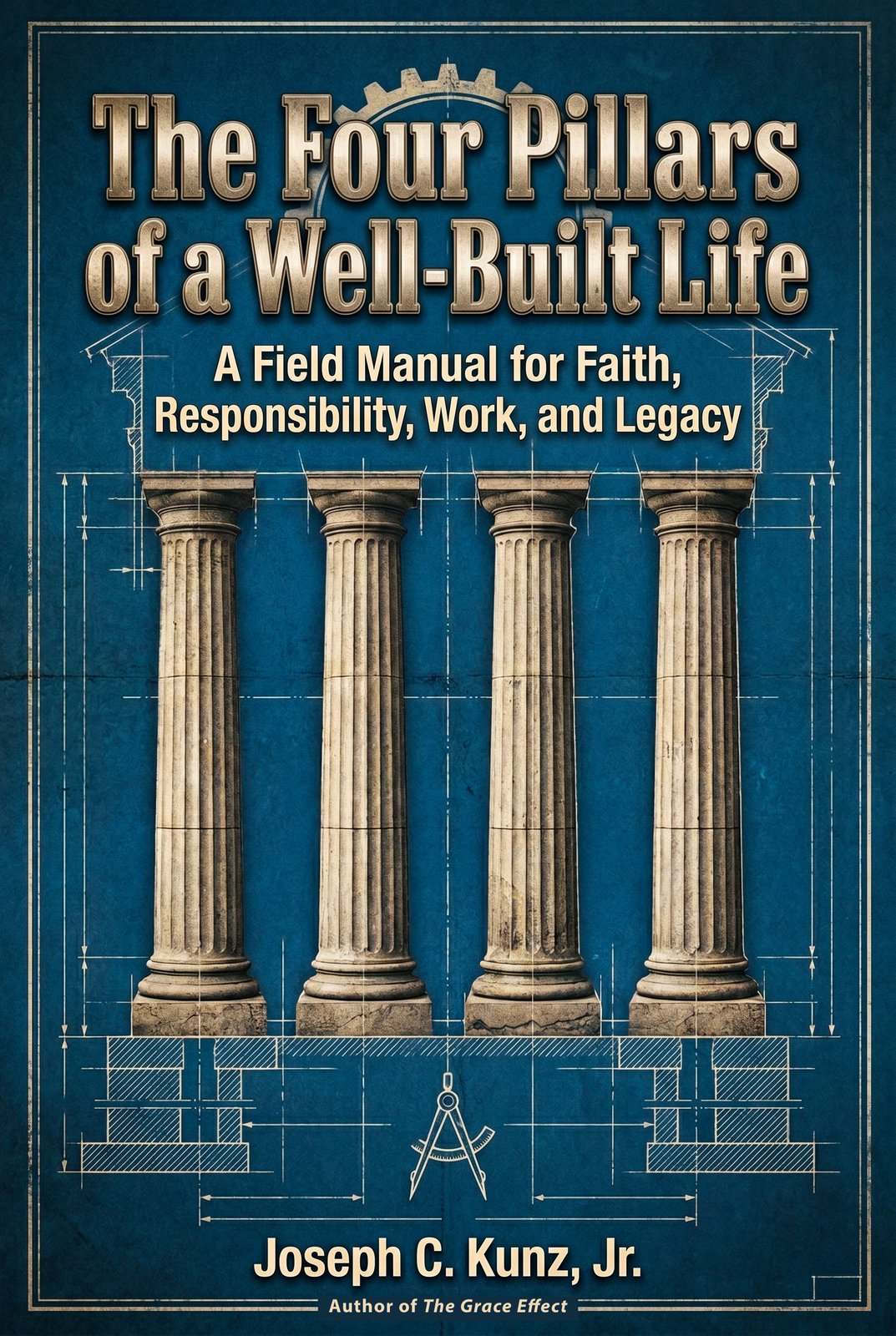
The Four Pillars of a Well-Built Life
You already know something is off. You can feel it. Not just in the country. In the house. In the habits. In the quiet little compromises people make and then rename so they can sleep at night. That is how a life starts slipping. That is how a family loses its center. That is how a nation full of undisciplined people starts begging to be managed.
That is the fight behind this essay.
The Four Pillars of a Well-Built Life is not a motivational sugar rush and it is not another stack of soft advice for people who want freedom without structure. It is a framework for men and women who are tired of the noise, tired of the drift, and tired of watching strong words get hollowed out by weak lives. It is about building the kind of inner structure that can carry faith, responsibility, work, wealth, and legacy without collapsing the moment life gets hard.
Because here is the part nobody wants to say out loud: if you cannot govern yourself, someone else will eventually do it for you — badly, coldly, and with paperwork.
You do not need more slogans. You need a structure that holds. You need language that tells the truth. You need a framework sturdy enough to help you rebuild from the inside out before the world outside finishes the demolition job.
Start building the life that can still stand when the lies get louder. Step into The Four Pillars of a Well-Built Life.
Under Construction.