Clarity Is Strength: The Words That Build (or Break) a Life
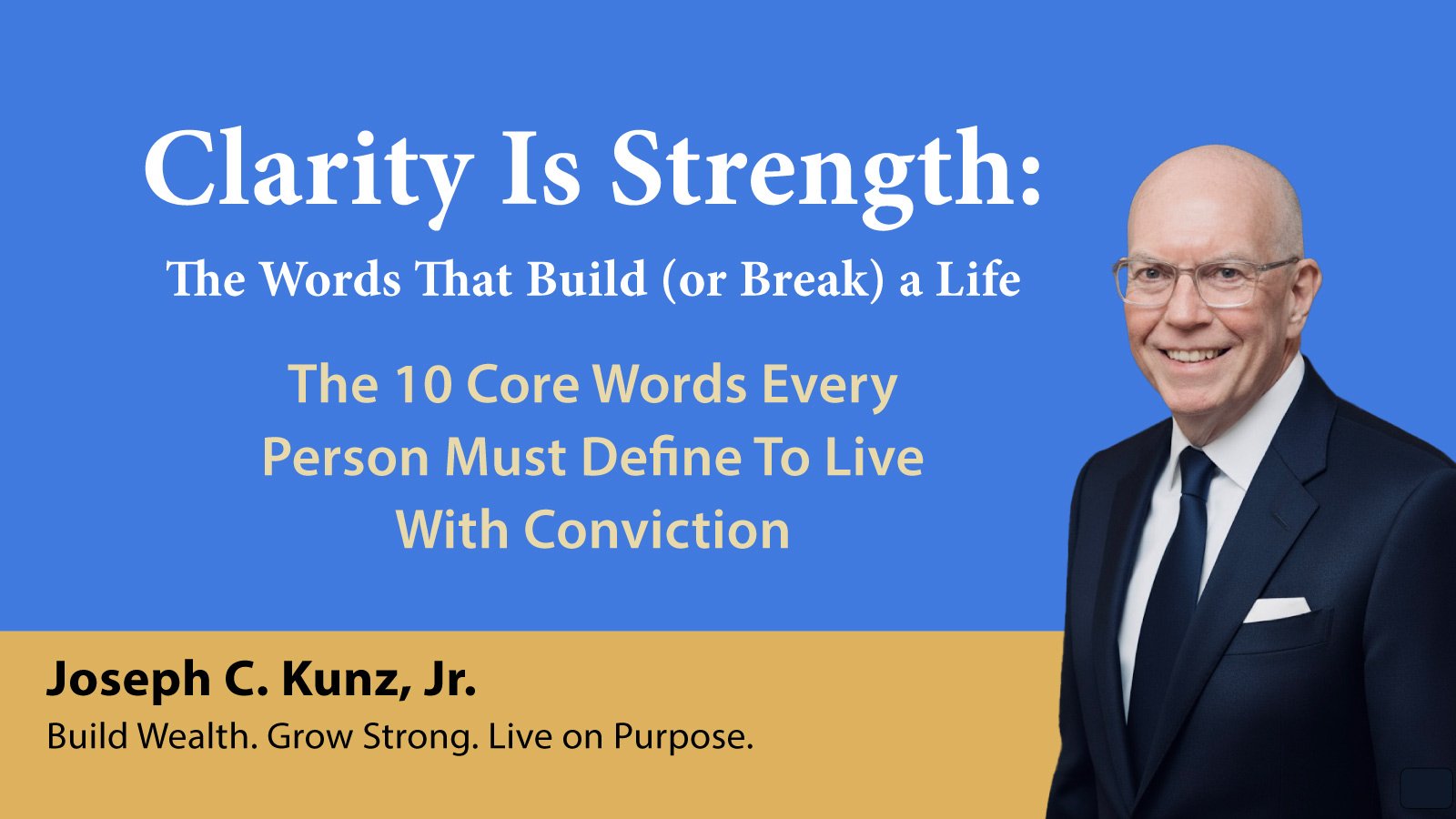
If you want a stronger life, start by defining the words that shape your choices, your character, and the direction of your future. —Joseph C. Kunz, Jr.
The 10 Core Words Every Person Must Define To Live With Conviction
By Joseph C. Kunz, Jr.
Synopsis
Most people don’t drift because they’re lazy—they drift because they’re undefined. In Clarity Is Strength, Joseph C. Kunz, Jr. argues that the fastest way to build a stronger life isn’t more motivation—it’s better definitions. If you don’t clearly define the words running your life—purpose, responsibility, freedom, faith, work, success, integrity, boundaries, strength, and legacy—you won’t build with conviction. You’ll build with emotion, pressure, and borrowed slogans.
This essay is a blunt, practical call to reclaim your vocabulary before the culture cheapens it. Kunz shows how vague words create weak choices, how borrowed meanings sabotage marriages, money, and character, and why clarity is a form of personal defense in a world that profits from confusion. The promise is simple: sharpen your definitions, and you sharpen your standards, your direction, and your ability to stand firm when life gets loud. Because when your words hold weight, your life does too.
Clarity isn’t cosmetic—it’s the backbone of a life that can withstand pressure, temptation, and other people’s confusion. —JCK
I. Introduction: The World Is Loud — But Clarity Cuts Through Noise
Most people don’t fall apart because they’re weak.
They fall apart because they’re unclear.
Unclear about what they stand for.
Unclear about what they believe.
Unclear about what they’re willing to fight for—and what they’re willing to walk away from.
They drift not because they lack talent, but because they lack definition.
And here’s the truth no one wants to admit:
If you don’t define your words, the world will gladly define them for you.
And the world always defines them downward.
We live in a culture where meaning is flexible, truth is negotiable, and words are twisted until they serve someone else’s agenda.
That’s why clarity isn’t just helpful—clarity is strength. It’s the anchor that keeps you grounded, the compass that keeps you steady, and the shield that protects you from manipulation.
People don’t need more motivation.
They need more definition.
They need a language worthy of a life built with intention.
And that begins with defining—with ruthless honesty and precision—the ten words that silently shape your decisions, your character, and your destiny.
II. Why Words Build (or Break) a Life
A. Words shape identity.
Before you build anything in your life, you must build the language that frames it. The words you choose—and how you define them—become the blueprint you follow.
Weak words create weak character.
Vague words create vague choices.
Undefined words create lives that collapse under the slightest pressure.
People who crumble don’t collapse all at once.
They collapse because the meaning that held them together was never strong enough to carry real weight.
B. Words determine direction.
Direction is not set by desire.
It’s set by definition.
You can want success, but if you haven’t defined it, you’ll chase someone else’s version of it.
You can believe in freedom, but if you haven’t defined it, you’ll confuse it with comfort or indulgence.
You can value faith, but if you haven’t defined it, you’ll turn it into superstition or a safety blanket.
When you don’t define the meaning of your life, you live out the meaning of someone else’s.
C. Words establish boundaries.
Every strong life has a clear perimeter.
Every weak life is boundaryless.
Why?
Because without clear definitions, other people’s needs become your obligations.
Their emotions become your responsibilities.
Their expectations become your marching orders.
Clarity creates a border. That border creates peace.
And that peace creates strength.
D. Words sharpen courage.
The clearer your definitions, the harder you are to manipulate.
The more precise your convictions, the less you crumble under pressure.
That’s why clarity is threatening to weak people—and liberating for strong ones.
Courage isn’t loud.
It’s not theatrical.
Courage is simply a person standing on a definition they refuse to compromise.
III. The Ten Words Every Person Must Define
These ten words are the backbone of a meaningful life.
You will personalize them—but they give you the map.
1. Purpose
Your “why” behind everything you do.
Not your job title.
Not your goals.
Not your dreams.
Purpose is the direction of your life—the thing that doesn’t evaporate when circumstances change.
People without purpose drift.
People with purpose endure.
2. Responsibility
What is yours to carry—and what is not.
Most people’s lives are chaotic because they’re carrying everyone else’s emotional laundry, financial failures, or expectations.
Responsibility isn’t about doing more.
It’s about owning the right things.
When you define responsibility clearly, you stop apologizing for carrying your load—and refusing to carry someone else’s.
3. Freedom
Freedom is not the absence of restraint.
Freedom is the discipline of choosing your life on purpose.
People confuse freedom with comfort—which is why they end up controlled by their cravings, impulses, debt, emotions, and political narratives.
Freedom defined well becomes freedom lived well.
4. Faith
The thing that holds you steady when nothing else does.
Not a feeling.
Not a sentiment.
Not a hashtag.
Faith is your anchor.
It’s the courage to trust what God is building in you—especially when you can’t see the blueprint yet.
Define it clearly or you’ll turn it into superstition, fear, or guilt.
5. Work
Your philosophy of effort.
What do you believe about excellence?
About contribution?
About showing up when no one sees?
Work is never just work.
It’s the expression of who you are when you’re tired, unnoticed, or discouraged.
Define it honestly and work becomes a form of strength—not punishment.
6. Success
Your personal definition of what a life well-lived looks like.
Most people chase success the way a dog chases a car—hard, desperately, and without the faintest idea what they’ll do if they ever catch it.
Success must be defined or it becomes a treadmill:
always moving, always demanding, always disappointing.
Define it, and success becomes possible.
Leave it vague, and it becomes forever out of reach.
7. Integrity
What you do when the applause stops.
Integrity is not about being perfect.
It’s about consistency with your values when no one is keeping score.
Define integrity clearly and you’ll stop being a puppet to convenience and pressure.
8. Boundaries
Where you end and the rest of the world begins.
If you do not define your boundaries, the world will erase them.
Boundaries protect your time, your peace, your mental bandwidth, and your energy.
Weak boundaries create resentment. Strong boundaries create dignity.
9. Strength
What strength means to you—emotionally, mentally, spiritually, physically.
Strength is not about dominance.
Nor is it about never breaking.
Real strength is the ability to keep going without becoming bitter, cynical, or hardened.
Strength defined clearly becomes strength pursued intentionally.
10. Legacy
What remains after your name disappears from the payroll, the mailbox, and the phone screen.
Legacy is not what people remember about you.
Legacy is what they learn from you.
Define it early and you begin to live differently today.
IV. How to Build Your Own Definitions
A. Start with honesty, not aspiration.
Don’t define these words based on who you wish you were.
Define them based on who you’re becoming—and who God is shaping you to be.
Aspiration makes definitions poetic.
Honesty makes them powerful.
B. Use short, sharp, memorable sentences.
A definition that’s too long becomes decoration.
The ones that shape you are the ones you can repeat during stress, temptation, or confusion.
Think in soundbites—not paragraphs.
C. Revisit your definitions every year.
You change.
Your circumstances change.
Your clarity should deepen with you.
Think of your definitions as a yearly calibration of your life.
D. Post them where you can see them.
Clarity only works when you confront it daily.
Put your definitions on your office wall, your phone lock screen, or inside your journal.
Don’t hide them.
Use them.
V. What Happens When You Define Your Words
A. You stop being manipulated.
Clear definitions make you unmovable.
People can’t twist you, guilt you, or emotionally blackmail you.
B. You stop drifting.
When your definitions are solid, decisions become easier.
You stop second-guessing yourself.
You stop apologizing for your strength.
You stop watering down your standards.
C. You become someone others can depend on.
Clarity creates steadiness.
Steadiness creates trust.
Trust creates influence.
People follow the person who knows where he stands.
D. You live with conviction, not convenience.
Clarity turns your life into a mission—not a mood.
The clearer your definitions, the more disciplined your actions become.
Conviction builds a life.
Convenience destroys it.
VI. Conclusion — Define Your Words or Lose Your Life to Someone Else’s
Life doesn’t reward the unclear.
Life rewards the person who defines their words and then builds their life on those meanings.
Your strength doesn’t come from being loud.
It comes from being clear.
Your peace doesn’t come from avoiding conflict.
It comes from knowing what you stand for.
Your legacy doesn’t come from ambition.
It comes from definition.
So, define your words.
Define your life.
And build something worthy of your time, your effort, and your name.
Because the person who defines their words becomes the person who cannot be moved.
Weak definitions build weak lives; the moment you sharpen your words, you sharpen your identity, your courage, and your destiny. —JCK
Related Reading: For the Thinker Who Wants a Sharper Mind and a Stronger Life
If this essay stirred something awake in you, these will sharpen that clarity even further.
1. Language as the First Battleground for Clarity
Weak words build weak lives—defending meaning is the first act of independence.
Quote: If you lose the meaning of your words, you lose the meaning of your life. —JCK
2. Don’t Outsource Your Thinking — Even to “Experts”
Real independence begins when you challenge borrowed beliefs and sharpen your own judgment.
Reader Comment: This essay woke me up to how much of my thinking wasn’t mine—and how dangerous that really is.
The Book Behind This Essay: For Readers of “Clarity Is Strength”

The Success Lexicon: Plain-English Rules for Money, Mastery, and a Life That Compounds
The Words You Live By Will Make You—Or Break You. Get the Lexicon That Will Make You Stronger.
If this essay hit home…
If something inside you said, “Yes—this is what I’ve been missing,” then it’s time to stop living with vague ideas and start building a life with clarity, precision, and power.
That’s exactly why I wrote The Success Lexicon — not as another self-help book, but as a field manual, a personal dictionary, a framework of definitions that gives ordinary people the tools to think clearly, act boldly, and live with conviction.
Inside, you’ll find:
• The essential words that determine success or failure—defined with force and simplicity.
• A mindset vocabulary that makes you harder to manipulate and easier to motivate.
• Principles you can actually use—not fluff, not theory, not recycled clichés.
• A clarity that cuts through confusion, pressure, and the nonsense the world keeps throwing at you.
Because here’s the truth: If you don’t own your definitions, someone else will.
And they will not define your life in your favor.
The Success Lexicon is your antidote to drifting. It’s the book that helps you build a mind strong enough to build the life you want.
If you’re ready to think sharper, live clearer, and lead yourself with strength…
Get your copy of The Success Lexicon — and start building a vocabulary worthy of your future.
Coming Soon.