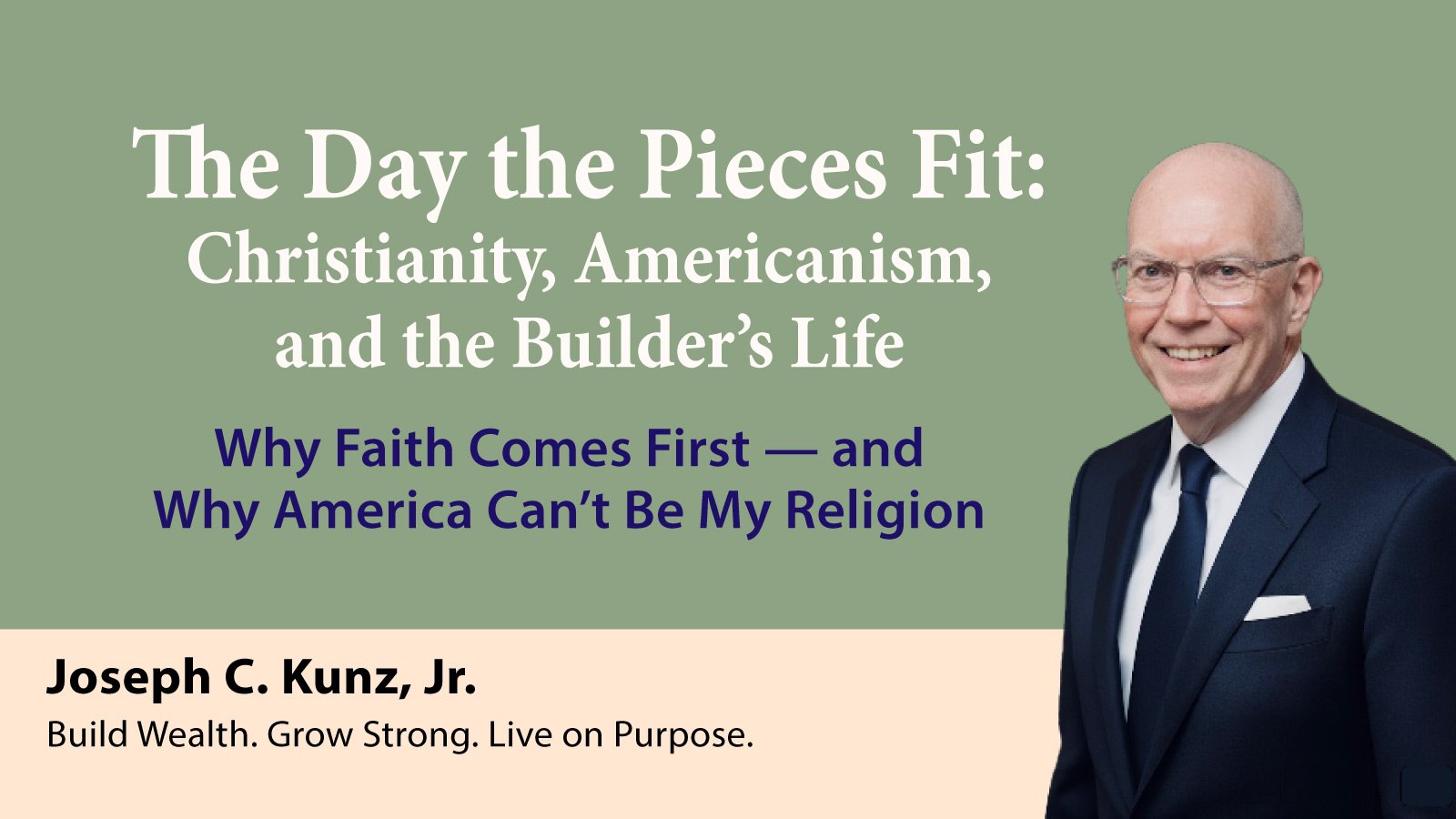
The Day the Pieces Fit: Christianity, Americanism, and the Builder’s Life
Faith is upstream—and everything else in a man’s life either aligns downstream or collapses into counterfeit freedom. —Joseph C. Kunz, Jr.
Why Faith Comes First — and Why America Can’t Be My Religion
By Joseph C. Kunz, Jr.
Synopsis
Many self-reliant men treat Christianity, Americanism, and the Builder’s Life as separate convictions—useful in their own lanes, but not connected. This isn’t a claim about who “counts” as American—it’s a claim about what forms the virtues freedom depends on. In this essay, Joseph C. Kunz, Jr. argues that the breakthrough comes when you finally see the proper order of things: faith is upstream, and everything else is downstream. Christianity isn’t one piece among equals—it’s the foundation that defines moral law, human dignity, accountability, and the limits that keep freedom from collapsing into appetite.
He explains how self-reliance becomes strength only when it’s purified of pride and placed under moral authority, how small-c conservatism is meant to conserve hard-won wisdom about human nature rather than chase power, and how Americanism works best as a civic framework that restrains government because it assumes human fallibility. He ties it all together in a simple blueprint: faith forms character, character strengthens family, family gives meaning to work, and freedom becomes the fruit of alignment—not autonomy. A man can survive hardship, debate, and even doubt. What he can’t survive for long is a life built upside down—where freedom replaces morality, politics replaces meaning, and self becomes sovereign.
You can’t build a life right if you build it upside down. Faith comes first—everything else either falls into place, or it turns into a counterfeit. —JCK
I. Introduction: The Moment It Clicked
For years, I treated the biggest convictions in my life like separate tools in a toolbox.
Christianity was faith—moral, personal, and spiritual.
Americanism was civic—ordered liberty: constitutional limits, civic duty, local responsibility, and a love of country disciplined by truth.
Self-reliance was my operating system—work, grit, discipline, and responsibility.
Small-c conservatism was my instinct—protect what works, respect what lasts, distrust utopian fantasies.
I believed all of it. I lived by all of it. But I didn’t always understand how it all fit together.
And when you don’t understand how the pieces fit, you start using them wrong.
You try to make freedom do the job of morality.
You try to make self-reliance do the job of salvation.
You try to make politics do the job of meaning.
You try to make “being a good man” do the job of being a clean man.
That works for a while. Especially if you’re competent. Especially if you’re driven. Especially if you’re the kind of man who can muscle his way through problems and keep moving.
But eventually you hit a moment—maybe quiet, maybe painful—when you realize something simple:
The order matters.
That’s when it clicked for me.
Christianity isn’t one tool in the box. It’s the foundation under the whole build. It’s ultimate. It defines what a human being is, what dignity means, what right and wrong are, what accountability is for, and why your conscience keeps bothering you when you do the thing you know you shouldn’t do.
Everything else—self-reliance, conservatism, Americanism—belongs downstream. They’re not competing faiths. They’re not replacements. They’re applications. They’re what a man tends to build when faith is real, not cosmetic.
Once that hierarchy became clear, life got clearer too.
Not easier. Clearer.
And clarity is where strength begins.
A quick clarification before I go further: I’m not arguing that you must be a Christian to be a good American. You don’t. I’m making a structural claim: freedom requires self-government, self-government requires virtue, and for me, Christianity is the deepest training ground for that virtue. Faith isn’t a political credential—it’s moral authority over me. And it’s the only thing that keeps my love of country from turning into a substitute religion.
II. Faith Comes First: Not a Mood — An Authority
Moral law, human dignity, accountability. Without “upstream,” everything becomes preference or power.
Here’s what I mean by “faith comes first.”
I don’t mean it as a sentimental slogan. I mean it as a structural reality.
Faith—specifically Christian faith—doesn’t merely add comfort to life; it names the moral architecture underneath it.
It tells you:
• Right and wrong are real.
• Human beings have dignity that can’t be voted away.
• Your life is accountable to something higher than your opinions.
• Evil isn’t a “misunderstanding.” It’s a corruption of the good.
• And you can’t fix what’s broken in you by sheer willpower and cleverness.
A society can survive many disagreements.
What it can’t survive for long is this: the loss of moral authority above the self.
Because when faith is removed from the top, something else takes its place.
If it’s not God, it’s often the state — or the crowd — or the self.
If it’s not truth, it’s trend.
If it’s not conscience, it’s appetite.
If it’s not moral law, it’s raw power.
And this is why “faith first” isn’t abstract to me. It’s practical.
If there is no upstream moral authority, then freedom becomes license. Self-reliance becomes pride. Conservatism becomes mere power. Americanism becomes a slogan. And eventually the whole structure starts bending under the weight of human desire—because appetite makes a terrible god.
Christianity comes first because it gives me the foundation: moral reality, human dignity, and accountability.
III. Self-Reliance: Strength or Self-Worship
Christianity doesn’t weaken strong men—it purifies strength: discipline vs. pride; responsibility vs. autonomy.
I’ve always been drawn to self-reliance. Not because I’m trying to be a lone wolf, but because life taught me early that a man must carry weight.
Work. Provide. Protect. Solve problems. Keep your word. Show up.
That’s not toxic. That’s strength.
But here’s the uncomfortable truth: self-reliance has a counterfeit twin.
It looks almost identical from the outside, but it’s rotten at the core.
Real self-reliance says:
I’m responsible.
Counterfeit self-reliance says:
I’m self-made.
Real self-reliance says:
I’ll do the hard thing.
Counterfeit self-reliance says:
I answer to no one.
And that’s where Christianity doesn’t oppose strength—it purifies it.
It doesn’t tell a man to become soft. It tells him to become honest.
Because a man can build an impressive life and still be ruled by pride.
He can provide and still be selfish.
He can lead and still be arrogant.
He can appear disciplined and still be enslaved to approval.
He can win outwardly and still lose inwardly.
Faith comes first because it does something self-reliance alone will not do:
It places strength under authority.
Christianity turns self-reliance into self-government—not just competence, but character. Not just control, but restraint. Not just I can, but I ought.
And the moment a man starts to live by “I ought,” he’s no longer free to worship himself.
That’s the beginning of real freedom.
IV. Small-c Conservatism: Social Memory
Not nostalgia—wisdom about human nature. Conservatism without faith drifts into mere power.
Small-c conservatism, at its best, is not anger. It’s not a brand. It’s not online shouting.
It’s social memory.
It’s the recognition that human nature doesn’t change, and therefore the moral lessons learned the hard way don’t magically become obsolete because a new generation gets confident.
It respects institutions not because institutions are perfect, but because they’re necessary. It respects tradition not because tradition is always right, but because tradition is often the record of what worked—what kept families stable, communities sane, and children from becoming experiments.
But conservatism has the same problem self-reliance has: it can be purified, or it can be corrupted.
Conservatism downstream of faith tends to protect the conditions where virtue can grow: family stability, moral restraint, human dignity, ordered liberty, the limits of power.
Conservatism cut loose from faith tends to drift into something else:
• mere power games
• “my tribe wins” thinking
• cynicism instead of conviction
• strong language with weak moral center
That’s why the hierarchy matters.
Conservatism can’t be the foundation. It’s not ultimate. It’s an application. It’s a way of conserving what faith reveals as valuable—because faith defines human dignity, moral law, and accountability.
When faith comes first, conservatism becomes less reactive and more principled.
It becomes what it’s meant to be: protection of what allows human beings to flourish.
V. Americanism: Civic Framework, Not Substitute Religion
Liberty under law. Rights plus duties. Freedom requires virtue—or it collapses.
I love America. Not as a blind romantic. As a man who understands what it is—at its best.
America is not heaven. It’s not the kingdom of God. It’s not perfect.
Patriotism is a virtue. Nationalism is a temptation. Faith keeps me from confusing the two.
And that’s exactly why my faith must be upstream—because it keeps my patriotism grateful, disciplined, and honest, instead of blind.
Christianity doesn’t take marching orders from America—Christianity judges America, including the parts I love.
I owe America my gratitude. I owe God my obedience.
But America’s founding framework—liberty under law, limited government, rights paired with duties—contains a hard truth that aligns with Christianity better than most people realize:
Power must be limited because human nature is flawed.
That’s not cynical. That’s realistic. And it’s deeply compatible with the Christian understanding of fallen man.
If you believe humans are basically good and getting better, you’ll keep expanding power “for the common good” until it becomes a boot on someone’s neck.
If you believe humans are capable of great good and great evil, you design systems with restraints, checks, and limits. You decentralize power. You protect conscience. You emphasize local responsibility. You guard freedom of speech and religion because you know what happens when the state gets to declare ultimate truth.
Americanism, downstream of faith, becomes a civic framework that protects space for virtue to grow—families, churches, businesses, civil society.
But Americanism without faith is vulnerable to becoming its own substitute religion:
• flags as sacraments
• politics as salvation
• elections as moral absolution
• ideology as god
That’s when people start asking the state to do what the soul needs God for. And the state is a terrible replacement.
Faith comes first because it keeps Americanism in its proper place: important, valuable, worth defending—but not ultimate.
VI. The Builder’s Life: The Downstream Blueprint
Faith → Character → Family → Work → Freedom. Alignment, not autonomy.
Once the hierarchy became clear, the dots connected into a simple blueprint:
Faith forms character.
Character strengthens family.
Family gives meaning to work.
Work creates value and responsibility.
And freedom becomes the fruit of alignment—not the reward for selfishness.
That blueprint is what I mean by the Builder’s Life.
Because builders don’t just want ideas. They want something that holds weight.
This blueprint holds weight.
It holds when you’re tired.
It holds when you’re tempted.
It holds when you’re under pressure.
It holds when your ego wants to win and your conscience wants to stay clean.
And it also exposes you. Because it won’t let you compartmentalize.
It won’t let you be “a good man at work” and a selfish man at home.
It won’t let you talk about values and live by convenience.
It won’t let you demand freedom while refusing discipline.
That’s the point.
A meaningful life isn’t built by intensity. It’s built by integrity—alignment between what you say you believe and how you actually live.
And that alignment begins upstream.
It begins with faith.
VII. Conclusion: Build in the Right Order
Stop living upside down. Faith first—then everything else.
If you’ve been trying to make your life make sense by rearranging the downstream pieces—more money, more productivity, more political clarity, more “self-improvement”—I’m not mocking that. I understand it.
But it won’t hold if the foundation is wrong.
You can’t build a stable life with freedom at the top.
You can’t build a clean life with self-reliance as your savior.
You can’t build a sane society with politics as the moral center.
The order matters.
Faith comes first—not as a mood, but as moral authority.
Then the rest becomes what it’s meant to be: application, structure, fruit.
Here’s a simple map for this week:
• Faith: Where are you acting like you’re accountable to no one?
• Character: What desire is currently trying to run your life?
• Family: Where do you need humility instead of control?
• Work: What corner are you tempted to cut—and what would “clean” look like instead?
• Freedom: What would alignment require that your ego keeps postponing?
If you answer those honestly, you’ll start connecting the dots in your own life.
And you’ll discover what I did:
When faith comes first, life stops feeling like a pile of competing demands… and starts feeling like a blueprint you can actually build.
You can’t build a legacy on borrowed morals. Faith first—then work, family, and freedom stop fighting each other. —JCK
Related Reading: For the Ambitious Individual Ready to Go Deeper
If this essay gave you the “order matters” moment, these two will help you live it—not just agree with it.
1. Why Autonomy-First Men Flinch at Faith A hard-edged explanation of why modern “independence” quietly makes real faith impossible—because faith begins where self-rule ends.
Reader Comment: This one hit me like a mirror—I realized I wasn’t rejecting faith for intellectual reasons; I was protecting control.
2. Faith First: The Real Foundation of Conservative Principles A clear case for why conservatism can’t stand on nostalgia or power alone—without faith, it loses its moral center and drifts.
Reader Comment: This connected the civic dots for me—faith isn’t “extra,” it’s the anchor that keeps everything else from becoming tribal.
Quote: The moment you treat autonomy as your god, you don’t become freer—you just become easier to control. —JCK
The Book Behind This Essay: Stop Building Your Life Upside Down
You felt it while you read this essay—that click. That quiet, brutal realization that you can work hard, stay disciplined, love your family, vote right, fly the flag… and still be building on the wrong foundation.
Because when faith isn’t upstream, everything downstream turns into a counterfeit.
Self-reliance becomes self-worship. Freedom becomes appetite with a PR team. Conservatism becomes tribal noise. Americanism becomes a slogan you wave while your soul quietly drifts.
And here’s the part nobody wants to say out loud: A man can be competent and still be crooked inside. A man can be “successful” and still be unclean.
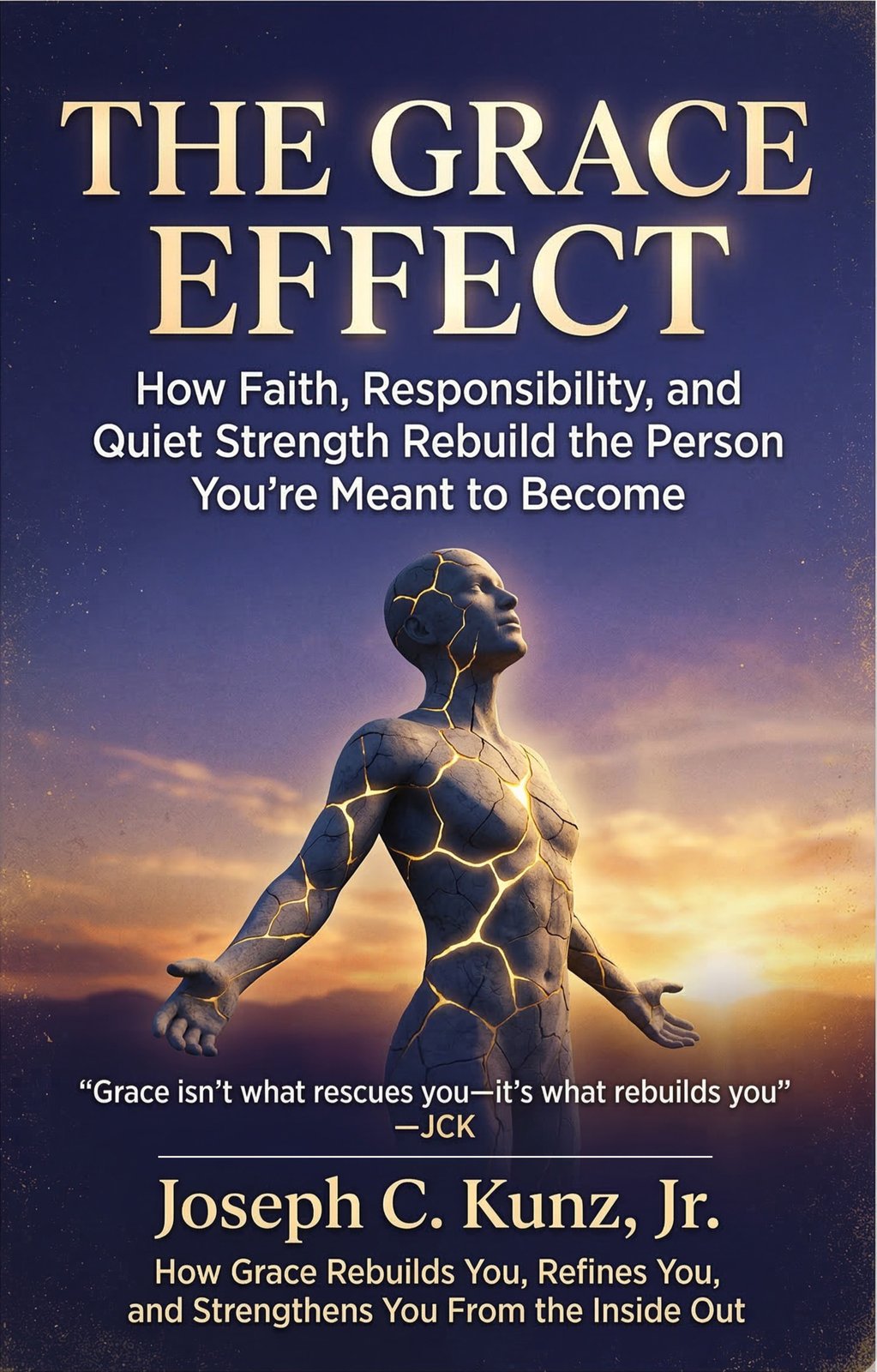
That’s why I wrote The Grace Effect.
Not to make you softer. To make you cleaner. To rebuild the man behind the résumé—the one who’s tired of white-knuckling life, tired of pretending willpower is enough, tired of carrying the weight without admitting he needs help from something higher than himself.
The Grace Effect is for the driven man who’s done a lot right… but knows something still isn’t fully aligned.
If this essay hit you in the chest, don’t shrug it off and go back to “business as usual.” That’s how men waste decades.
Read the book that puts the foundation back where it belongs.
The Grace Effect — The Upstream Fix for a Life That’s Tired of Counterfeits
Coming soon.