The Conservative Mind Holds Tensions Together
Maturity may consist less in finally choosing one side of every tension than in learning which truths must never be allowed to destroy one another. —Joseph C. Kunz, Jr.
Prudence, Stewardship, and the Refusal to Make One Good Absolute
By Joseph C. Kunz, Jr.
Synopsis
Holding tensions together is easy to praise and easy to abuse. Every compromiser in history has claimed it. In The Conservative Mind Holds Tensions Together, Joseph C. Kunz, Jr. argues that what makes the habit conservative is not balance itself, but two things balance alone cannot supply: an order among goods, and a presumption in favor of what has already proven it can hold.
Freedom and order, permanence and change, independence and obligation, reason and inheritance—each pair contains two real goods, and wisdom refuses to let either one destroy the other. But not every pair is a tension. Some truths are foundations, not weights on a scale. Grace is not balanced against self-reliance; it is the ground self-reliance stands on.
The result is a working method for judgment in family, business, faith, and public life: three questions that separate real tensions from false ones, an honest account of what judgment can and cannot settle, and a burden of proof that change must carry before it removes what came before.
Holding tensions together does not mean refusing to choose. It means refusing to choose before understanding what each choice may destroy. —JCK
I. Introduction — The Temptation to Simplify Reality
A sixteen-year-old stands in the kitchen with his hand out for the car keys. His father wants him to become a free and capable man. He also wants him to come home alive. Both desires are good, and neither can be dropped. Whatever the father says next—yes, no, or yes with conditions—will be a judgment about how two goods fit together tonight, with this son, at this stage of his growth.
No principle settles it for him. “Freedom is good” does not tell him what to do. Neither does “safety comes first.” Followed all the way, the first would hand the keys to a boy who is not ready, and the second would keep a grown man in the passenger seat forever.
Most of the hard decisions in life look like that kitchen. They are not choices between good and evil. They are choices between goods that make legitimate claims on us at the same time.
Some ideas are attractive precisely because they make that difficulty disappear. If freedom is good, then more freedom must always be better. If tradition is valuable, then change must be dangerous. If self-reliance is a virtue, then needing others must be weakness. If reason corrects our mistakes, then inherited wisdom must justify itself before the judgment of the present.
Each of these ideas contains something true. The trouble begins when one truth is treated as the whole truth.
Think of a suspension bridge. Its cables pull in one direction and its towers resist in another. Remove the opposing force and the bridge does not become stronger. It falls.
Sometimes tension is what keeps a structure standing.
I have come to believe that learning to hold such tensions is one of the defining habits of the conservative mind. But that claim is easy to make and easy to abuse. Before it can mean anything, it must survive its strongest objection.
II. The Objection — Isn’t This Just Moderation With Better Manners?
Every thoughtful person claims to see both sides. The moderate who never takes a stand says he is holding tensions together. So does the politician who splits every difference, and so does the executive who never makes the hard call. Some of the most serious thinkers in modern history have made the same claim. Isaiah Berlin, one of the best-known liberal philosophers of the twentieth century, built much of his work on it. He argued that many good things cannot all be had in full at the same time. Take liberty and equality. A society that leaves people completely free to earn, keep, and pass on what they can will not stay equal. A society determined to make everyone equal must limit what people are free to do. Justice and mercy can collide the same way. For Berlin, this was not a flaw in our thinking that a clever enough theory could fix. It was a permanent feature of human life, which is why he distrusted anyone who promised a perfect society.
If holding tensions is the mark of the conservative mind, then nearly everyone is a conservative—which means the phrase means nothing.
The objection is fair. Balance alone is not a philosophy. A man who weighs everything against everything has not achieved wisdom. He has only found a more sophisticated way to avoid deciding.
What distinguishes the conservative habit is not that it holds tensions. It is how it holds them. Two things set it apart.
First, it recognizes an order among goods. Not every claim on us carries the same weight, and some things are not on the scale at all.
Second, it places the burden of proof on change. What has endured is presumed to have reasons behind it until someone shows otherwise.
Without the first, balance becomes relativism. Without the second, balance becomes a polite name for drift. With both, it becomes judgment.
It is no accident that Russell Kirk called his great study of this tradition The Conservative Mind. He was not describing a party platform. He was describing a way of seeing that took both permanence and change seriously and refused to make either one absolute.
III. Not Every Tension Deserves to Be Preserved — Three Questions
Here is the distinction that keeps tension-holding from collapsing into mush: a real tension exists only between two goods. Before deciding how to hold one, three questions must be asked, in order.
First: Are both things actually good?
Truth and falsehood are not in tension. Honesty and fraud are not two legitimate claims in need of balance. Faithfulness and betrayal do not deserve a compromise somewhere in the middle. And a worthy goal does not make every means of reaching it acceptable. When one side of a question is simply wrong, holding it “in tension” is not wisdom. It is cowardice wearing the clothes of nuance.
Second: Are they the same kind of good—and does one set limits on the other?
A moral obligation, a practical benefit, and a personal preference do not carry the same authority. Some goods are prudential. Freedom and order are both real goods, but how much of each a family, a business, or a nation needs depends on circumstance. A five-year-old and a twenty-five-year-old should not have the same freedom. A country at war and a country at peace may need different measures of order. These goods are weighed, and the weighing changes as conditions change.
Other things are not weighed at all, because they are what the weighing stands on. The dignity of a human person is not one factor to be balanced against efficiency. The moral law is not a preference to be traded against convenience. In the framework I call the Four Pillars of a Well-Built Life, Faith is the Foundation for exactly this reason. It is not one more weight on the scale. It is the floor the scale sits on.
Third: Where both goods are legitimate, what does prudence require here?
Prudence is not a mood or a shrug. It means asking concrete questions. Who will be affected, and how? What responsibilities do I actually hold in this situation? What alternatives exist besides the two obvious ones? What are the likely consequences—including the consequences of doing nothing? The father in the kitchen does not answer with a principle. He answers by looking at this son, this car, this night, and this stage of his growth.
These questions will not always produce certainty. Their purpose is not to turn hard decisions into automatic answers. It is to make our reasoning accountable, so that when we choose, we know what we chose, what we gave up, and why.
I was reminded how much the first two questions matter in an unlikely place: the copyright page of a book.
While reviewing the copyright pages for our books, I questioned a line I had been using: “Printed in the USA.” I had included it because I thought it helped our books look like the work of a professional publishing company. But our books are printed on demand, and I could not be certain where every copy would be produced.
The desire to present our books professionally was reasonable. It still is. But a familiar publishing convention did not settle whether I could support that particular sentence. The line was not necessarily false for any given copy. The problem was that I could not stand behind it as a blanket statement for every copy. Once I asked the question that way, the apparent tension disappeared. This was not a case in which accuracy and appearance each deserved half the decision. Professional presentation was a legitimate goal, but it had to be reached through words I could stand behind. A claim I could not support was never a second good to be balanced. It was only a convenient means.
So I removed the line from every one of our books. The goal did not change. The sentence did.
That points to three different outcomes judgment can reach. Sometimes there is no real tension at all, and we simply reject the wrong path. Sometimes one good sets the limits within which another must operate. And sometimes two legitimate goods continue to make demands that cannot both be fully satisfied, and we must honor both as well as circumstances allow. Most of this essay concerns the second and third. But recognizing the first is what keeps the rest honest.
That is why the conservative mind can be flexible about methods while remaining immovable about foundations. The two are not inconsistent. They are the same discipline applied to different kinds of things.
Most bad judgment comes from confusing the two. Treat a foundation as a preference, and you will trade away what cannot be replaced. Treat a preference as a foundation, and you will defend a method long after it has stopped serving its purpose. The man who changes everything and the man who changes nothing are making the same mistake from opposite directions. Neither has asked what kind of thing he is holding.
IV. Permanence and Change — Where the Burden of Proof Sits
Edmund Burke is often remembered as the great opponent of change. He was not. “A state without the means of some change,” he wrote, “is without the means of its conservation.” Institutions sometimes must change precisely in order to preserve what matters most about them.
Here a second distinction matters. Russell Kirk distinguished the moral order—a hierarchy of transcendent norms and standards—from the social order, the arrangement of a society’s classes and functions that serves justice, consent to law, and common safety. He also called freedom and order “ends of equal importance,” so his view cannot be reduced to a rule that established arrangements always win.
The distinction matters for my own argument. Respect for an established practice does not place it beyond examination. We need to understand what it protects and whom it affects. But once a practice is shown to be unjust, its age alone cannot justify preserving it.
Burke also understood something reformers tend to forget: the reasons behind an inherited practice are often invisible to the people who inherit it. The practice survives. The memory of why it began does not.
G. K. Chesterton made the point with a simple parable. A reformer comes upon a fence across a road, announces that he sees no use for it, and proposes to tear it down. The wiser man answers that if he cannot see its use, he certainly may not clear it away. Let him first go and learn why it was built. Then they can talk.
Imagine a business owner who requires his own signature on every check above a modest amount. A capable new manager finds the rule slow and a little insulting. Good people are treated as suspects, and payments wait while the owner travels. The manager proposes dropping it, and every argument he makes is reasonable.
What he does not know is that fifteen years earlier, a trusted bookkeeper quietly drained the company’s accounts for two years before anyone noticed. The rule is a scar. It may still be the right rule, or the protection it provides may now be better served by modern controls that do not slow everything down. But the conversation changes once the scar is visible. The question is no longer, “Why do we do this?” It becomes, “What was this protecting, and how do we keep protecting it?”
That is what it means for change to carry the burden of proof. It does not mean change always loses. It means change must first understand what it proposes to replace. Change is permitted, and it is often required. But it must improve humbly, aware that it may not yet understand everything it is touching. Kirk put the danger bluntly: hasty innovation may be “a devouring conflagration, rather than a torch of progress.”
The people who lived before us were capable of injustice, blindness, and error, just as we are. They also learned things, often at a price we have never had to pay. We inherit both. The burden of proof is simply the discipline of telling the difference before we act rather than after.
V. Freedom and Order — Self-Government Is the Hinge
Few words are more attractive than freedom, and few are more often misunderstood.
If everyone were free to drive through every red light, traffic would not become freer. It would become dangerous. If contracts could be ignored whenever one party changed his mind, commerce would not become freer. Trust would disappear.
Some forms of order make freedom possible.
Order can be pushed too far as well. A government can produce order by controlling nearly every choice its citizens make. A parent can produce order by never letting a child make a meaningful decision. The result may look tidy, but something essential has been lost, because people need room to choose, attempt, fail, learn, and become responsible.
These two goods correct each other. Freedom reminds authority that human beings are persons, not pieces to be arranged. Order reminds freedom that our choices reach beyond ourselves.
What holds them together is self-government. The more a person governs himself—keeps his word, pays what he owes, restrains his appetites, and accepts the responsibility that belongs to him—the less he needs to be governed from outside. The less he governs himself, the more someone else eventually will.
That is why the father in the kitchen is not really choosing between freedom and safety. He is measuring how much self-government his son has developed and extending freedom to match it. Freedom grows as judgment grows. That is true of sons, and it is true of nations.
VI. Independence and Obligation — Self-Reliance Without Isolation
I have long believed in self-reliance: becoming capable, solving problems, preparing, working, and accepting responsibility for the choices we make. There is dignity in standing on our own feet.
But self-reliance carries a hidden temptation. It can slowly become the belief that because we can take care of ourselves, we owe little to anyone else. That is not self-reliance. It is isolation.
Capability creates possibilities, and possibilities create obligations. Parents owe their children. Business owners owe their employees and customers. Citizens owe something to the country whose order protects them. Knowledge creates opportunities to teach, and wealth creates opportunities for stewardship.
Not every need around us becomes our responsibility. We must still distinguish between what belongs to us, what belongs to someone else, and what we owe one another. That distinction is exactly why self-reliance matters. When each of us carries what is ours to carry, families and communities have more strength left for those who truly cannot.
The self-reliant person says, I will carry what is mine to carry. The responsible member of a family or community adds, And I will not pretend that only my burdens matter.
A society of people who ask only, “What am I entitled to do?” will not remain free for long. It must also ask, “What do I owe?”
VII. Reason and Inheritance — We Did Not Begin the Conversation
I want to understand why I believe what I believe. I want ideas to withstand examination, and I want to correct an idea when the evidence shows that it needs correction. Tradition should never become an excuse to stop thinking.
But reason can become arrogant too. It can tempt us to assume that anything we cannot immediately explain must be irrational. Burke’s point was not that our ancestors were always right. It was that one human life holds very little experience compared with the accumulated experience of generations, and that experience deserves a hearing before it is discarded.
A carpenter does not rediscover woodworking every morning. He inherits tools, measurements, techniques, and lessons learned by craftsmen who worked long before he was born. Experience may teach him to improve a method or abandon one. But he begins with an inheritance, and so does every mind. We inherit language before we analyze it, and moral concepts before we debate them.
The arrogant modern attitude says, If I cannot see why this exists, it probably has no good reason to exist. The blindly traditional attitude says, If we inherited it, we have no right to question it. Neither is sufficient. The responsible approach is the one Chesterton described at the fence: Before I discard this, I must understand it.
That is how reason and inheritance work together. We receive ideas without surrendering judgment, and we question ideas without assuming that questioning makes us wiser than everyone who came before us.
VIII. Self-Reliance and Grace — Where the Tension Becomes an Order
Here the distinction between tensions and foundations matters most.
It is tempting to describe self-reliance and grace as two goods in balance: some effort, some help from God, held in sensible proportion. But Christianity does not describe them that way. Grace is not the other weight on the scale. Christian teaching describes it as God’s free initiative, which both calls forth and sustains our free response. The relationship is not fifty-fifty. It is gift and response.
We did not create ourselves. We did not choose to be born, invent the language we think in, or manufacture the abilities we use. Effort matters, discipline matters, and work is good. But some of the most important things cannot be earned as wages for good performance, and grace is first among them. It cannot be demanded because we have worked hard. We cannot place God in our debt.
That does not abolish responsibility. It puts responsibility in its proper place. Self-reliance without grace becomes pride. Grace misunderstood as a substitute for responsibility becomes an excuse for passivity. The mature Christian does not split the difference between the two. He works fully inside a gift he did not earn.
Both statements remain true: I worked for this. And: I received much that made the work possible. They do not cancel each other. They are ordered—the gift first, the work within it.
I have written about why that order is so hard for self-reliant people to accept in Grace Is Not a Prize. Here it is enough to see that this is not a compromise. It is a hierarchy. And getting the hierarchy right is what keeps every other tension from becoming arbitrary.
IX. Conclusion — The Discipline of Holding Things Together
Positions matter. Principles matter. Politics matters. But beneath all of them is a more basic question: what kind of judgment allows us to live responsibly in a complicated world?
Part of the answer is learning to hold legitimate tensions together: permanence and change, freedom and order, independence and obligation, reason and inheritance. The mistake is allowing one good to become so absolute that it destroys another. Freedom without responsibility consumes the conditions that make freedom possible. Order without freedom becomes domination. Tradition without examination preserves error. Change without inheritance destroys wisdom that cannot easily be rebuilt.
But holding tensions is only half the discipline. The other half is knowing what is not a tension at all. Sometimes judgment rejects a false choice. Sometimes it recognizes that one good governs another. And sometimes it must live with two goods that cannot both be fully satisfied.
The conservative mind is flexible about methods because it is fixed about foundations. It weighs prudential goods against one another because it refuses to weigh the permanent things. And when it must choose, it asks change to explain itself before it asks inheritance to step aside.
That is harder than ideology, which promises one principle that answers every question. It is harder than moderation, which promises that the middle is always safe. It requires us to think, to distinguish, to judge, and sometimes to live with tensions that will never be permanently resolved.
It also changes what we do with everything placed in our hands. If we did not begin the story and will not finish it, then what we receive is neither ours to consume nor ours to freeze. It is ours to carry well. I have written about that responsibility at length in What We Inherit Is Not Ours to Preserve Unchanged, and it comes down to four movements:
Receive gratefully. Judge carefully. Build responsibly. Hand forward what matters.
Judgment sits near the center of that sequence for a reason. Without it, gratitude becomes nostalgia and building becomes vandalism.
The task is not to eliminate every tension.
The task is to become wise enough to know which tensions are holding the structure together—and which foundation they rest on.
A life is not well built because every tension has disappeared. It is well built when the right tensions are carrying weight together. —JCK
Related Essays: For Readers Ready to Go Deeper Into What We Carry and What We Receive
This essay asks how judgment holds competing goods together. These two companion essays carry its two most personal questions further: what a self-reliant person must learn to receive, and what an inheritor owes to what has come into his hands.
Why Self-Reliant People Struggle to Receive What Cannot Be Earned
A deeper examination of responsibility and grace—and why the habits that help us become capable can also make it difficult to receive what effort cannot earn.
Reader Comment: Read this next because it takes this essay’s claim about grace to its deepest conclusion: strength is not abandoned when we learn to receive; it is finally placed in its proper order.
Quote: “The hands that know how to carry must also learn how to receive.” —JCK
2. What We Inherit Is Not Ours to Preserve Unchanged
Tradition, Stewardship, and the Obligation to Hand Something Better Forward
Why preservation and stewardship are not the same thing—and how a faithful inheritor decides what must be kept, what must be repaired, and what should go no farther.
Reader Comment: This essay explains why change must carry the burden of proof. Read this next to see what that burden looks like when the thing in question is your family, your business, or your faith.
Quote: “What comes into our hands eventually leaves them. The question is what condition it will be in when it does.” —JCK
Related Book: Build a Life That Can Hold More Than One Truth
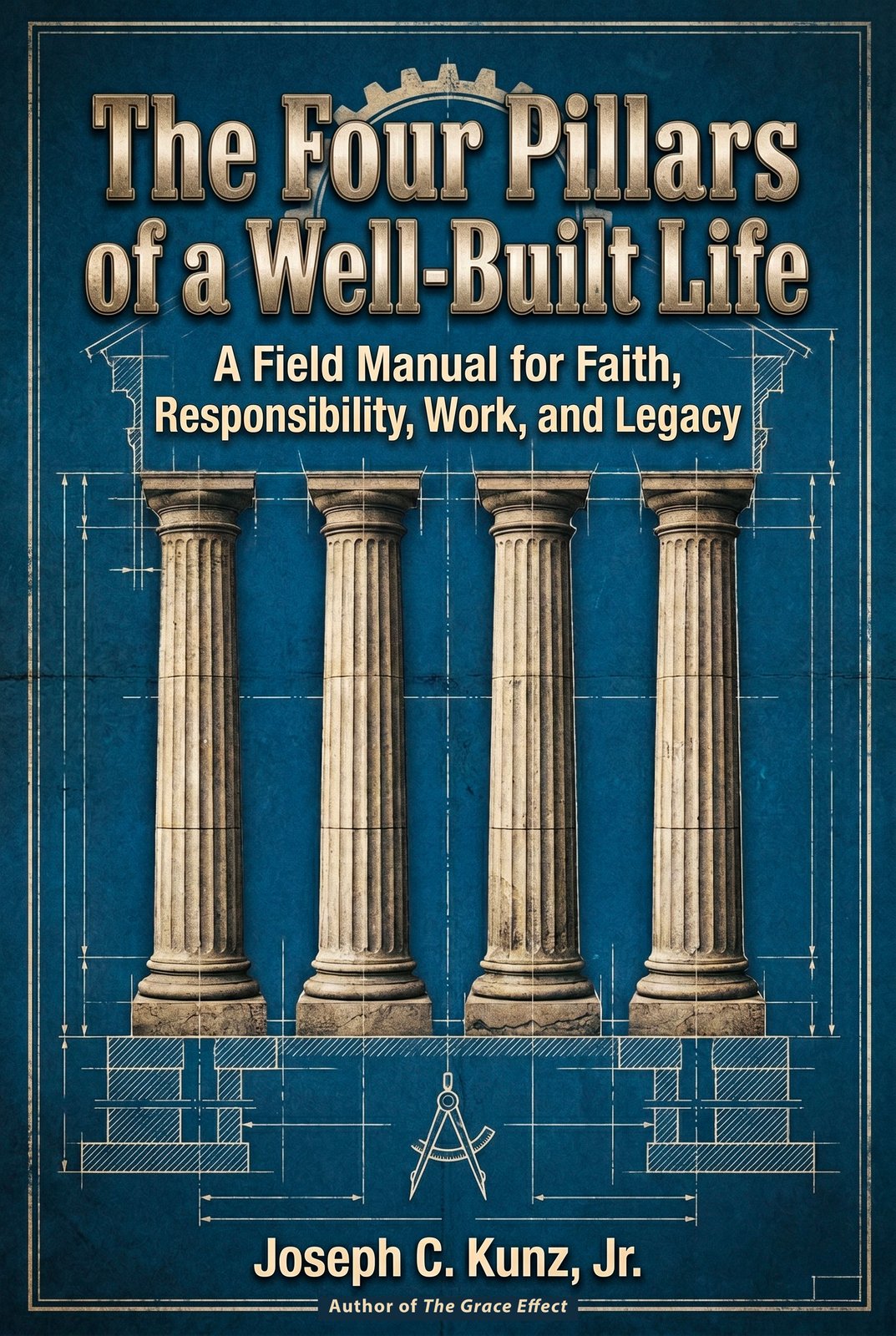
The Four Pillars of a Well-Built Life
A Field Manual for Faith, Responsibility, Work, and Legacy
The tensions in this essay do not remain in philosophy. They appear in the structure of an actual life.
Faith asks us to act responsibly while recognizing that we are not self-sufficient.
Responsibility asks us to become capable without pretending that we live only for ourselves.
Work & Wealth asks us to build, provide, and prosper while remembering that what we possess also carries obligations.
Legacy asks us to receive what came before us, care for what passes through our hands, and think seriously about what will remain after us.
That is the larger architecture of The Four Pillars of a Well-Built Life. This essay examines one habit of mature judgment: holding legitimate tensions together without allowing one good to destroy another, and without forgetting which truths are not on the scale. The book takes the next step. It asks what happens when faith, responsibility, work & wealth, and legacy are understood not as separate compartments, but as parts of one life that must strengthen, correct, and support one another.
If you want a faith that deepens responsibility rather than replacing it, this book goes further.
If you want freedom joined to discipline, independence joined to obligation, and achievement joined to stewardship, this book goes further.
If you want to understand not merely what you believe, but how those beliefs should shape what you build, protect, improve, and hand forward, this book goes further.
The goal is not a perfectly balanced life. It is a life whose parts are strong enough, ordered enough, and connected enough to carry real weight.
Taking Shape: The Four Pillars of a Well-Built Life