Why I Respect New Polity’s Zeal — But Walk a Different Road

When theory drifts from reality, I’ll stand with the road tested by faith, family, and forty years of work. —Joseph C. Kunz, Jr.
A Reflection on Postliberal Zeal and the Realities That Can’t Be Ignored
By Joseph C. Kunz, Jr.
Synopsis
New Polity’s critique of “liberalism” isn’t aimed at today’s progressives—it’s aimed at the deeper Enlightenment framework of individual rights, contracts, private property, and limited government. In this essay, Joseph C. Kunz, Jr. argues that their zeal is serious and worth hearing, especially their insistence that Christianity must shape the whole of life—not just private devotion. But he also argues that sweeping theories can drift away from the realities they claim to fix.
Kunz credits New Polity for spotlighting what happens when freedom loses its moral anchor: virtue thins, family weakens, markets become idols, and faith gets shoved into a private corner. Still, his lived experience pulls him toward a different road—reform over replacement. He makes the case that classical liberty and free markets have proven workable when grounded in a broadly Christian moral order, and that the American experiment succeeded not by abandoning freedom, but by anchoring it. The test is blunt: if a system can’t survive contact with marriage, work, bills, temptation, and responsibility, it’s not wisdom—it’s theory.
Theories may impress on paper, but only truths tested in real life can carry a family, build a business, or keep faith alive. –JCK
I. Introduction
Every once in a while, I come across a group that makes me stop and think. Recently, it was New Polity, a Catholic institute that wants to move “beyond liberalism.” Their writers are serious thinkers—philosophers and theologians with shelves of books behind them. They write long, dense essays that unpack centuries of intellectual history. And I’ll be honest: I’m not trying to compete with that.
Now, before going further, I should be clear about what they mean by “liberalism.” They’re not talking about modern liberals—the progressives, leftists, and Marxists who push big government, redistribution, and identity politics. What they’re targeting is classical liberalism—the Enlightenment framework of limited government, private property, and individual rights. That’s the soil that produced both American conservatism and libertarianism. In other words, they’re aiming their critique at the very foundation most of us, left and right, take for granted.
I’ll leave the fine-grained academic arguments to the experts. What I can offer is something different: the perspective of a man who has spent more than forty years building a business, raising a family, and trying to live out his Christian faith in the real world. My authority doesn’t come from books and footnotes—it comes from tested experience.
That’s why I find New Polity both intriguing and unsettling. I respect their zeal, but I can’t ignore how their sweeping critique seems detached from the realities of daily life. And it’s from that standpoint—plainspoken, lived, and tested—that I want to reflect on where I agree with them, where I differ, and why I choose a different road.
Key Terms: What I Mean (and Don’t Mean)
1. Liberalism: Not “liberal” in the modern political sense. Here it means the Enlightenment philosophy that treats people as isolated individuals, defined by rights, contracts, and property—not by faith, family, or virtue.
2. Classical Liberalism (Libertarian): The older tradition of limited government, free markets, property rights, and personal liberty. It gave birth to both American conservatism and libertarianism. This is what New Polity is critiquing when they say “liberalism.”
3. Modern Liberalism (Progressive/Leftist/Marxist): The 20th-century shift toward big government, redistribution, identity politics, and state-driven “solutions.” This is the soil that feeds today’s left and looks very different from classical liberalism.
4. Conservatism: Not clinging to the past for nostalgia’s sake. Conserving the moral and cultural order—faith, family, responsibility—that makes freedom work.
5. Christian Conservative Capitalism: The tested road I walk—free markets, limited government, and personal responsibility, all anchored in faith. It’s not perfect, but it works in real life.
II. What New Polity Is Saying
At its heart, New Polity’s argument is that our society is built on liberalism—the Enlightenment philosophy that treats the individual as the fundamental unit of life. In their eyes, this philosophy divides human beings into separate compartments: the economic self, the political self, the religious self. It reduces marriage to a contract, work to a transaction, and politics to a contest of rights.
To them, liberalism doesn’t just distort public life; it distorts how people think about themselves. Instead of seeing ourselves as whole persons defined by love of God and neighbor, we start to see ourselves as consumers, workers, or voters.
New Polity also believes Christianity has been boxed into a corner by this system. Instead of shaping public life, Christianity is told to stay private, sentimental, or “spiritual.” Churches can run food pantries, but they shouldn’t question how the economy works. Christians can pray at home, but they shouldn’t bring their faith into politics or law.
From their perspective, this has left our society hollow. Laws are plentiful, but virtue is scarce. Rights are abundant, but responsibilities are neglected. Freedom is celebrated, but love is sidelined.
Their proposed solution is bold: move beyond liberalism altogether. Don’t just reform the system—replace the categories. Instead of Christianity fitting inside a liberal framework, they want Christianity itself to become the framework. For them, the Church should be the center of life, not the state or the market.
III. What I Appreciate
I’ll be the first to admit: there’s a lot in New Polity’s critique that hits home.
A. They’re serious about faith
They refuse to let Christianity be treated as a hobby or a private comfort. They remind us that faith is supposed to shape the whole of life—family, work, politics, economics. That’s a message Christians in every tradition need to hear.
B. They’re right about virtue
They emphasize that relationships of love, loyalty, and sacrifice matter more than contracts or profits. As someone who’s been married for decades, raised a family, and run a business, I know this is true. A contract won’t hold a marriage together. A balance sheet won’t hold a business together. People hold things together—through honesty, trust, and virtue.
C. They’re courageous
It takes guts to say, “The whole system is flawed,” especially when that system is as big and powerful as modern liberalism. Even if I don’t fully agree with their conclusion, I admire their willingness to challenge assumptions that most people take for granted.
In short, I respect their seriousness. They’re not playing games. They want a society where Christianity isn’t sidelined but central. That’s something worth listening to.
IV. Where I Differ
But here’s where my lived experience leads me down a different road.
A. My life is proof that faith and freedom can work together
For more than forty years, I’ve built a business, served thousands of customers, and provided for my family. I did all this inside the framework of what New Polity would call “liberalism”: free markets, private property, limited government. Far from corrupting me, that framework gave me the freedom to work hard, take risks, and put Christian principles into practice.
The very freedoms they criticize—freedom of contract, property rights, limited government—were the conditions that allowed me to raise a family and run a business without interference. Without those conditions, none of what I’ve built would have been possible.
Now, I’ll be clear about one thing: modern liberalism—progressivism, leftism, cultural Marxism—has been destructive. It has hollowed out the family, undermined faith, and replaced responsibility with dependency. I’ve seen the damage firsthand in business, in culture, and in communities. In that sense, New Polity’s instincts are right: something is deeply broken.
But here’s where I part ways with them. The problem isn’t with the entire classical liberal framework of freedom, property, and limited government. Those foundations gave us the room to build families, businesses, and communities that actually worked. The problem is what happens when those freedoms lose their anchor in faith. That’s when liberty collapses into license—and that’s exactly what modern liberalism exploits.
B. Reform works better than replacement
I understand their frustration. Liberalism without faith becomes shallow and hollow. But I don’t think the answer is to tear the whole house down. I think the answer is to repair it. Keep the framework of liberty and capitalism, but re-anchor it in virtue and faith.
Yes, marriage has been reduced to a contract in some circles. But the solution isn’t to scrap contracts altogether—it’s to restore the Christian understanding of marriage within the freedom we have. Yes, markets can become greedy. But the solution isn’t to abandon capitalism—it’s to run businesses that honor God, serve people, and create wealth responsibly.
C. The danger of utopian thinking
When I read New Polity, I sometimes hear an echo of other revolutionary movements: the belief that if we just start fresh, we can build a perfect society. That kind of thinking always worries me. Real life is messy. People are sinful. Systems can help, but they can’t erase human weakness. Any system—whether liberal, postliberal, or anything else—still has to be lived out by flawed people.
For me, that’s why reform is more realistic than revolution. It works with the world as it is, not as we wish it could be.
V. The American Experiment as Proof
Here’s another reason I take a different road: the American experiment itself.
America was built on classical liberal principles—individual rights, property, limited government. But it worked, for generations, because it was anchored in a broadly Christian moral framework. The freedoms of liberalism made sense only because they were guided by the virtues of Christianity.
That’s why Alexis de Tocqueville, the Frenchman who toured America in the 1830s, could say that the strength of America was not in its laws alone but in its faith. Churches, families, and voluntary associations gave shape and meaning to freedom.
In other words, it wasn’t liberalism or Christianity—it was liberalism and Christianity, working together. That’s the balance New Polity seems to miss.
When faith retreats, liberalism shows its cracks. That’s true. But that doesn’t mean liberalism itself is the enemy. It means we need to bring faith back to the center of our freedoms.
VI. My Takeaway
What do I walk away with after engaging New Polity? A mix of admiration and caution.
I admire their zeal. I admire their insistence that faith should not be sidelined. I admire their courage to challenge the system.
But I also caution against their radicalism. My life tells me that free markets, limited government, and individual rights are not enemies of Christianity—they are gifts that, when rooted in faith, allow families and communities to thrive.
I don’t believe we need to abandon liberalism. I believe we need to reform it, re-anchor it, and live it out with virtue.
VII. Conclusion
I’ll give New Polity this much: they’re asking the big questions. They want Christianity to be more than a private comfort, and they’re willing to challenge the whole system to make that happen. That takes courage, and I respect it.
But when I put down their essays and look around at the life I’ve actually lived—decades of marriage, raising children and grandchildren, building a business from scratch, and keeping the faith through setbacks and successes—I can’t follow them all the way. Their vision often feels detached from the grit of daily life, where bills need to be paid, promises kept, and families provided for.
I don’t need a theory that promises a new order. I need a framework that works in the real world. And in my experience, Christian conservative capitalism—faith anchoring freedom, virtue guiding markets, responsibility shaping family and work—has proven itself.
So, while I’ll leave the intricate debates to the intellectuals, I’ll keep walking the tested road. It may not sound as radical as tearing down liberalism, but it has given me freedom, purpose, and the ability to pass on something worthwhile to my children and grandchildren. In the end, that’s what matters most—not how impressive an argument looks on paper, but how true it proves in life.
Radical ideas often promise a new order, but it’s steady faith, freedom, and responsibility that actually hold the world together. –JCK
Related Reading: For Those Who Refuse to Separate Faith from Real Life
If this essay challenged how you think about faith and freedom, these will push you even deeper.
1. Faith Gives Conservatism Its Moral Compass
Without faith, conservatism loses its anchor; with it, principles gain clarity and strength.
Reader Comment: This one made me realize conservatism without faith is just management, not conviction.
2. Faith Isn’t a Crutch — It’s a Competitive Edge
Faith doesn’t weaken you; it sharpens clarity, resilience, and the courage to lead when others fold.
Quote: Faith isn’t a fallback plan—it’s the sharp edge that cuts through fear. —JCK
The Book Behind This Essay: Stop Worshiping Theories—Start Living Truth
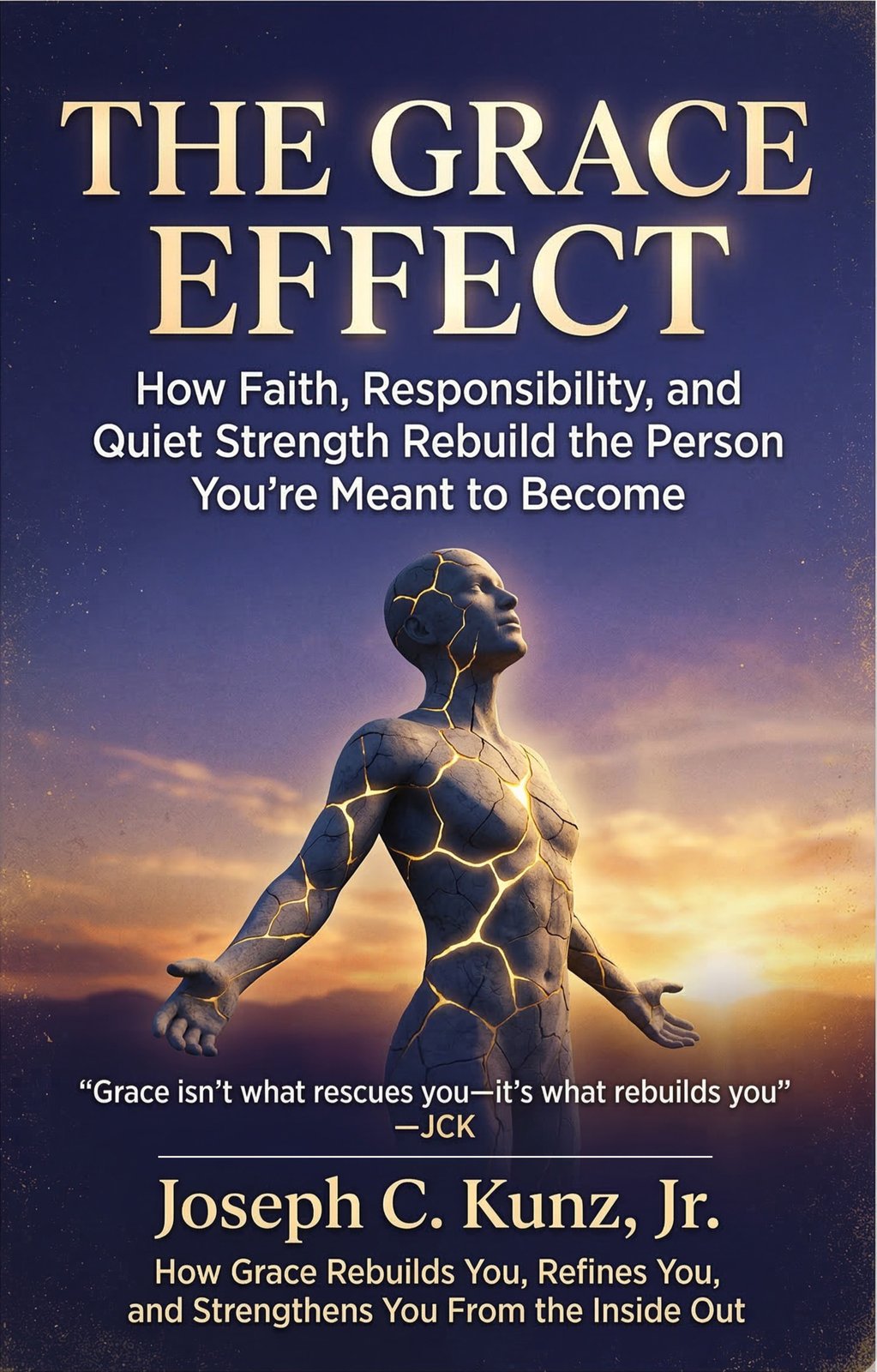
You don’t need another 10,000-word essay from a philosopher telling you what’s wrong with the world. You already know what’s wrong—you see it every day when families fall apart, when work feels empty, when faith gets shoved into the corner like it’s an embarrassment.
Here’s the gut check: truth isn’t proven in academic debates—it’s proven in whether it holds up in the grit of real life. Theories don’t keep marriages together. Theories don’t pay bills or raise children. Theories don’t carry you through failure, illness, or loss. Only faith lived with grit does that.
That’s why I don’t walk the radical road of tearing everything down. I walk the tested road—faith that anchors freedom, virtue that guides work, responsibility that holds a family together. That road isn’t flashy, but it’s strong enough to outlast every fad and every failed promise of utopia.
If you’re tired of being dazzled by clever words and hungry for clarity that works, then you’re ready for The Grace Effect. This book isn’t about impressing—it’s about equipping. It’s about the kind of grace that gives you steel in your spine and tenderness in your heart. Grace that makes you stronger, not softer. Grace that can hold your family, your work, and your faith together when everything else is falling apart.
Don’t settle for arguments that look impressive on paper but collapse in life. Grab The Grace Effect and discover the truth that doesn’t just sound good—it works.
Keep watching.