Where Reason Ends and Meaning Begins

Science can describe life, but only faith can explain it—and confusing the two leads to a thin, brittle worldview too small for the human soul. —Joseph C. Kunz, Jr.
Why Science and Faith Are Not Enemies
By Joseph C. Kunz, Jr.
Synopsis
Science is a gift—but it’s not a god. In Where Reason Ends and Meaning Begins, Joseph C. Kunz, Jr. draws a hard line between what science can measure and what it can never fully explain: love, suffering, conscience, purpose, sacrifice, hope. He challenges modern materialism for shrinking the human person down to chemistry and calling the soul an illusion—then shows why that worldview collapses the moment life stops being theoretical.
Drawing on faith, lived experience, and the kind of “earned clarity” that only comes through hardship, Kunz argues that reason and faith aren’t enemies—they’re partners. Science can tell you what’s happening inside your body; faith tells you why your life matters, why courage is noble, why morality is real, and why meaning survives pain. If you’ve felt the emptiness of a world explained but not understood, this essay is your reminder: the human soul was made for depth, not data alone.
Science can tell you what is happening inside your body; only faith can tell you what it means for your soul. —JCK
I. Introduction: The Limits of the Lab Coat
Modern culture loves to pretend that a white lab coat can answer every question worth asking.
If a thing can be measured, recorded, graphed, or scanned, then—according to some—it is true.
And if it cannot, then we are supposed to call it an illusion.
It is a remarkably cramped vision of human existence.
Yet some modern thinkers cling to it with the confidence of people who believe the universe is no deeper than the tools used to examine it.
The trouble isn’t science itself.
Science is one of God’s great gifts to humanity.
The trouble is the misunderstanding of what science is actually for.
Science explains mechanisms.
Faith explains meaning.
Confusing the two is like mistaking a recipe for a meal.
II. Reason Is Real, But It Is Not Enough
C.S. Lewis once wrote: Reason is the natural organ of truth; imagination is the organ of meaning.
A man may use reason to understand how a violin is constructed.
But unless he has imagination—unless he has the organ of meaning—he will never understand why a violin makes him weep.
Many in the secular world behave as though the only valid truths are the ones that fit under a microscope.
But the deepest truths of human life don’t live in the petri dish.
They live in:
• loyalty
• gratitude
• courage
• sacrifice
• worship
• love
• forgiveness
• grief
• hope
These are not irrational.
They are not illusions.
They are not “outdated” because they have endured longer than the modern mind has existed.
They are simply bigger truths than science is equipped to hold.
III. Chronological Snobbery and the Poverty of New Ideas
Lewis warned about a sin he called “chronological snobbery”: the belief that anything old is automatically inferior to anything new.
This is the modern mistake:
Because we have smartphones, we think we have wisdom.
Because we can split atoms, we think we have understanding.
Because we can sequence DNA, we think we have discernment.
But it does not follow that ancient people were ignorant of the truths that matter most simply because they didn’t have access to our gadgets.
A man with a smartphone may still be a fool.
A man with a plow may still be a sage.
The arrogance of the present age—especially among strict materialists—is believing that moral wisdom arrived after the internet.
That is the real illusion.
IV. The Soul Cannot Be Graphed
The materialist insists:
• Love is a chemical.
• Meaning is a hallucination.
• Morality is a brain glitch.
• Hope is a coping mechanism.
• Faith is self-deception.
But try applying those definitions to real life—
not a podcast, not a lecture, not a laboratory simulation.
Tell a mother holding her dying child that her love is a “neurochemical cascade.”
Tell a nurse in the ICU that her devotion is a “social construct.”
Tell a man who survived brain surgery that his gratitude is a “psychological pattern.”
The soul is not a glitch.
The soul is the most real part of us.
We know this not because we reject science,
but because we refuse to shrink the human experience to the size of a neuron.
I believe in Christianity as I believe that the sun has risen: not only because I see it, but because by it I see everything else. —C.S. Lewis
V. A Universe Too Small for the Human Heart
Secular materialism tries to convince us that:
• the universe has no purpose,
• the human story is accidental,
• choices are preprogrammed,
• morality is subjective,
• consciousness is a trick,
• death is the end.
But people don’t—and can’t—live that way.
Our hearts rebel.
Our souls protest.
Our experience contradicts our theories.
We don’t live as though life is meaningless.
We live as though every second matters.
We don’t live as though love is chemistry.
We live as though love is sacred.
We don’t live as though morality is invented.
We live as though good and evil are real and eternal.
A worldview that contradicts lived experience is not enlightenment.
It is blindness with a vocabulary.
VI. Faith Doesn’t Replace Science —It Completes It
Science can tell us:
• how blood pressure rises,
• how cells divide,
• how light travels,
• how planets orbit.
But only faith can tell us:
• why human life is worth saving,
• why self-sacrifice is noble,
• why love is sacred,
• why hope survives tragedy,
• why forgiveness heals,
• why suffering can be meaningful.
Science tells us how the world works.
Faith tells us why it matters.
This is not a conflict.
It is a partnership.
Science was born from faith, not in spite of it.
To pit them against each other is to misunderstand both.
VII. Faith Is Not a “Comforting Story” — It’s What Survives When Comfort Fails
I do not speak as a philosopher in an armchair.
I speak as a man who has lived through:
• brain surgery,
• fear,
• paralysis,
• uncertainty,
• rebuilding,
• responsibility,
• family duty,
• and the slow, painful climb back toward strength.
In those moments, something became unmistakably clear:
Comforting stories don’t survive real suffering.
Faith does.
Some secular thinkers claim religious belief is a psychological cushion—a sentimental layer added to soften a harsh world.
This would be insulting if it weren’t so shallow.
Faith is not comforting.
Faith is costly.
It demands humility, obedience, sacrifice, forgiveness, courage, and discipline.
These are not emotional escape routes.
These are spiritual disciplines—the opposite of comfort.
The real “comforting story” is the idea that:
• life is an accident,
• morality is flexible,
• meaning is optional,
• consciousness is a glitch,
• and nothing ultimately matters.
That worldview asks nothing of you.
It comforts you with the illusion that nothing higher is watching and nothing deeper is required.
But when the MRI shows a tumor…
when you wake up unable to move your face…
when you fear you won’t see your family again…
when every illusion collapses…
A worldview built for comfort falls apart.
Faith does not.
Science explained what happened to my body.
Faith sustained my soul.
Science gave me data.
Faith gave me hope.
Science guided my doctors.
Faith guided my spirit.
Faith is not a story we tell ourselves to avoid reality.
It is the structure that allows us to face reality when reality becomes unbearable.
VIII. Where Reason Ends and Meaning Begins
Reason is a tool.
Science is a blessing.
Knowledge is a gift.
But they are not gods.
And they cannot replace the One who made the mind that studies the cosmos.
At some point in every serious human life, science reaches its limit.
It can announce the diagnosis.
It cannot explain the purpose.
It can measure the heartbeat.
It cannot measure love.
It can map the brain.
It cannot map the soul.
It can predict the moment of death.
It cannot say what comes next.
When reason ends, meaning begins.
And meaning has never been found in equations alone.
IX. Conclusion: The Larger Life
Critiquing a worldview is not an attack on a person.
Ideas can be wrong without anyone being wicked.
A worldview can be too small without anyone being malicious.
The way forward is not contempt, but clarity.
Not mockery, but meaning.
Not superiority, but truth spoken plainly.
When you live a life full of faith, gratitude, purpose, sacrifice, and love, you don’t need to argue with small philosophies.
You outgrow them.
And that is the most powerful critique of all.
When life collapses, data can steady your mind, but only faith can steady your spirit. —JCK
Related Reading: For Readers Who Refuse a Shallow Life
1. Life Is Too Short for Small Philosophies
A bold challenge to abandon the thin, reductionist worldviews of modern secularism and embrace a faith-shaped reality big enough to hold suffering, truth, beauty, and purpose.
Reader Comment: This essay felt like someone finally saying what I’ve been thinking for years but couldn’t articulate.
2. The Adolescent Atheist: Why Rebellion Disguised as Reason Leaves the Soul Malnourished
A clear-eyed look at why immature skepticism masquerades as intellect—and why true wisdom requires growing beyond rebellion into meaning, maturity, and faith.
Quote: A worldview built only on opposition can never grow into anything strong, beautiful, or lasting. —JCK
The Book Behind This Essay: When the World Gets Loud, Choose a Life With Depth
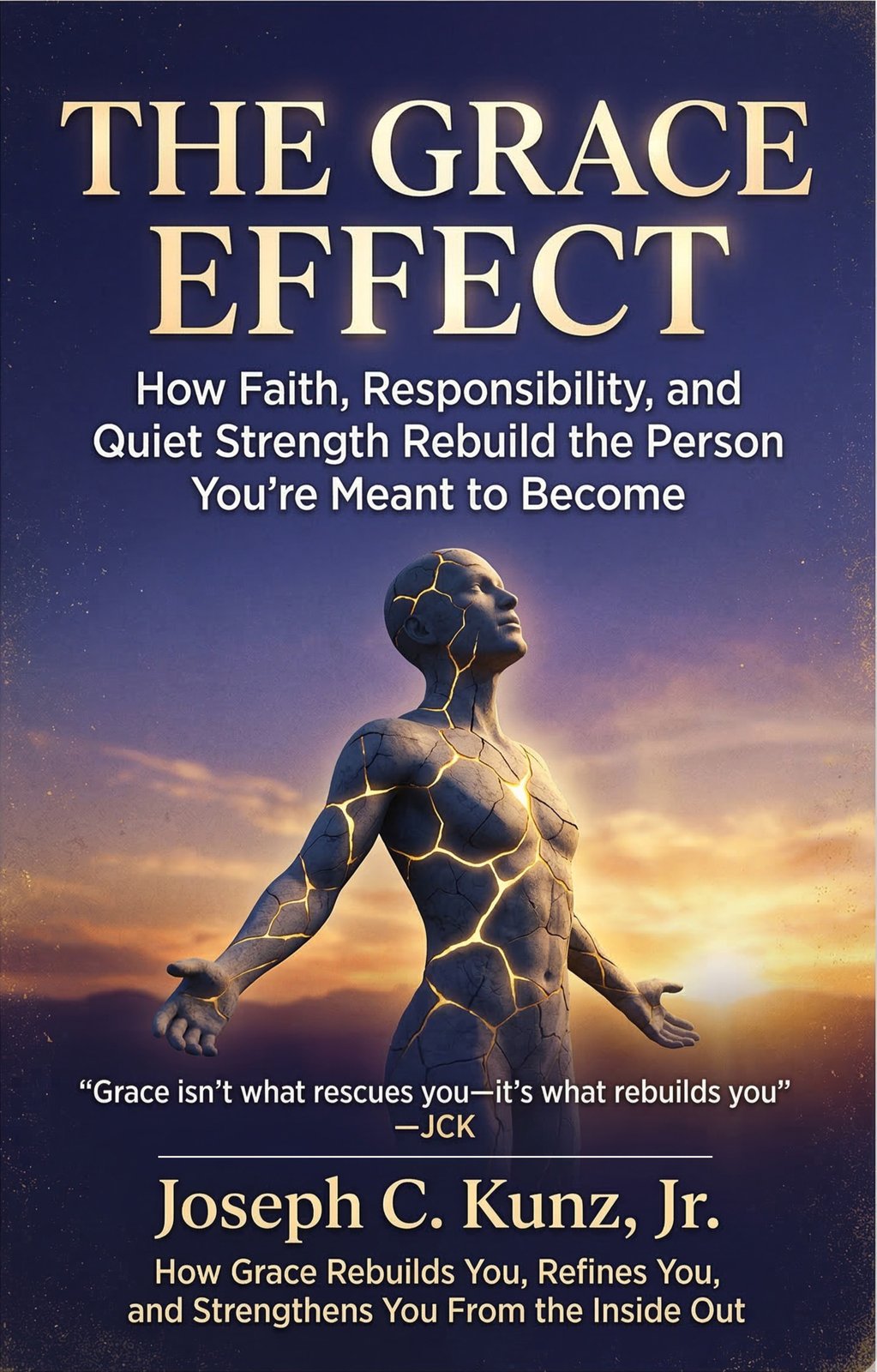
If this essay shook something awake in you, good. That feeling is your soul reminding you that you were made for more than algorithms, headlines, and hollow philosophies.
But waking up is only the first step.
Now you need a way forward.
That’s why I wrote The Grace Effect.
It’s not a “feel-better book.”
It’s a live-better, stand-taller, love-stronger, rebuild-your-life-from-the-inside-out book.
If you want a worldview that actually works when the MRI goes wrong…
when the fear hits at 3 A.M.…
when people you love are depending on you…
when suffering becomes real, not theoretical…
—this is the book you need today, not someday.
Because grace isn’t soft.
Grace is steel wrapped in mercy.
Grace is the power that rebuilt me when everything I trusted failed.
Grace is what gives meaning where science reaches its limit.
Grace is what will give you the strength to live boldly, love fiercely, and walk through fire without losing your soul.
Step into the deeper life. Read The Grace Effect and discover the courage you didn’t know you had and begin the work that shallow worldviews can’t touch.
Coming soon.