When Refusing to See Becomes a Sin

Willful blindness is not innocent ignorance; it is the refusal to see what truth requires, and over time that refusal weakens faith, responsibility, work, wealth, family, and legacy. —Joseph C. Kunz, Jr.
Willful Blindness and the Collapse of a Well-Built Life
By Joseph C. Kunz, Jr.
Synopsis
This isn’t another essay about legal guilt, political cowardice, public silence, or blaming every confused, fearful, or cautious person for failing to act with perfect courage. Those distinctions matter. In this essay, Joseph C. Kunz, Jr. argues that willful blindness is something deeper and more dangerous: the moral refusal to see what truth already makes visible because seeing it would require repentance, responsibility, discipline, courage, or change.
Kunz makes the case that willful blindness must be separated from ignorance, confusion, fear, prudence, cowardice, and recklessness. Ignorance does not know. Confusion does not understand. Fear sees but trembles. Prudence sees but acts carefully because others depend on it. Cowardice sees but chooses comfort over truth. Recklessness sees and acts without wisdom. But willful blindness refuses to see because seeing would make a person responsible. That refusal does not remain private. It weakens faith, corrodes responsibility, distorts work and wealth, trains families in evasion, and leaves legacy to carry the weight of what previous generations refused to face.
The conclusion is simple: a well-built life cannot stand on what a man refuses to see. Faith requires sight. Responsibility requires sight. Work and wealth require sight. Legacy requires sight. When individuals, families, institutions, and nations train themselves not to notice what they are morally capable of seeing, collapse does not begin with catastrophe. It begins with evasion.
Willful blindness is not the absence of sight. It is the refusal to look because looking would require responsibility. —JCK
I. Introduction: The Sin That Wears a Blindfold
Some sins announce themselves loudly. Rage. Greed. Betrayal. Cruelty. Lust. Theft. Lies.
Others enter quietly, dressed in reasonable clothing.
Willful blindness is one of those quieter sins.
It rarely begins with a dramatic act of evil. It begins with a decision not to look too closely. A man does not examine his habits because he knows what he will find. A father refuses to see disorder in his household because seeing it would require him to govern himself first. A believer avoids the gap between what he says and how he lives because the gap has become comfortable. A citizen pretends a cultural lie is harmless because naming it would cost approval. A worker ignores incompetence because confronting it would disturb the peace. A family avoids an obvious problem because everyone has agreed that silence is easier.
And the whole thing gets called peace.
But it is not peace. It is evasion with better manners.
Willful blindness is not simple ignorance. It is not honest confusion. It is not the natural limitation of being human. It is the refusal to see what is available to be seen because seeing it would require responsibility.
That is why it is so dangerous.
A man can survive not knowing many things. No one knows everything. But a person cannot build a serious life while refusing to see the truth directly in front of him.
A life built on avoided truth does not hold. It may look stable for a while. It may impress people from the street. It may have nice landscaping, polite language, and respectable routines. But underneath, the foundation is taking water.
Eventually, what we refuse to see becomes what someone else is forced to inherit.
II. What I Mean—and What I Do Not Mean
Before going further, the distinctions must be clear. Without them, this idea becomes unfair and dangerous.
Not every failure to see is willful blindness. Not every silence is cowardice. Not every person who hesitates is morally weak. Not every person who avoids public confrontation is living a lie.
Here is the difference.
Ignorance means: I do not know.
Confusion means: I do not understand.
Fear means: I see, but I am afraid.
Prudence means: I see, but I must act carefully because others depend on me.
Cowardice means: I see, but I refuse to act because comfort matters more than truth.
Willful blindness means: I refuse to see because seeing would make me responsible.
That last line is the key.
A person may be ignorant through no fault of his own. He may be confused because the issue is complicated. He may be afraid because the consequences are real. He may be prudent because reckless speech or action could harm his family, destroy his livelihood, damage his business, or place others in danger.
That is not willful blindness.
A father who stays quiet at work because one careless sentence could cost him the job that feeds his children is not necessarily blind. A business owner who chooses careful timing because employees depend on him is not necessarily cowardly. A person living under serious pressure may see reality clearly and still decide that wisdom requires restraint.
Good people do not always go quiet because they are blind. Sometimes they go quiet because they see exactly what disorder is willing to destroy.
So this essay is not an attack on the decent, burdened, careful person who is trying to protect what has been entrusted to him.
It is aimed at something else.
It is aimed at the person who refuses to look honestly because looking would end the excuse.
It is aimed at the habit of avoiding truth until avoidance becomes character.
It is aimed at the moral evasion that says, “I didn’t know,” when the deeper truth is, “I made sure not to know.”
III. The Difference Between Weakness and Evasion
Human beings are weak. That is not news. Every serious moral tradition begins there.
We get tired. We get scared. We rationalize. We want comfort. We want approval. We want to belong. We want our lives to remain manageable. We do not enjoy correction. We do not naturally run toward painful truth.
That does not automatically make us corrupt. It makes us human.
But weakness becomes dangerous when it is protected by self-deception.
There is a difference between saying, “I am afraid to face this,” and saying, “There is nothing to face.”
There is a difference between saying, “I do not know how to fix this,” and saying, “This is not broken.”
There is a difference between saying, “I need time and wisdom,” and saying, “This is none of my concern.”
That difference is where willful blindness begins.
The willfully blind person does not merely struggle with truth. He arranges his life to avoid being confronted by it. He avoids certain conversations. He mocks certain warnings. He dismisses certain people. He refuses certain evidence. He surrounds himself with voices that keep him comfortable. He calls clarity harsh, conviction judgmental, discipline extreme, and responsibility unrealistic.
He does not want sight.
He wants insulation.
And insulation is not innocence.
At some point, refusing to see becomes a chosen posture toward reality. When that happens, blindness is no longer merely a limitation. It becomes a moral act.
IV. Faith: Refusing to See What You Really Stand On
The first pillar of a well-built life is faith because every life stands somewhere.
A man may claim he stands on God. He may claim he stands on truth. He may claim he stands on tradition, family, freedom, morality, or principle.
But the real test comes when those claims cost him something.
Willful blindness in faith appears when a person refuses to see what actually governs him.
He says he believes in God, but he is governed by approval.
He says truth matters, but he is governed by convenience.
He says family matters, but he is governed by appetite.
He says virtue matters, but he is governed by image.
He says faith matters, but he keeps it away from his habits, money, work, speech, and private decisions.
That is not merely inconsistency. Everyone has inconsistency. The deeper danger is refusing to admit the inconsistency exists.
Faith becomes decorative when it is not allowed to correct anything.
This is one of the great temptations of religious language. It can be used either to reveal truth or to protect the self from truth. A person can use faith as a mirror, or he can use it as wallpaper.
A mirror shows the face.
Wallpaper covers the crack.
Willful blindness turns faith into wallpaper.
It allows a man to sound grounded while remaining unformed. It allows him to speak of conviction while avoiding obedience. It allows him to claim moral seriousness while refusing the hard interior work that seriousness requires.
Faith, rightly understood, does not flatter us. It forms us. It reveals what is disordered. It names what is false. It calls us out of self-protection and into truth.
That is why willful blindness is so destructive to faith. It does not merely avoid information. It avoids transformation.
A man who refuses to see what faith reveals will eventually reshape faith into something that asks less of him.
And once faith asks nothing, it holds nothing.
V. Responsibility: Refusing to Own What Is Yours
Responsibility begins with sight.
You cannot govern what you refuse to see. You cannot repair what you refuse to name. You cannot carry what you keep pretending belongs to someone else.
This is why willful blindness is one of the great enemies of responsibility.
It teaches a person to outsource blame before he examines duty.
The irresponsible man asks, “Who can I blame?”
The responsible man asks, “What is mine to govern?”
That question changes everything.
It does not mean everything is your fault. It does not mean you caused every problem. It does not mean you control every circumstance. It does not mean other people, systems, institutions, cultures, and histories do not matter.
But responsibility asks a harder question:
Even here, even now, even under pressure, what part of this belongs to me?
Willful blindness refuses that question.
A father refuses to see the disorder in his home because seeing it would require him to become steadier, stronger, more disciplined, and more present.
A husband refuses to see the emotional distance in his marriage because seeing it would require humility.
A parent refuses to see what a child is becoming because seeing it would require boundaries.
A citizen refuses to see civic disorder because seeing it would require courage.
A worker refuses to see his own lack of competence because seeing it would require effort.
A leader refuses to see institutional rot because seeing it would require confrontation.
Responsibility is not glamorous. It is not a slogan. It is the daily willingness to see clearly and act faithfully within one’s proper sphere.
That is why evasion feels so attractive. It offers the emotional relief of innocence without the burden of reform.
But false innocence is expensive.
A person who refuses responsibility does not become free. He becomes dependent on excuses. And a life dependent on excuses cannot stand upright for long.
VI. Work and Wealth: Refusing to Look at the Numbers
Few areas expose willful blindness more quickly than work and money.
Numbers are rude. They do not care about feelings. They do not applaud excuses. They do not soften the consequences of habit.
Debt has a number.
Savings have a number.
Income has a number.
Spending has a number.
Productivity has a number.
Waste has a number.
Time has a number.
This is why people often avoid looking.
They do not want to see what their habits are costing. They do not want to see how much time they waste. They do not want to see how little they have prepared. They do not want to see that resentment has become a substitute for competence. They do not want to see that their financial life is not being crushed only by outside forces but also by private disorder.
That is not always true. Some people are genuinely trapped by hardship, sickness, family burdens, job loss, or economic pressure. A serious discussion of work and wealth must leave room for real suffering.
But it must also leave room for real responsibility.
Willful blindness about money often sounds sophisticated. It hides behind phrases like, “Money is not everything,” or “I’m just not good with numbers,” or “Rich people are greedy,” or “The system is rigged,” or “I’ll deal with it later.”
Some of those statements may contain partial truths. But partial truths are often the favorite hiding place of full evasions.
Money is not everything. True. But disorder with money still damages families.
Not everyone is naturally good with numbers. True. But adults can learn what they need to know.
Some rich people are greedy. True. But that does not excuse laziness, envy, or financial irresponsibility.
Some systems are unfair. True. But no serious life can be built entirely on resentment.
“I’ll deal with it later” is often the lullaby people sing while consequences gather interest.
Work and wealth require honest sight because they are tied to stewardship. A man who refuses to look at his financial life is not merely avoiding math. He may be avoiding reality. He may be avoiding discipline. He may be avoiding the painful truth that freedom requires structure.
Wealth is not merely about having more. It is about becoming the kind of person who can handle more without being owned by it.
That requires sight.
And willful blindness hates sight.
VII. Family: The Place Where Avoided Truth Becomes Personal
Every family has problems. The question is not whether a household contains weakness. Every household does.
The question is whether the household is allowed to tell the truth about itself.
Family life is one of the places where willful blindness becomes most painful because the consequences are intimate. They sit at the dinner table. They sleep down the hall. They grow up watching what the adults refuse to name.
A family may refuse to see addiction.
A family may refuse to see emotional neglect.
A family may refuse to see financial chaos. A family may refuse to see a father’s weakness.
A family may refuse to see a mother’s bitterness.
A family may refuse to see a child’s disorder.
A family may refuse to see that everyone is walking around the same obvious truth.
And because everyone knows the rule—do not say what everyone knows—the household becomes trained in dishonesty.
That is one of the quiet tragedies of family disorder.
The children learn more than the official lesson. They learn the hidden curriculum. They learn what cannot be said. They learn which emotions control the room. They learn which person must be protected from truth. They learn which lies keep the peace.
But peace built on avoidance is not peace.
It is a cease-fire with reality.
A well-built family does not require perfection. It requires enough truth to make repair possible. It requires adults who can see what is happening without collapsing into denial, rage, blame, or self-pity.
This is especially important for fathers and mothers.
Authority without sight becomes performance.
Authority without self-government becomes noise.
Authority without truth becomes control or retreat.
A father who refuses to see himself clearly cannot govern a household wisely. A mother who refuses to see disorder clearly cannot nurture strength. Parents who refuse to see reality raise children inside confusion and then act surprised when confusion bears fruit.
The family is where avoided truth becomes flesh.
That is why willful blindness is not private. It is passed down.
VIII. Culture: When Evasion Becomes Normal
A culture can become willfully blind too.
Not because every individual is equally guilty. Not because everyone understands everything. Not because every silence is cowardice.
But because enough people, for enough time, agree not to see what is obvious.
They agree not to see disorder if disorder is fashionable.
They agree not to see failure if failure is protected by slogans.
They agree not to see cruelty if cruelty uses compassionate language.
They agree not to see weakness if weakness calls itself progress.
They agree not to see lies if the lies are useful.
They agree not to see collapse if naming collapse would make them unpopular.
This is where public life begins to rot.
Words are changed. Standards are lowered. Responsibility is mocked. Prudence is replaced by cowardice. Compassion becomes theater. Freedom becomes appetite. Justice becomes revenge. Truth becomes whatever power can enforce.
And the average person feels the pressure.
He sees what is happening. He knows something is wrong. But he also knows that saying so may come with a price.
Again, that person may not be blind. He may be calculating costs in a culture that punishes honesty.
The deeper guilt belongs to the people and institutions that demand blindness as the price of acceptance.
A healthy culture helps people see.
A disordered culture trains people not to notice.
That is why the battle over truth is never merely intellectual. It is moral. It shapes what people are allowed to say, what they are pressured to deny, and what they must pretend not to understand.
When a culture rewards evasion long enough, blindness becomes a credential.
And when blindness becomes a credential, seriousness becomes rebellion.
IX. Legacy: What We Refuse to See Does Not Disappear
Legacy is where the bill comes due.
A person can avoid truth for a long time. He can explain it away. He can bury it under busyness. He can distract himself with entertainment, status, work, politics, money, religion, or noise.
But what he refuses to see does not disappear.
It waits.
It waits in his marriage.
It waits in his children.
It waits in his health.
It waits in his finances.
It waits in his habits.
It waits in his business.
It waits in his conscience.
It waits in the next generation.
Legacy is not what a person says he valued. It is what his life actually formed.
This is why willful blindness is so dangerous. It does not merely damage the present. It mortgages the future.
The son inherits what the father refused to face. The daughter carries what the mother would not name. The family absorbs what everyone avoided. The business suffers from what leadership ignored. The nation pays for what its citizens normalized. The next generation lives inside the consequences of truths their elders found too inconvenient to confront.
That is the brutal honesty of legacy.
Avoided truth compounds.
So does responsibility.
A man who sees clearly may not fix everything. But he gives those who come after him a cleaner inheritance than denial ever could. He gives them language. He gives them courage. He gives them a model of honesty. He gives them the dignity of reality.
That matters.
A legacy worth leaving is not built by perfect people. It is built by people who were willing to stop lying to themselves.
X. When Refusing to See Becomes a Sin
So when does blindness become sin?
Not when a person lacks information.
Not when a person is honestly confused.
Not when a person is afraid.
Not when a person acts carefully to protect those entrusted to him.
Blindness becomes sin when a person has enough light to see but chooses darkness because darkness protects him from responsibility.
That is the line.
The willfully blind person does not merely fail to know. He resists knowing. He does not merely lack clarity. He avoids clarity. He does not merely struggle with truth. He manages his life so truth cannot interrupt him too forcefully.
That is a spiritual problem.
Because truth is not merely information. Truth is a summons.
It summons us to repent.
It summons us to repair.
It summons us to govern ourselves.
It summons us to stop pretending.
It summons us to become responsible for what we can no longer honestly deny.
That is why refusing to see can become sinful.
It is a refusal of the summons.
And once a person refuses the summons often enough, he may begin to lose the ability to hear it.
That may be the most frightening part of willful blindness. It does not leave the soul unchanged. A man who repeatedly refuses to see does not remain neutral. He becomes trained in evasion. His conscience becomes quieter. His excuses become smoother. His tolerance for disorder grows. His appetite for truth weakens.
The first refusal may feel uncomfortable.
The tenth feels normal.
The hundredth feels like wisdom.
That is how collapse begins.
Not with one giant act of rebellion, but with repeated small agreements not to see.
XI. The Courage to Look
The opposite of willful blindness is not recklessness.
That distinction matters.
Recklessness is not courage. Recklessness is action without proper regard for duty, timing, consequence, or the people who may be harmed by your actions.
A reckless person may see something true, but he does not act wisely with what he sees. He blurts out what should be handled carefully. He mistakes emotional release for moral courage. He creates damage and then calls the damage proof of his honesty. He may tell himself he is “just speaking the truth,” but truth handled without wisdom can become another form of disorder.
Willful blindness refuses to see. Cowardice sees but refuses to act because comfort matters more than truth. Recklessness sees and acts without wisdom. Prudence sees and acts carefully because responsibility requires more than emotional reaction. —JCK
This is especially important for a person with real responsibilities.
A father does not get to pretend that his words affect only him. A husband, mother, business owner, employer, teacher, pastor, nurse, worker, or leader must consider the people entrusted to his care. He must think about timing, setting, tone, strategy, and consequence. He must ask not only, “Is this true?” but also, “What is the faithful way to handle this truth?”
That is prudence.
Prudence is not cowardice. Prudence is disciplined judgment. It is the ability to see truth clearly without acting foolishly. It understands that not every truth must be spoken in every room, at every volume, at every moment, to every person.
Willful blindness refuses to see.
Cowardice sees but refuses to act because comfort matters more than truth.
Recklessness sees and acts without wisdom.
Prudence sees and acts carefully because responsibility requires more than emotional reaction.
That is the balance.
The opposite of willful blindness is honest sight.
It is not shouting every truth at every moment. It is not turning every conversation into a battlefield. It is not confusing bluntness with courage. It is not destroying one’s family, business, livelihood, or trusted responsibilities in order to prove moral seriousness to strangers.
The opposite of willful blindness is the willingness to look at reality without flinching, even when action must be careful.
A serious person learns to say:
I see this.
I will not pretend I do not see it.
I may need wisdom before I act.
I may need patience before I speak.
I may need courage before I confront.
I may need help before I repair.
But I will not build my life on denial.
That is the beginning of responsibility.
A person does not need to solve everything immediately. But he must stop lying about what he sees.
There are times when wisdom requires silence. There are times when leadership requires timing. There are times when protecting others requires restraint. There are times when direct confrontation would be foolish, vain, or destructive.
But there is never a time when the soul benefits from pretending that truth is not truth.
A well-built life begins when a person is willing to see.
Not theatrically.
Not self-righteously.
Not cruelly.
Not performatively.
Not recklessly.
Clearly.
That clear sight is one of the first acts of faith. It is one of the first acts of responsibility. It is one of the first acts of stewardship. It is one of the first acts of legacy.
Because what we are willing to see determines what we are willing to build.
XII. Conclusion: No Life Holds on Avoided Truth
A well-built life does not require perfect vision. None of us sees everything clearly. None of us understands every consequence. None of us is free from fear, weakness, habit, or self-protection.
But a well-built life does require a basic loyalty to truth.
That loyalty begins with the courage to look.
To look at what faith demands.
To look at what responsibility requires.
To look at what work and wealth reveal.
To look at what family life is forming.
To look at what legacy will inherit.
Willful blindness offers relief, but it does not offer freedom. It protects comfort, but it weakens character. It avoids pain, but it multiplies consequences. It lets a person postpone responsibility while pretending the postponement is harmless.
It is not harmless.
What we refuse to see does not vanish. It waits for us. And if it cannot reach us, it often reaches those who come after us.
That is why refusing to see can become a sin.
Not because every person knows everything.
Not because every silence is cowardice.
Not because every fearful person is guilty.
But because there are moments when truth stands close enough to be seen, and the only thing keeping us blind is the part of us that does not want to become responsible.
The conclusion is simple: no life holds on avoided truth.
A man may build around it. He may decorate over it. He may explain it away. He may convince himself that not looking is the same as not knowing.
But reality is patient.
And eventually, the truth we refused to see becomes the weight our life can no longer carry.
A life cannot be well built on what a man refuses to see. —JCK
Related Reading: Where Sight Becomes Strength
These essays deepen the same moral architecture: truth must first be seen clearly before it can be carried responsibly.
1. Clarity Is Strength: The Words That Build (or Break) a Life
Define your core words with precision, or life will be defined for you by people far less invested in your future.
Reader Comment: This is the natural companion essay because willful blindness depends on strong distinctions. If readers cannot tell the difference between ignorance, fear, prudence, cowardice, recklessness, and evasion, they will either excuse too much or condemn too quickly.
Quote: Weak words build weak lives. —JCK
Silence spreads when ordinary people learn that telling the truth carries a cost—and that cost quietly reshapes the culture.
Reader Comment: This essay protects the argument from becoming simplistic. Not every quiet person is blind. Some people see clearly but must calculate the cost because families, jobs, businesses, reputations, and safety are on the line.
Quote: Good people do not always go quiet because they are blind. Sometimes they go quiet because they see exactly what disorder is willing to destroy. —JCK
The Book Behind This Essay: Stop Decorating the Cracks
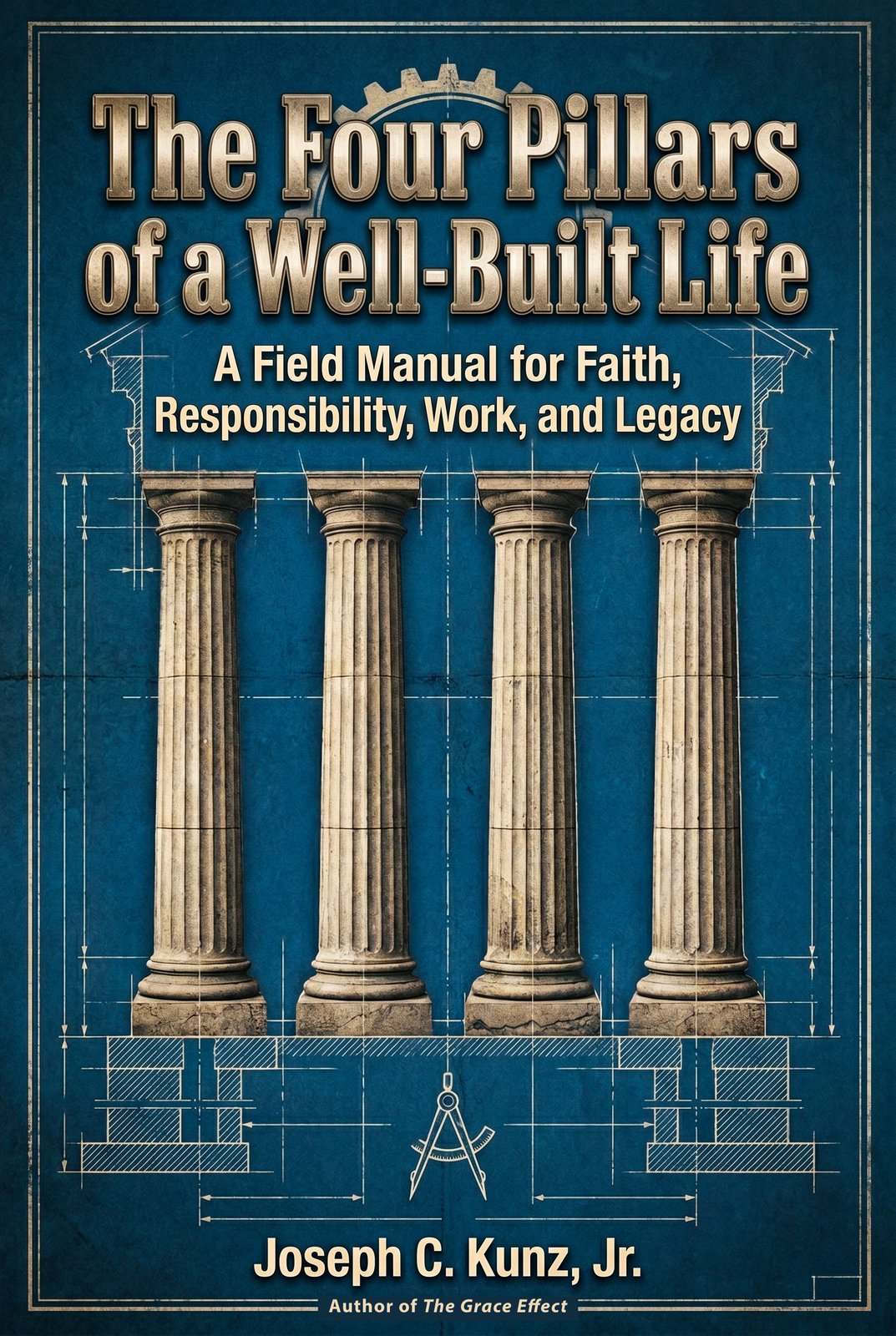
The Four Pillars of a Well-Built Life
A life does not collapse all at once. It usually starts with the truth a man refuses to see. The bad habit he excuses. The disorder he renames. The responsibility he pushes away. The weakness he calls prudence. The family problem everyone tiptoes around. The financial reality he refuses to count. The spiritual gap he covers with respectable language.
That is why I am writing The Four Pillars of a Well-Built Life. This book is about the structure beneath a serious life: faith as the foundation, responsibility as the frame, work and wealth as the engine, and legacy as the destination. It is not a motivational pep talk. It is a framework for people who want a life strong enough to carry truth, duty, pressure, family, money, work, and consequence without folding.
If you are tired of slogans that sound good but hold nothing, this book is for you.
If you know comfort has become too expensive, this book is for you.
If you want to stop managing appearances and start building something that can actually stand, this book is for you.
Being Built to Hold: The Four Pillars of a Well-Built Life