Wallace Wattles Was Right — Wealth Is a Moral Duty
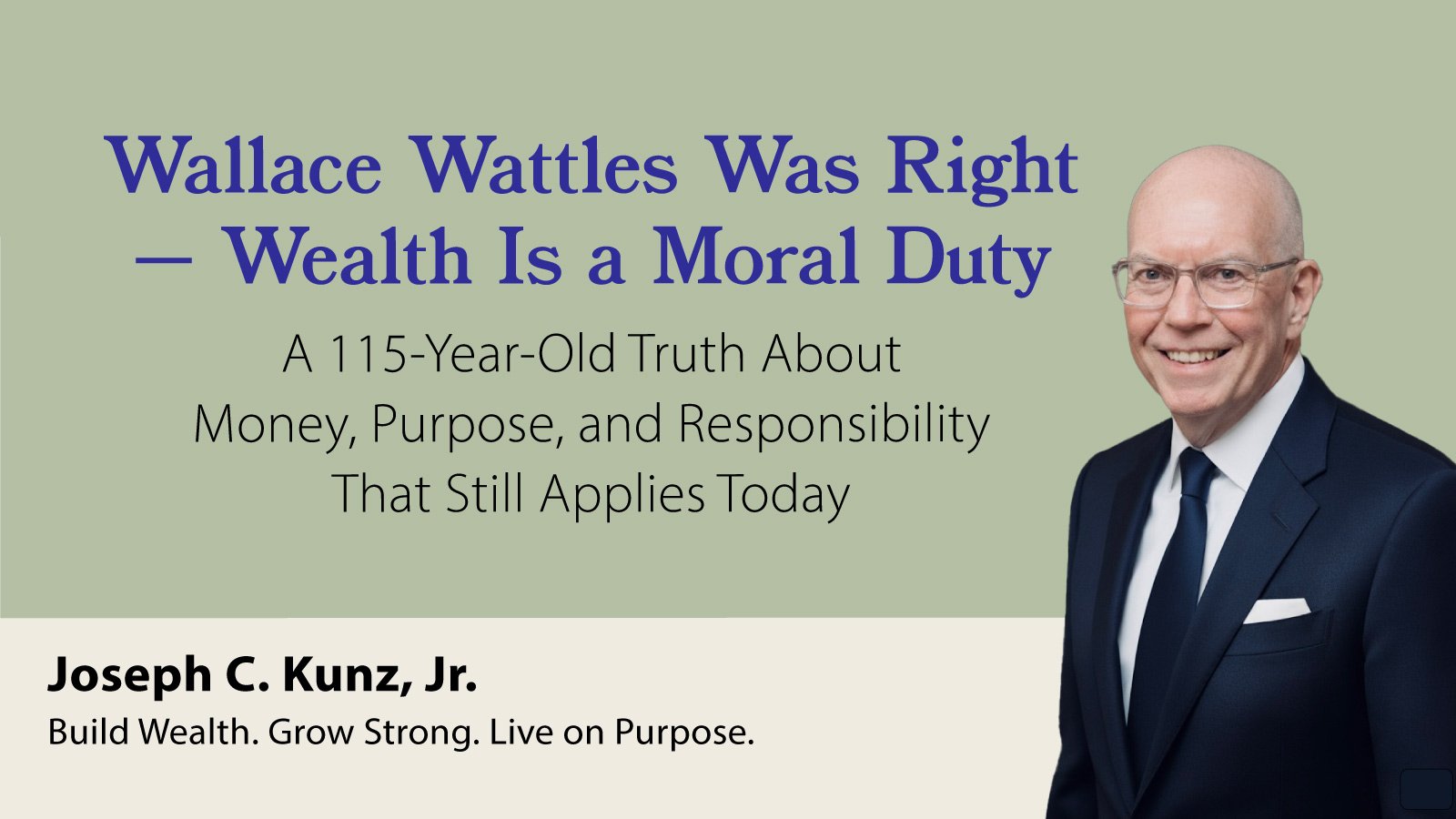
Wallace Wattles understood what too many modern minds forget—building wealth isn’t just about personal gain, but about fulfilling your duty to serve, grow, and provide for those you love. —Joseph C. Kunz, Jr.
A 115-Year-Old Truth About Money, Purpose, and Responsibility That Still Applies Today
By Joseph C. Kunz, Jr.
Synopsis
More than a century ago, Wallace Wattles made a claim that still unsettles modern minds: building wealth is not a selfish pursuit—it is a moral duty. In this essay, Joseph C. Kunz, Jr. revisits Wattles’ core insight and strips it of mystical fog to reveal a harder, truer principle: poverty limits your ability to lead, provide, protect, and serve those entrusted to you.
This is not a defense of greed or excess, but a call to responsibility. Wealth, rightly built, creates strength, independence, and capacity—without which good intentions remain fragile. In a culture that glorifies dependence and demonizes success, this essay reframes wealth as preparation, stewardship, and love in action.
Whatever may be said in praise of poverty, the fact remains that it is not possible to live a really complete or successful life unless one is rich. —Wallace Wattles
I. Introduction: The Courage to Say It Out Loud
Most people today are afraid to say what Wallace Wattles said boldly over a century ago:
Becoming wealthy is your duty—not just your desire.
We’ve been trained—especially in modern Western culture—to associate wealth with guilt. If you pursue it, you’re selfish. If you have it, you must have taken it from someone else. And if you lose it, well, at least you stayed humble.
Wattles didn’t buy that lie—and neither should we.
He understood that wealth, rightly built, wasn’t about indulgence. It was about capacity. Capacity to lead. Capacity to give. Capacity to grow. Capacity to protect your family from forces that seek to control them.
He spoke to working-class people—not Wall Street elites—and told them, bluntly: You cannot fulfill your life’s purpose from a position of weakness.
I don’t agree with Wattles on everything. He was a product of early metaphysical thinking, not biblical principle. But on this truth, he was dead right:
Wealth is not optional for those who want to live lives of meaning, impact, and integrity.
II. Why Wattles Said Wealth Was a Moral Imperative
Wattles built his entire book around one unshakable principle:
Every man or woman who lives a complete life must have the means to fully develop mind, body, and soul.
And that requires money.
He wasn’t saying everyone should chase riches for the sake of prestige. He was saying poverty stifles growth. It reduces life to survival. It cuts people off from beauty, knowledge, health, and purpose. It turns them into dependents—on government, on corporations, on systems that keep them small.
Wattles saw the truth that most people today still try to avoid:
You cannot live freely or lead confidently if you are financially fragile.
Wealth gives you:
• Margin for health and rest
• Access to opportunity and education
• The ability to choose your work—not be trapped in it
• The freedom to walk away from bad systems, toxic people, and broken institutions
Without wealth, your life is lived on someone else’s terms. That’s not just inconvenient—it’s immoral, because it limits your ability to serve and protect the people who depend on you.
That’s what Wattles understood. And it’s what today’s culture desperately needs to hear.
III. Where Wattles Was Ahead of His Time
Wattles saw the economic future coming before anyone had a name for it.
Long before FIRE movements, passive income books, or YouTube finance gurus, he was warning that:
• Poverty is not noble—it’s dangerous.
• Dependence is not safety—it’s bondage.
• Wealth is not a vice—it’s a weapon of freedom.
He wasn’t talking to billionaires. He was talking to everyday people—working men and women struggling under the weight of industrial-era limitations.
And his message was radical:
You don’t need luck. You don’t need inheritance. You don’t even need genius. You need purpose, order, discipline, and a willingness to reject the lie that smallness is virtuous.
Even now, over a century later, most modern personal finance advice is designed to contain people, not empower them. Budget tighter. Expect less. Be grateful for whatever job you can get.
Wattles would’ve laughed at that—and so should you.
He saw wealth as the foundation for human expansion. Today, we need to reclaim that truth with moral clarity, not mystical fog.
IV. Where I Build on Wattles’ Foundation
While Wattles had the courage to say what few dared to, his foundation had cracks. His framework lacked structure, and his message—while powerful—was incomplete.
A. He didn’t ground his message in moral absolutes.
Wattles based his method on vague metaphysical principles: "thinking in a certain way." But without moral grounding, this becomes manipulation—wealth as a magic trick.
My version: True wealth-building is based on discipline, stewardship, responsibility, and values. Not just desire—but design. Not just belief—but behavior.
B. He overlooked the central role of family and legacy.
Wattles focused on the self. Self-development. Self-expression. Self-growth. But what’s wealth for, if not to protect and strengthen those entrusted to you?
My version: Wealth is not about ego—it’s about legacy. It’s about raising strong children, supporting a faithful spouse, and passing down a foundation so the next generation doesn’t start at zero.
C. He left God out of the equation.
Wattles referenced “thinking substance” and “universal supply,” but avoided God, truth, or divine authority. His system worked in theory—but lacked conviction and accountability.
My version: Wealth must be tied to truth. It must answer to something higher than profit. If it doesn’t serve your faith, your family, or your future, then it’s not wealth—it’s noise.
V. Why His Message Still Matters — More Than Ever
In today’s culture, everything Wattles warned about has been normalized.
We’ve built a world where:
• Dependency is encouraged
• Victimhood is monetized
• Responsibility is avoided
• Wealth is painted as corrupt or oppressive
We’re told it’s more virtuous to struggle than to succeed. More noble to barely survive than to build something meaningful. More humble to have nothing than to become someone capable of real, lasting provision.
Wattles refused that lie. And so should we.
He reminded us that you cannot fulfill your potential from a place of weakness.
And today, you don’t just owe it to yourself to build wealth. You owe it to your family. To your legacy. To your God-given calling.
Because your family won’t be saved by your good intentions. They’ll be saved by your preparation, your leadership, and your strength.
VI. Conclusion: He Was Right. But You Must Go Further.
Wattles saw what too many still deny: Wealth is not optional. It is the foundation of freedom, leadership, and impact.
But he stopped short.
He offered technique without truth. Desire without discipline. Personal gain without personal responsibility.
Now it’s your turn to finish what Wattles started.
Reclaim his courage. Keep his clarity. But anchor it in real conviction:
• Build wealth to lead, not escape.
• Build wealth to serve, not flaunt.
• Build wealth to protect, not impress.
Your calling isn’t just to make money. It’s to become the kind of person who builds wealth with purpose—and uses it with honor. —JCK
Related Reading: For Those Who Believe Wealth Is About Stewardship, Not Status
If this essay resonated with you, these will take the idea even further.
1. Why Building Wealth Is a Moral Duty If You Love Your Family
Why wealth isn’t selfish—but a moral duty for anyone who wants to protect, provide, and pass on a legacy.
Reader Comment: This essay hit me hard—it reframed wealth as love in action, not just money in the bank.
2. Money, Wealth, and Financial Truths
Explore the timeless truths about money that separate lasting wealth from empty illusions.
The Book Behind This Essay: Ready to Build with Purpose? Start Here.

Wattles gave us the philosophical spark. But you need a practical fire.
If you’re tired of vague advice, empty formulas, and soft principles, my book Money’s Dirty Little Secrets will give you the clarity, conviction, and blueprint you need to build real, values-driven wealth.
Inside, you'll learn:
• How to reject the lies that keep families in survival mode
• How to lead with financial strength and moral clarity
• How to build wealth that serves your faith, your family, and your future
Get the book here and begin the sacred work of building wealth that lasts.