The Hardest Person to Forgive Is Yourself — Do It Anyway

You can’t rewrite the past—but you can refuse to let it keep writing your future. —Joseph C. Kunz, Jr.
Why Grace Toward Yourself Is the First Step to Real Freedom
By Joseph C. Kunz, Jr.
Synopsis
This isn’t about excusing what you did or pretending it didn’t matter. In this essay, Joseph C. Kunz, Jr. argues that the most destructive prison most people live in isn’t built by their enemies — it’s built by their own shame. He makes the case that self-forgiveness is not weakness or “letting yourself off the hook,” but the necessary first step to rebuilding a life with peace, purpose, and strength.
Drawing from a builder’s framework — truth, responsibility, repair, and forward motion — Kunz distinguishes guilt (which can teach) from self-condemnation (which only corrodes). He gives a practical process for owning the past without living inside it, so the reader can stop rehearsing failure and start living as proof of growth. The goal isn’t comfort. It’s freedom — the kind that makes real change possible.
Self-forgiveness isn’t letting yourself off easy—it’s setting yourself free to do the hard work of living well. —JCK
I. Introduction: The Unforgiving Judge in the Mirror
We’re often harder on ourselves than anyone else could ever be.
Why? Because we know the whole story. Every detail. Every wrong turn. We become both the prosecutor and the judge—presenting the evidence, declaring ourselves guilty, and sentencing ourselves to a lifetime of regret.
But here’s the truth: you can’t build a meaningful future while dragging the wreckage of your past behind you. You’re punishing someone who can’t go back and change the mistake—only move forward and live differently.
II. Forgiveness Is Not Forgetting
Most people aren’t haunted by what other people think. They’re haunted by what they think.
Because you know the whole story. Every detail. Every wrong turn. Every moment you wish you could grab and redo. And over time you become both prosecutor and judge — presenting the evidence, declaring yourself guilty, and sentencing yourself to a lifetime of regret.
But you can’t build a meaningful future while dragging the wreckage of your past behind you. That isn’t “accountability.” It’s a slow, private form of self-destruction.
You’re punishing someone who can’t go back and change the mistake — only move forward and live differently.
III. Self-Forgiveness Is Not Forgetting
Let’s get this straight. Self-forgiveness is not denial. It’s not revisionist history. It’s not calling evil “no big deal” so you can sleep at night.
Self-forgiveness is facing what you did, owning it without excuses, and refusing to let guilt become the permanent manager of your identity.
Guilt can be useful. It’s a signal. It’s the alarm that says, “Something needs to change.” But shame is different. Shame doesn’t say, “I did wrong.” Shame says, “I am wrong.”
And shame doesn’t produce growth. It produces hiding, numbing, bitterness, and paralysis.
You don’t need to forget what happened. You need to stop living like it has the authority to define you forever.
IV. Why It’s Harder to Forgive Yourself Than Anyone Else
Forgiving others can feel noble. Forgiving yourself can feel suspicious — like you’re getting away with something.
A lot of people secretly believe this lie: If I keep punishing myself, I’m proving I’m serious.
But self-condemnation isn’t righteousness. It’s stuckness with a halo on it.
Here’s another hard truth: we often refuse to forgive ourselves because we confuse self-forgiveness with self-respect. We think mercy is softness. We think if we release the sentence, we’ll repeat the crime.
So we keep the guilt around like a guard dog. Except it doesn’t protect us. It eats us.
And there’s one more layer most people don’t notice: pride. Not the loud kind. The quiet kind. The kind that says, “I should’ve known better, therefore I’m unforgivable.”
That isn’t humility. That’s you insisting you’re the one person grace doesn’t apply to.
V. The Self-Forgiveness Protocol
If you want to move forward, you need a process. Not a mood. Not a motivational quote. A process.
Here’s the builder’s way through it:
1. Name It Clearly
Stop speaking in fog. Write down what happened — what you did, what you didn’t do, what you should’ve done, and why it was wrong. Clarity is not cruelty. Clarity is the first step toward change.
2. Own It Without Excuses
Take responsibility without performing self-hatred. Excuses keep you comfortable. Ownership makes you free.
3. Repair What You Can
Apologize. Make restitution. Pay the debt. Correct the pattern. Action clears the haze faster than endless reflection ever will. You can’t always fix everything — but you can always stop making it worse.
4. Extract the Lesson
Every failure has a lesson you can either learn or repeat. What’s the principle you refuse to violate again? What boundary do you need? What habit needs to die? What truth do you need to live by now?
5. Release the Sentence
This is the turning point. You don’t need to forget. You need to stop rehearsing the punishment. You did the work: truth, ownership, repair, learning. Now you choose to walk forward without chains.
6. Live as Proof
Let your growth be louder than your guilt. The best evidence of repentance is a changed life — steady, disciplined, and real.
VI. Grace Toward Yourself Is Not Softness
Self-forgiveness isn’t telling yourself, “It’s fine.” It’s telling yourself, “It happened — and I’m not letting it ruin the rest of my life.”
Grace doesn’t erase consequences. It prevents corrosion.
A man or woman drowning in shame doesn’t become stronger — they become smaller. They hide. They drift. They numb out. They lash out. They sabotage good things before good things can fully land.
Grace is what lets you stand up again without pretending you never fell. It’s what lets you rebuild without living in self-disgust. It’s what turns failure into training instead of a life sentence.
You don’t need to be perfect to move forward. You need to be honest — and willing to change.
VII. Conclusion: Grace Starts at Home
If you can’t give yourself grace, you’ll never give it cleanly to anyone else. The person at war with himself can’t be at peace with others — not for long.
Self-forgiveness isn’t weakness. It’s controlled strength. It’s refusing to be chained to a version of yourself that no longer exists.
When you forgive yourself, you’re not saying, “It’s okay.” You’re saying, “It’s over.”
And once it’s over, you can finally get to work building the life you were meant to live.
The past is a place of reference, not a place of residence. Visit it to learn, not to live. —JCK
Related Reading: For Anyone Learning to Carry Grace into the Hardest Places
If this essay spoke to you, these will help you keep walking the path of forgiveness, strength, and renewal.
Quiet endurance, steady faith, and the grace that only reveals itself when the storms roll in.
Reader Comment: This essay reminded me that scars don’t mean I’m weak—they prove I’m still here.
2. Grace in the Quiet The subtle power of grace to restore strength and clarity in the still moments of life.
The Book Behind This Essay: Grace Isn’t Theory — It’s Survival
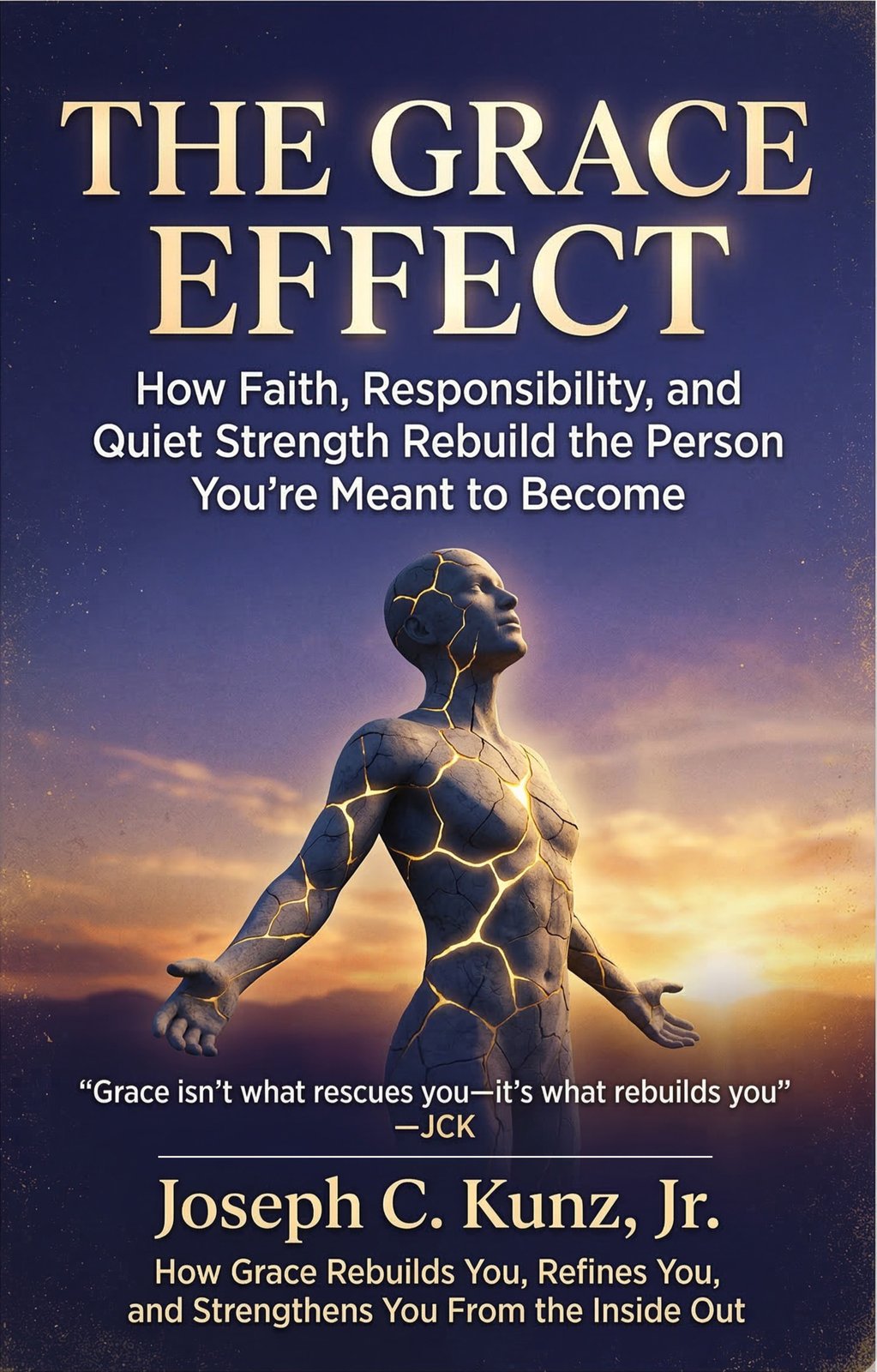
I didn’t write The Grace Effect from a mountaintop.
I wrote it in the trenches, after learning the hard way that grit alone isn’t enough.
Grace is what steadied me through loss, setbacks, and the weight of responsibility.
This book carries every lesson I had to bleed for—because I don’t want you to learn them the hard way.
I poured myself into these pages because I know what it feels like to be worn thin, to wonder if strength alone will carry you.
Grace is the difference.
It’s what kept me showing up when life told me to quit.
And it’s what can keep you steady, too.
Get your copy of The Grace Effect.
Check back for the release.