The Best Advice My Father Never Said Out Loud

When a father says nothing, his silence still teaches. The question is whether a son turns that silence into bitterness, or into a standard he refuses to betray. —Joseph C. Kunz, Jr.
What Silence Taught Me About the Man I Refused to Become
By Joseph C. Kunz, Jr.
Synopsis
This is not an essay about blaming the past, excusing weakness, or turning fatherlessness into a permanent grievance. In this essay, Joseph C. Kunz, Jr. reflects on a harder and more useful truth: sometimes the most powerful instruction a man receives comes from what was missing, what was never said, and what he decides never to repeat.
A father’s silence does not remain neutral. It teaches through absence, consequence, pressure, and the empty places where guidance should have been. But silence does not automatically produce wisdom. It can create bitterness, drift, emotional distance, or hardness. It becomes useful only when a man interprets it through responsibility, grace, and legacy—when he allows the wound to sharpen his standards without allowing it to rule his heart.
The conclusion is simple: you cannot control the silence you inherit, but you can control the legacy you leave. A father’s absence may explain part of your story, but it does not get authority over the man you become. Sometimes the best advice a father never said out loud is the warning his life left behind: do not repeat this.
Some lessons arrive as wisdom. Others arrive as warning. A mature man learns from both. —JCK
I. Introduction: The Advice That Was Never Spoken
Some men receive advice from their fathers in words.
They get the talks.
The warnings.
The stories.
The correction.
The ordinary instruction that happens in cars, at kitchen tables, in garages, on walks, at work, or in the quiet after something has gone wrong.
They learn by listening.
They also learn by watching.
A father does not have to be eloquent to teach a son. Much of fatherhood is transmitted without speeches. A boy watches how a man handles pressure, money, marriage, anger, fatigue, work, disappointment, faith, and responsibility. He watches what a man carries. He watches what a man avoids. He watches whether a man’s word can be trusted.
That is how much of manhood is handed down.
I did not receive much of that.
What I received instead was silence.
No steady fatherly voice helping me make sense of work, pressure, family, money, marriage, faith, anger, or manhood.
No daily model close enough to study.
No ordinary handoff.
No father standing there long enough for his life to become a pattern.
But silence teaches too.
That is the strange truth.
Silence teaches through what is missing.
Through what is not carried.
Through what is not explained.
Through the pressure that lands on other people when one man fails to show up.
That kind of silence is not empty. It has weight. It changes the emotional atmosphere of a home. It teaches a boy that absence is not merely a private failure. It becomes a practical, emotional, and spiritual fact that other people must live around.
And when a boy sees that clearly enough, he begins learning one of two lessons.
Either he absorbs the pattern.
Or he decides to break it.
This essay is about that decision.
Not self-pity.
Not accusation.
Not a performance of old pain.
It is about the severe kind of instruction that can come from failure. It is about how a father’s silence can become a warning. It is about learning what not to become. And it is about grace—not as forgetting what happened, but as refusing to let what happened become the future.
II. Silence Is Not Neutral
People sometimes speak about silence as if it were nothing.
It is not nothing.
Silence has meaning when speech was owed.
Absence has meaning when presence was required.
A missing father does not merely leave a blank space. He leaves a message, even if he never intended to send one.
The message may be confusing at first.
To a child, it may sound like:
Why didn’t he stay?
Was I not worth staying for?
What did I do wrong?
Is this what men do?
Is this what love does?
Is this what family means?
A child should not have to wrestle with those questions. But many do. And because children do not yet have adult categories, they often absorb what they cannot explain.
That is one of the dangers of fatherlessness.
The silence can become personal before the child knows how to protect himself from that lie.
A father’s failure can feel like a verdict on the child.
It is not.
But it can feel that way.
That is why silence has to be interpreted carefully. If it is not, it can become a false teacher. It can teach a boy to distrust love, to expect abandonment, to confuse distance with strength, to believe vulnerability is unsafe, or to think that needing a father was itself a weakness.
Those are bad lessons.
They have to be unlearned.
The silence may have been real, but it was not always truthful.
A father’s leaving may reveal something about the father.
It does not define the worth of the child.
That distinction can take years to understand.
III. The Lesson Was Not “Become Hard”
One wrong lesson a fatherless son can learn is that hardness is strength.
It makes sense.
If something hurts, you protect the place that hurts. If someone leaves, you learn not to need. If guidance does not come, you figure things out yourself. If the house is under pressure, you become useful. If emotions feel dangerous, you put them away and keep moving.
Some of that may be necessary for survival.
But survival habits are not always life-giving habits.
A boy can become tough and still be wounded.
A man can become successful and still be guarded.
A husband can be loyal and still be emotionally distant.
A father can provide and still fail to be truly present.
That is why the lesson cannot be simply, “Be strong.”
Strength has to be rightly ordered.
Strength without grace can become hardness.
Responsibility without humility can become control.
Independence without love can become isolation.
Discipline without tenderness can become a cold house with good rules.
I had to learn that the hard way.
The silence did teach me that responsibility matters. It taught me that presence matters. It taught me that vanishing has consequences. But it also could have taught me to shut down, stay guarded, and confuse emotional distance with manhood.
That would have been another form of inheritance.
And I did not want to pass that forward.
The goal was not to become unbreakable.
The goal was to become faithful.
Those are not the same thing.
IV. What My Father’s Silence Taught by Warning
My father did not sit me down and say, “Be present.”
But his absence taught me the cost of not being present.
He did not say, “Carry your responsibilities.”
But I saw what happens when responsibility is abandoned and the weight falls on others.
He did not say, “Your family needs more than your name.”
But the silence made that obvious.
He did not say, “Do not leave a hole behind you.”
But the hole taught the lesson.
In that sense, his life gave me a kind of negative instruction.
Not advice to imitate.
Advice to reverse.
Do not disappear.
Do not make others carry the cost of your selfishness.
Do not confuse freedom with abandonment.
Do not leave your children guessing whether they mattered.
Do not make your wife absorb what you refused to carry.
Do not let your absence become the defining fact of someone else’s childhood.
That is not the kind of advice a boy should have to receive.
But it is advice.
Severe advice.
Painful advice.
Advice without tenderness.
Advice paid for by the people left behind.
Still, it became clear.
Sometimes a man learns from a good example.
Sometimes he learns from a warning.
Wisdom receives both.
V. The Decision Hidden Inside the Wound
One of the great lies about pain is that it automatically makes a person wise.
It does not.
Pain can deepen a man.
It can also deform him.
Fatherlessness can produce responsibility, endurance, and clarity. It can also produce bitterness, cynicism, emotional withdrawal, rage, mistrust, overcompensation, or a lifelong hunger for approval from people who cannot give what was missing.
A missing father does not hand a son character.
He hands him a wound.
Then life waits to see what the son will do with it.
That is the real fork in the road.
A man can build his identity around what he did not receive.
He can make absence the explanation for everything.
He can keep saying, in one form or another, “Of course I am like this. Look what happened to me.”
He can turn the wound into a defense.
Or he can choose another road.
He can refuse repetition.
He can decide that another man’s failure will not become his permission slip.
He can let the wound sharpen his standards instead of lowering them.
He can let pain clarify what matters instead of using it to justify a smaller, colder, more selfish life.
That second road is harder.
Bitterness often feels more honest than grace.
Anger often feels stronger than restraint.
And when you have been deprived of something you should have had, resentment can feel justified.
Sometimes it is justified.
But justified resentment is still dangerous if you build your life on it.
Because resentment does not merely remember the wound.
It keeps feeding it.
And what gets fed eventually grows.
That is why the deepest decision is not whether the wound was real.
It was real.
The decision is whether the wound gets promoted into lordship.
Whether it governs the marriage.
Whether it speaks to the children.
Whether it shapes the home.
Whether it becomes the hidden architect of the legacy.
That is where responsibility becomes spiritual.
A man must decide what has authority over him.
VI. Grace Is Not Forgetting
Grace is often misunderstood.
Some people think grace means minimizing the offense.
It does not.
Some think it means pretending the damage did not matter.
It does not.
Some think it means excusing the person who caused the wound.
It does not.
Grace does not deny reality.
Grace faces reality and refuses to become enslaved by it.
For someone shaped by absence, that distinction matters.
Grace does not say:
What happened was fine.
Grace says:
What happened will not own me.
Grace does not erase memory.
It redeems direction.
That was the deeper work for me.
Not merely surviving fatherlessness.
Not merely working hard.
Not merely becoming responsible.
But refusing to let the injury create a colder man.
That choice has to be made more than once.
Grace is rarely a one-time emotional breakthrough. More often, it is a discipline. A repeated refusal to let bitterness harden into identity. A repeated surrender of the old claim that says, “Because I was wounded, I am allowed to wound.”
No.
That is not the way forward.
Grace says:
I will not let this make me cruel.
I will not let this make me absent in my own way.
I will not let this failure write my future.
I will not give another man’s silence that much power.
That is not weakness.
That is moral strength.
That is spiritual strength.
That is the strength a man needs when the old wound tries to become the hidden law of his life.
VII. Presence Is More Than Staying
One of the clearest standards I carried into my own life was this:
Be there.
But even that had to mature.
Because presence is more than not leaving.
A man can live in the house and still be absent.
He can provide money and withhold attention.
He can keep the schedule and lose the heart.
He can be physically near but emotionally unavailable.
He can be respected outside the home while remaining distant inside it.
That is another form of silence.
And it can damage a family too.
So the lesson had to deepen.
Do not merely stay.
Be present.
Be attentive.
Be reachable.
Be correctable.
Be involved.
Be affectionate.
Be steady.
Be willing to speak the words that need to be spoken.
Be willing to apologize.
Be willing to bless.
Be willing to instruct.
Be willing to tell the truth in love.
Be willing to let your family experience more than your work ethic.
That last one matters.
A man can be proud of providing. He should be. Provision matters. Work matters. Responsibility matters. But a family needs more than the evidence of his labor. They need the gift of his person.
They need his words.
His warmth.
His correction.
His laughter.
His steadiness.
His faith.
His example.
His time.
His presence.
A father’s silence taught me what absence costs.
Grace had to teach me what presence requires.
VIII. The Legacy I Chose Instead
My father never gave me a speech about manhood.
But his silence still said something.
It said:
Do not walk away.
Do not vanish.
Do not leave others to carry what you refused.
Do not confuse selfishness with freedom.
Do not make your children decode your absence.
Do not turn silence into an inheritance.
That lesson was not poetic.
It was severe.
But it was clear.
And clarity matters.
In time, the silence became not only a wound, but a standard.
It taught me what I never wanted my wife, my children, or my grandchildren to receive from me. It made presence non-negotiable. It made responsibility feel sacred in the most practical sense. It made staying power—not charm, not style, not performance—feel like one of the highest forms of love.
So yes, I chose differently.
Not perfectly.
No man does that perfectly.
But deliberately.
I chose to stay.
I chose to carry.
I chose to keep building.
I chose to let responsibility become reliability.
I chose to let pain become instruction instead of inheritance.
I chose to let grace keep the wound from becoming the center of the house.
That is the strange mercy hidden in some wounds.
Sometimes the clearest instruction you ever receive comes from seeing exactly what must never be repeated.
IX. What I Want My Children and Grandchildren to Know
This is where the essay finally lands.
Not in the past.
In what gets handed forward.
I do not want my children and grandchildren to inherit silence without explanation.
I do not want them to spend years decoding what I meant because I lacked the courage to say what mattered.
I do not want them to wonder whether they were loved, valued, wanted, or worth staying for.
I do not want them to inherit only my work, my opinions, my habits, or my name.
I want them to inherit something clearer.
A witness.
A set of standards.
A sense of what faith, responsibility, work, marriage, fatherhood, and legacy are supposed to look like when they are lived by an imperfect man trying to remain faithful.
That does not mean I need to have all the right words.
No father does.
No grandfather does.
But silence cannot be the whole inheritance.
The people we love should not have to guess at the truths we were responsible for handing forward.
That may be one reason I write.
To say what should not remain buried.
To name what silence once concealed.
To turn experience into instruction.
To make sure the wound does not become the only thing passed down.
A family needs more than survival stories.
It needs interpreted wisdom.
It needs someone willing to say:
Here is what happened.
Here is what it taught me.
Here is what I got wrong.
Here is what I tried to build.
Here is what I pray you carry further than I did.
That is legacy.
Not perfection.
Transmission.
X. Conclusion: Silence Does Not Get the Final Word
I am not writing this to reopen old injuries.
I am writing it because many people grew up with some version of this same silence.
A gap where guidance should have been.
A wound where steadiness should have been.
A question mark where example should have been.
A missing voice.
A missing hand.
A missing pattern.
And if that is part of your story, then I want to say this plainly:
Silence is real.
Absence is costly.
What was missing mattered.
But it does not get the final word.
The past does not get veto power over your future.
Another person’s abandonment does not get to become your identity.
A father’s failure does not relieve you of the responsibility to become something better.
You may not have been handed the blueprint.
But you are still responsible for the building.
That is the hard truth.
And the hopeful one.
Because it means the legacy is still in your hands.
You cannot control the silence you inherit.
But you can control whether you pass it on.
And sometimes the best advice a father ever gave without saying a word is the warning his absence left behind:
Do not repeat this.
You can’t control the silence you inherit, but you can control the legacy you leave. —JCK
Companion Note
This essay is the final meaning-layer of the four-essay fatherlessness and formation series. Read Becoming the Man You Needed as a Boy first as the umbrella essay on turning old wounds into new standards. Then read The Clean Break: Growing Up Without a Father’s Presence for the silence, missing blueprint, and emotional landscape of fatherlessness. Read No Father, No Excuses for the pressure, work, bills, standards, and early responsibility. This essay brings the series to its moral landing: silence becomes warning, pain becomes instruction, and grace keeps the wound from becoming the inheritance.
Related Reading: For Those Turning Silence Into Standards
These essays complete the fatherlessness arc by moving from absence, to pressure, to the legacy a man chooses to build instead.
1. The Clean Break: Growing Up Without a Father’s Presence
This essay explores the silence, the missing blueprint, and the strange open field left when a father leaves early and stays gone.
Reader Comment: Read this first because it explains the emotional landscape beneath the whole trilogy: no daily shadow to outrun, but no daily model to follow either.
Quote: A clean break may remove the daily shadow, but it does not give a boy the blueprint. That still has to be built. —JCK
This essay shows how fatherlessness became real-world pressure—bills, work, responsibility, and the early decision to build instead of drift.
Reader Comment: Read this second because it shows what silence looks like when it becomes practical pressure and early responsibility.
Quote: A man is not responsible for the father he did not receive, but he is responsible for the man he becomes in response. —JCK
The Book Behind This Essay: Grace for the Man Who Refuses to Repeat the Wound
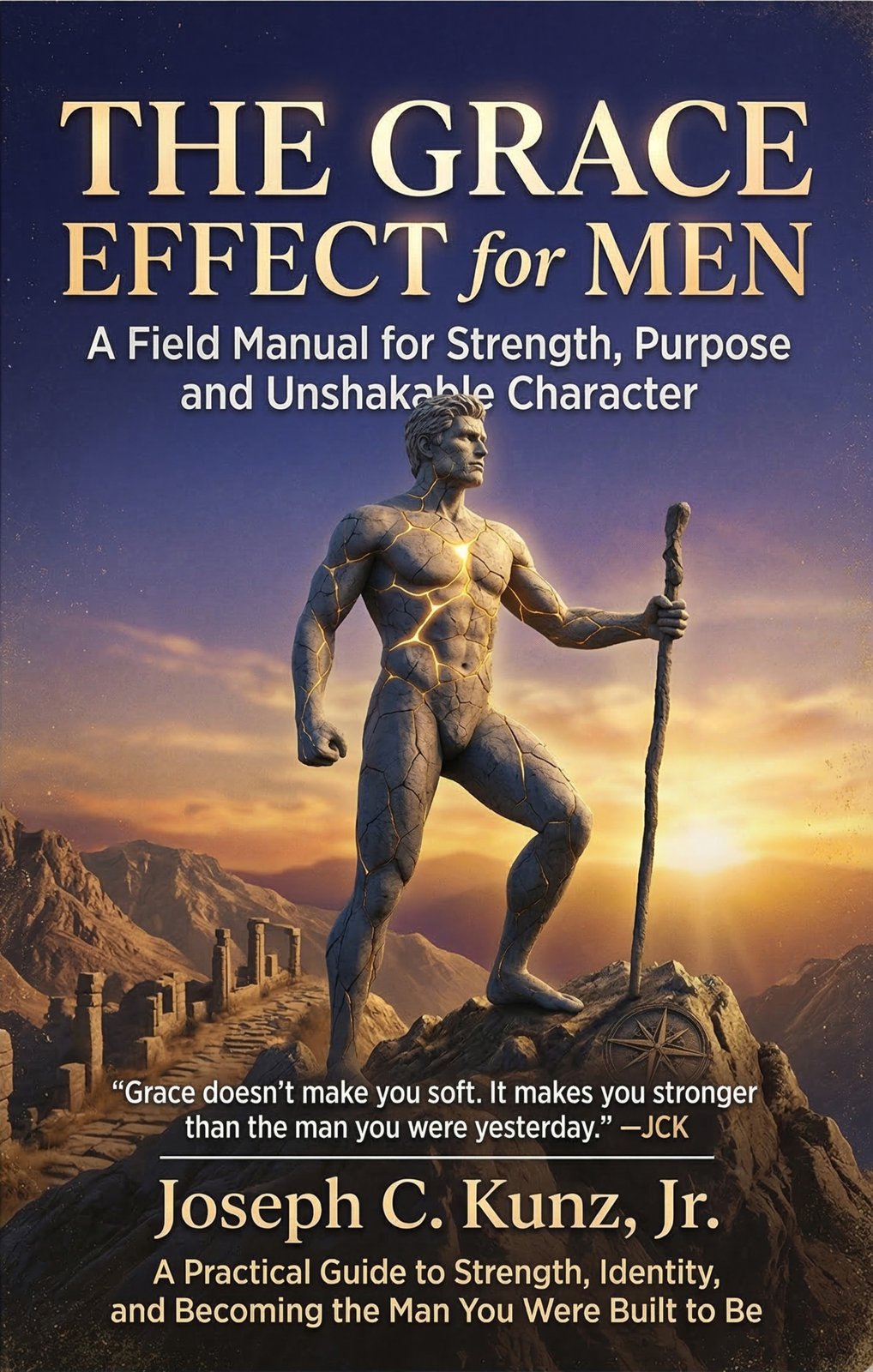
Some men receive wisdom through presence. Others learn through silence, absence, pressure, and the hard clarity of what must never be repeated. They become strong because they had to. They become responsible because someone else was not. They learn to build because too much around them was left unfinished.
But strength alone is not enough.
The Grace Effect for Men is being written for the man who wants his wound to become wisdom, not bitterness. It is for the man who wants to stay present without becoming controlling, carry responsibility without becoming hard, lead his family without handing forward the silence that shaped him, and receive grace without mistaking it for weakness.
If you grew up with absence, this book is for you.
If you learned responsibility through pressure, this book is for you.
If you want to become the kind of husband, father, grandfather, worker, builder, and witness who refuses to repeat what wounded him, this book is for you.
You cannot control the silence behind you. But by responsibility and grace, you can decide what your life says from here.
In Formation: The Grace Effect for Men