Science Is a Tool. Faith Is the Frame.
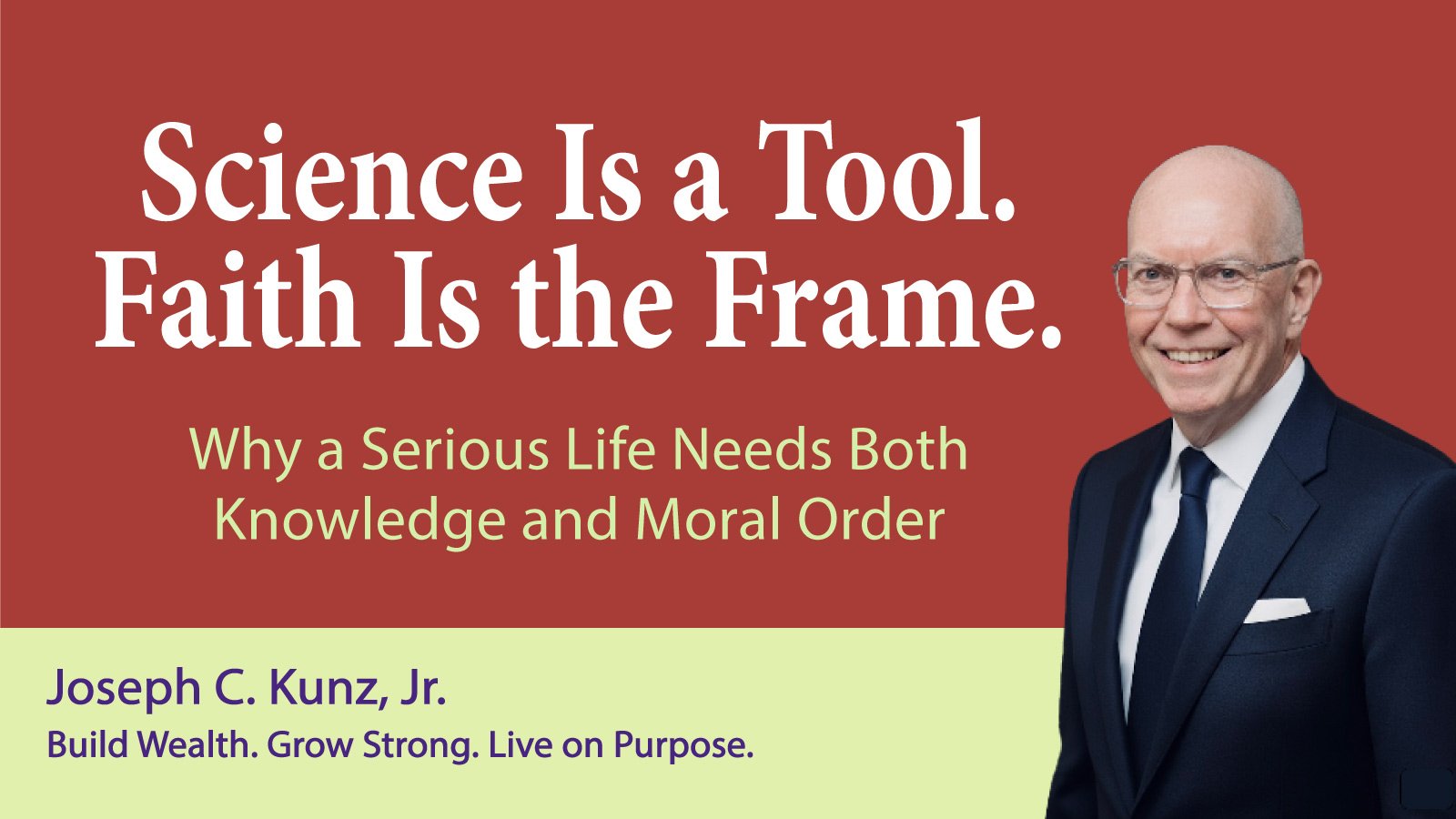
Science gives us tools for understanding the world, but faith gives us the moral frame to use those tools wisely, build responsibly, and live for something greater than knowledge alone. —Joseph C. Kunz, Jr.
Why a Serious Life Needs Both Knowledge and Moral Order
By Joseph C. Kunz, Jr.
Science can show us how the world works, but faith teaches us why the life we build inside it matters. —JCK
Synopsis
This isn’t an argument against science, a retreat into religious sentiment, or a claim that faith should replace evidence, medicine, discovery, or disciplined inquiry. In this essay, Joseph C. Kunz, Jr. argues that science and faith are not enemies when each is understood honestly. Science helps us understand how the world works. Faith helps us understand why life matters, how knowledge should be used, and what kind of people we must become.
Kunz makes the case that science becomes dangerous when it is treated as a complete worldview, and faith becomes weak when it fears truth, evidence, or discovery. Science can measure, test, heal, predict, build, and explain. But it cannot tell us what a person is worth, why suffering matters, why truth binds the conscience, or what kind of life deserves to be built and handed down. Faith gives that larger frame.
The conclusion is simple: science gives us tools, but faith gives us moral direction. A well-built life needs both knowledge and formation, both evidence and wisdom, both humility before reality and humility before God.
A tool without a frame can build almost anything, including ruins. —JCK
I. Introduction: The False War Between Science and Faith
I do not see science and faith as enemies.
I see them as different forms of contact with reality.
Science helps us understand the world we inhabit. Faith helps us understand the kind of people we must become while living in that world.
Science studies the body, the stars, disease, gravity, energy, matter, time, biology, chemistry, and cause and effect. It helps us measure, test, treat, build, repair, predict, and correct. No serious person should dismiss science. A serious person should be grateful for it.
Faith deals with meaning, moral order, conscience, responsibility, suffering, sacrifice, love, human dignity, stewardship, judgment, mercy, and the kind of life worth building. Only a shallow age would dismiss those questions. A serious person should be humbled by their weight.
The conflict between science and faith is often badly framed.
The real conflict is not science versus faith.
The real conflict is knowledge without moral order versus faith without intellectual honesty.
Science becomes dangerous when it forgets its limits.
Faith becomes weak when it fears what is true.
A well-built life needs both.
It needs the courage to face evidence and the wisdom to ask what evidence is for. It needs the discipline to understand the material world and the moral formation to live rightly inside it. It needs knowledge, but it also needs judgment. It needs tools, but it also needs a frame.
Science gives us tools.
Faith gives us the frame.
That distinction matters because a tool is powerful, but it is not wise. A tool can heal or harm. A tool can build a home or destroy a city. A tool can extend life or degrade it. A tool can make a man richer, faster, stronger, and more efficient without making him better.
That is why knowledge alone is not enough.
A man can know more and still become less.
A culture can advance technologically while collapsing morally.
A society can become brilliant with its machines and childish with its soul.
That is not progress.
That is imbalance with better equipment.
II. Science Is a Tool
Science is one of the great achievements of human civilization.
It teaches us to observe carefully, test assumptions, measure results, correct errors, and submit our theories to reality. It disciplines the mind against wishful thinking. It forces us to admit when the evidence does not support what we wanted to believe.
That is a gift.
In medicine, science helps us diagnose disease, treat infection, manage pain, repair injury, extend life, and relieve suffering. In engineering, it helps us build bridges, power cities, design tools, improve transportation, and protect human life from avoidable danger. In agriculture, it helps us grow food more efficiently. In technology, it allows us to communicate, learn, organize, create, and solve problems at a scale earlier generations could hardly imagine.
Science is not the enemy of serious faith.
Science is one of the ways human beings practice the discipline of paying attention to reality.
But science is still a tool.
That is not an insult. It is a clarification.
A tool is powerful because it helps us act. But a tool does not decide whether the action is good. A hammer can build a table or smash a window. A scalpel can heal a patient or harm one. A technology can connect families or addict children. A financial system can create opportunity or feed greed. A medical discovery can relieve suffering or become part of a cold machine that forgets the person.
The tool does not supply the moral frame.
The user does.
And the user must be formed.
That is where faith enters.
Not as an enemy of knowledge.
Not as a replacement for evidence.
Not as a sentimental escape from hard facts.
Faith enters as the deeper structure that asks: What is this knowledge for? Who does it serve? What kind of person should use it? What boundaries should govern it? What should never be done, even if it can be done?
Science can tell us what is possible.
Faith helps us ask whether it is right.
III. Faith Is the Frame
Faith should not be reduced to a tool.
That would make faith too small.
Faith is not merely a technique for feeling better, building wealth, improving family life, or becoming more productive. Faith is not life-management software with religious language sprinkled on top. It is not a mood. It is not a decorative tradition. It is not a private comfort blanket for people who cannot handle reality.
Faith is the foundation.
It is what a person stands on when everything else shakes.
But because faith is foundational, it also becomes practical. It shapes judgment. It governs desire. It orders priorities. It strengthens responsibility. It gives suffering context. It teaches humility. It reminds the strong that they are accountable. It reminds the weak that they are not worthless. It teaches a man that his wife, children, grandchildren, work, money, time, and influence are not toys. They are trusts.
That is why faith matters in real life.
Faith forms the person who uses the tools.
A doctor with science but no moral frame may become efficient without compassion.
A businessman with skill but no moral frame may become successful without honor.
A father with resources but no moral frame may provide materially while failing spiritually.
A citizen with information but no moral frame may become loud, tribal, and useless.
A leader with intelligence but no moral frame may become dangerous.
Knowledge increases power.
Faith should deepen responsibility.
That is the proper order.
Science can explain the material conditions of life. Faith teaches us what kind of life is worth living. Science can describe how things work. Faith asks what things are for. Science can study the human body. Faith insists that the body belongs to a person made for dignity, love, responsibility, and eternity.
Science gives us reach.
Faith gives us restraint.
Science gives us capability.
Faith gives us conscience.
Science gives us information.
Faith gives us formation.
IV. What Science Cannot Do
Science can answer many questions.
It cannot answer all of them.
That does not make science weak. It makes science properly limited.
Science can study the brain activity associated with love. It cannot tell a man whether love is worth sacrifice.
Science can measure pain. It cannot tell us why cruelty is evil.
Science can describe grief. It cannot explain why grief reveals the depth of love.
Science can study human behavior. It cannot fully ground human dignity.
Science can extend life. It cannot tell us what life is for.
Science can improve comfort. It cannot define goodness.
Science can help us survive. It cannot tell us whether survival is enough.
Science can describe the world. It cannot by itself tell us how to live.
A culture that forgets this becomes dangerously clever.
It starts to believe that if something can be measured, it must be what matters most. It begins to confuse data with wisdom, efficiency with goodness, innovation with progress, and technical ability with moral authority.
That is how people become impressed with power and careless with souls.
When science is treated as a complete worldview, it is forced to answer questions it was never designed to answer. It begins speaking outside its proper authority. It starts making moral claims while pretending it only deals in facts.
But every society lives by moral claims.
Every person does.
The question is not whether we believe in something beyond measurement.
The question is whether what we believe can carry weight.
V. What Faith Must Not Do
Faith also has limits in how it should be used.
Faith must not become an excuse for ignorance.
Faith must not become a hiding place for lazy thinking.
Faith must not train people to fear evidence.
Faith must not turn the Bible into a bad science textbook and then panic when science refuses to play along.
Faith should make a person more serious about truth, not less.
A Christian should not fear reality. If God is the author of reality, then truth is not the enemy of faith. Falsehood is.
This does not mean every scientific claim is settled, every expert is honest, every institution is trustworthy, or every fashionable theory deserves blind acceptance. Serious people should test claims, examine evidence, ask questions, and resist ideological capture wherever it appears.
But rejecting blind trust in experts is not the same as rejecting disciplined knowledge.
Faith should not make a man gullible.
It should also not make him proudly ignorant.
The faithful person should be able to say, “I do not understand this yet,” without feeling threatened. He should be able to learn without feeling disloyal. He should be able to ask questions without assuming every answer must fit inside his current understanding.
A fragile faith needs ignorance to protect it.
A mature faith does not.
A mature faith can look at the stars, the body, the cell, the brain, the ocean, the infant, the dying man, the mathematical order of the universe, and the strange ache of conscience, and still say: reality is deeper than my explanations.
That is not anti-science.
That is humility.
VI. Where Faith and Science Enhance Each Other
Faith and science work together when both remain honest.
Science keeps faith from becoming lazy about the physical world.
Faith keeps science from becoming arrogant about the whole of reality.
Science teaches precision.
Faith teaches purpose.
Science teaches discipline before evidence.
Faith teaches discipline before God.
Science teaches us that our assumptions must be tested.
Faith teaches us that our desires must be governed.
Science teaches us to correct error.
Faith teaches us to repent of sin.
Science helps us relieve suffering.
Faith teaches us why suffering matters.
Science helps us protect life.
Faith teaches us why life is sacred.
Science helps us build.
Faith teaches us what is worth building.
That is not conflict.
That is cooperation.
When faith and science are rightly ordered, they sharpen each other. Science prevents faith from floating away into vague spirituality. Faith prevents science from shrinking reality down to what can be measured.
Together, they help form a more serious person.
A person who respects evidence but does not worship expertise.
A person who values medicine but does not reduce the patient to a case file.
A person who uses technology but does not let technology rule the home.
A person who builds wealth but does not confuse net worth with human worth.
A person who thinks clearly but does not become cold.
A person who believes deeply but does not become sloppy.
That is the goal.
Not science without faith.
Not faith without thought.
But a well-ordered life where knowledge serves wisdom and wisdom governs knowledge.
VII. The Four Pillars Need Both
The Four Pillars of a Well-Built Life require this balance.
Faith is the foundation. But foundation does not mean fantasy. Faith must be strong enough to face reality, not hide from it. It must be able to deal with illness, death, doubt, discovery, disappointment, suffering, and responsibility without collapsing into fear or sentimentality.
Responsibility is the frame. Science strengthens responsibility by giving us better knowledge of consequences. Faith strengthens responsibility by reminding us that consequences are not merely practical. They are moral. A man is accountable for what he does with what he knows.
Work and wealth are the engine. Science, technology, systems, and practical knowledge help us work better, build better, heal better, produce better, and steward resources more wisely. But faith keeps work and wealth from becoming idols. It reminds us that success without moral order is just decorated failure.
Legacy is the destination. Science can help us live longer, communicate farther, preserve records, build institutions, and solve problems. But faith asks the deeper question: what are we handing down? More information, or more wisdom? More money, or more responsibility? More comfort, or more courage? More tools, or a stronger way of life?
A family does not become strong because it has access to technology.
A business does not become honorable because it has better systems.
A culture does not become wise because it has more data.
A man does not become good because he knows more.
Knowledge must be formed by moral order.
Tools must be governed by purpose.
A life must be built around something sturdier than capability.
That is why faith and science belong together inside a serious life.
VIII. The Danger of Tools Without a Frame
A tool without a frame eventually serves appetite, ego, fear, or power.
That is true in personal life.
It is true in family life.
It is true in business.
It is true in medicine.
It is true in politics.
It is true in civilization.
Technology without moral order becomes distraction, manipulation, addiction, and surveillance.
Medicine without moral order becomes treatment without tenderness, efficiency without humanity, and eventually calculation without conscience.
Business without moral order becomes greed with spreadsheets.
Education without moral order becomes credentialing without wisdom.
Politics without moral order becomes power with better messaging.
Science without moral order becomes capability without restraint.
That is not an attack on science.
It is a warning about man.
The problem is not the tool.
The problem is the unformed person holding it.
This is why every serious conversation about progress must also be a conversation about formation. The question is not only, “What can we do?” The question is, “What kind of people are we becoming with the power to do it?”
If that question is not asked, progress becomes dangerous.
Not because knowledge is bad.
Because knowledge increases the reach of the human soul.
If the soul is ordered, knowledge becomes service.
If the soul is disordered, knowledge becomes domination.
IX. Conclusion: Knowledge Needs Formation
Science and faith are not enemies.
They become enemies only when science becomes proud or faith becomes afraid.
Science should not pretend to be a complete answer to the human condition. Faith should not pretend that serious knowledge is a threat to God. Both errors make life smaller.
A serious person should want truth wherever it appears.
He should want the evidence.
He should want the deeper meaning.
He should want the mechanism.
He should want the moral order.
He should want the facts.
He should want the wisdom to use them.
The modern world does not suffer from a shortage of tools. It suffers from a shortage of formation. We have more information than any generation before us, but information alone does not build character. We have more technology, but technology alone does not build families. We have more medical knowledge, but medicine alone does not teach us how to suffer well, care deeply, or honor the dignity of the person in front of us.
The question is not whether science matters.
Of course it matters.
The question is whether science can carry the full weight of human life by itself.
It cannot.
And the question is not whether faith matters.
Of course it matters.
The question is whether faith is mature enough to welcome truth, discipline the mind, govern the heart, and form a person capable of using knowledge wisely.
That is the faith worth building.
The conclusion is simple: science gives us tools for understanding the world, but faith gives us the frame for living rightly within it. A well-built life needs both. Without science, faith can become careless about reality. Without faith, science can become careless about the soul.
Science gives us tools. Faith gives us the frame. Wisdom begins when we understand why both are necessary. —JCK
Related Reading: When Knowledge Needs Wisdom
These essays continue the deeper argument that a serious life requires more than information, expertise, or clever thinking; it requires moral order, disciplined judgment, and faith strong enough to form the person using the tools.
1. The False Victory Over Weak Religion
Attacking shallow belief may make science look mature and faith look childish, but defeating weak religion is not the same as thinking honestly about God, truth, meaning, or human life.
Reader Comment: This is the natural companion essay because it clears away the false fight between science and weak religion, while this essay builds the positive framework for how faith and science belong together.
Quote: The easiest way to win an argument is to choose the weakest opponent. The hardest way to find truth is to face the strongest one. —JCK
2. Don’t Outsource Your Thinking — Even to “Experts”
Real independence comes from respecting expertise without surrendering judgment, because a free mind still has to test, weigh, question, and think for itself.
Reader Comment: This essay extends the responsibility side of the argument: science and expertise matter, but they do not relieve a serious person of the duty to think clearly and live wisely.
Quote: Respect expertise. Do not surrender your judgment. A free mind still has to do its own work. —JCK
The Book Behind This Essay: Faith Strong Enough to Govern the Tools

A culture with powerful tools and weak formation is not advanced. It is dangerous with better equipment. Science, technology, medicine, business systems, financial knowledge, and information can help us build, heal, solve, and improve. But none of them can tell us what kind of people we should become, what we owe one another, what should never be done, or what kind of life is worth handing down.
The Builder’s Guide to Faith is being written for men and women who want faith that does more than decorate their lives. It is a practical framework for building faith that forms judgment, strengthens responsibility, orders ambition, deepens courage, clarifies suffering, steadies the home, and teaches a person how to use knowledge without being ruled by it.
This book is not about rejecting science.
It is not about hiding from evidence.
It is not about retreating into religious slogans.
It is about building the kind of faith that can face reality, welcome truth, govern desire, carry responsibility, and turn knowledge into wisdom.
If you believe life needs more than information, this book is for you.
If you believe tools need a frame, this book is for you.
If you believe faith should form the person holding the tools, this book is being built for exactly that purpose.
Being Built to Hold: The Builder’s Guide to Faith
Under construction.