Modern Man Suffers From Irony — What He Really Needs Is Sincerity

Modern men hide behind irony to avoid responsibility, but this essay reveals why sincerity—costly, courageous, and anchored in conviction—is the quality that builds real strength, trust, and a life that actually holds. —Joseph C. Kunz, Jr.
Why the Smartest Move You Can Make Today Is to Mean What You Say
By Joseph C. Kunz, Jr.
Synopsis
Modern men have learned a slick survival skill: hide behind irony. Stay sarcastic. Stay detached. Keep everything “just a joke.” That way no one can hold you to your words, your values, or your responsibilities. But that shield comes with a cost: it turns men into spectators of their own lives—clever, uncommitted, and increasingly untrustworthy.
In this essay, Joseph C. Kunz, Jr. argues that sincerity isn’t softness—it’s spine. It’s the rare courage to mean what you say, stand behind what you believe, and let your commitments carry real weight. Through a builder’s lens, he shows how irony creates distance and drift, while sincerity produces clarity, accountability, trust, and the kind of steadiness families, marriages, teams, and communities can actually rely on.
This essay is a wake-up call for men who are tired of performing and ready to build: drop the wink, ditch the shrug, and reclaim the only posture strong enough to hold a life together—sincerity.
Irony is cheap protection. Sincerity is risky—but it’s the only way to build anything real. —JCK
I. Introduction: The Age of the Wink and the Shrug
We live in a culture allergic to sincerity.
People hide behind sarcasm, irony, memes, and “just kidding” because meaning anything—really meaning it—feels dangerous.
Say something true and you risk being misunderstood.
Say something sincere and you might get mocked.
Say something about faith, duty, or responsibility and you’ll be told you’re “too serious.”
So modern man protects himself with irony.
He builds a shell of cleverness so he never has to commit, never has to stand, never has to be counted on.
Irony is the emotional equivalent of hiding behind your phone.
But here’s the problem:
Irony can amuse you. It can distract you.
But it can’t build you.
You cannot build a good life—or a good world—without sincerity.
II. Irony Is the Armor of the Unanchored
Irony is a defense mechanism for people terrified of being exposed.
It says:
• If I don’t take anything seriously, nothing can hurt me.
• If I wink while I say it, you can’t hold me to it.
• If I float above everything, you’ll never see what I stand on.
But the man who stands for nothing is controlled by everything.
Irony is a way to avoid moral responsibility.
It lets you smirk your way through life instead of showing up with conviction.
A builder can’t afford that.
Builders need clarity, not clever excuses.
Builders need direction, not detachment.
Builders need foundations, not footnotes.
III. Sincerity Takes Courage—Because It’s Naked
Sincerity doesn’t give you anywhere to hide.
When you’re sincere:
• Your yes means yes.
• Your no means no.
• Your beliefs stand out.
• Your values shape your actions.
• Your reputation actually matters.
Sincerity exposes what you love, what you fear, and what you believe.
And that scares people.
But here’s the truth:
Sincerity builds trust.
Irony builds distance.
People follow the sincere man—because he is committed, accountable, and real.
People laugh at the ironic man—then leave him alone when it matters.
IV. What Our Culture Lost When It Became “Too Cool to Care”
When sincerity disappeared, so did everything built on it:
• Meaning, because meaning requires commitment.
• Purpose, because purpose requires sacrifice.
• Community, because community requires loyalty.
• Faith, because faith requires humility.
• Responsibility, because responsibility requires people who show up without the safety of sarcasm.
A world without sincerity becomes a world where no one can be trusted and nothing can be built.
It’s all performance.
All posturing.
All air.
And that’s why the culture feels hollow:
It is hollow.
It is irony stacked on irony—no beams, no lumber, no weight-bearing truth.
V. The Builders of History Were Sincere Men
The Founders were not ironic.
They didn’t write the Declaration with a smirk.
They meant every word—and they signed their names knowing it might cost them their lives.
Great fathers aren’t ironic.
Strong leaders aren’t ironic.
Faithful husbands aren’t ironic.
Men of integrity aren’t ironic.
People who build nations, families, businesses, and legacies are people who stand for something—plainly, publicly, and without a safety net.
Their sincerity becomes the steel of their character.
VI. Here’s What Sincerity Demands of a Man
Sincerity isn’t soft.
It isn’t sentimental.
It is costly—and that’s why so few men choose it.
A sincere man steps out from behind his cleverness and stands where people can see him.
He gives his word without the escape hatch of irony.
He refuses the comfortable protection of cynicism.
Sincerity demands five things of a man:
1. Spine
A sincere man accepts that truth has weight.
He carries it anyway—calmly, without theatrics.
2. Responsibility
Sincerity makes you accountable.
It traps you inside your own words—and a builder welcomes that trap.
3. Clarity
A sincere man speaks plainly.
His values are visible.
There is no hidden angle.
4. Vulnerability Without Weakness
Sincerity exposes your convictions—but not your strength.
It reveals your principles, priorities, and scars.
5. Commitment
A sincere man is steady.
His “yes” is a promise.
His “no” is a boundary.
His presence is reliable, not performative.
VII. Conclusion: A Sincere Man Has Weight
Irony lets you drift.
Sincerity forces you to build.
It makes you unmistakable—
your character, your intentions, your faith, your values.
It creates a man who can be counted on—
by his family, his people, and his own conscience.
Sincerity is not about being liked.
It’s about being anchored.
A sincere man isn’t perfect—
but he is present.
He is trustworthy
He is real.
And in a culture addicted to winks, shrugs, and sarcastic dodges,
a sincere man becomes something rare:
A man with weight.
A man with direction.
A man worth following.
Any man can hide behind irony. Only a man with a spine can stand behind his word. —JCK
Key Terms: What I Mean (and Don’t Mean)
1. Irony
Not humor or wit.
Irony is cleverness used as armor—a way to avoid commitment, responsibility, and exposure.
2. Sincerity
Not naivety or emotional fragility.
Sincerity is moral clarity expressed plainly—truth without disguise or performance.
3. Burden
Not victimhood.
A burden is the chosen weight that builds strength, character, and legacy.
4. Clarity
Not simplistic certainty.
Clarity is alignment—your values, words, and actions all pointing in the same direction.
5. Vulnerability
Not weakness or oversharing.
Vulnerability is the courage to live without masks—where your principles are visible.
6. Accountability
Not punishment.
Accountability is the willingness to stand behind your words and choices.
7. Conviction
Not arrogance.
Conviction is the steady, internal anchor that keeps a man rooted in truth even when it costs him something.
8. Presence
Not performance.
Presence is reliability—the discipline of showing up whole, ready, and sincere.
Related Reading: For Readers Who Are Done Hiding and Ready to Stand Up Straight
If this essay stirred something in you, these two pieces will sharpen it into action.
1. Say What You Mean — Or Someone Else Will Say It for You
A powerful argument that clarity isn’t optional—if you don’t define your own words, values, and direction, the culture will gladly do it for you.
Reader Comment: This essay finally made me understand why my life felt vague—I wasn’t defining anything. It pushed me to stop mumbling and start meaning what I say.
Quote: Clarity is the first act of courage—because once you define your words, you must live by them. —JCK
2. Manhood Is Built in the Moments No One Sees
A reminder that real character is constructed quietly, consistently, and sincerely long before anyone praises it or recognizes it.
The Book Behind This Essay: The One Every Man Should Feel in His Chest
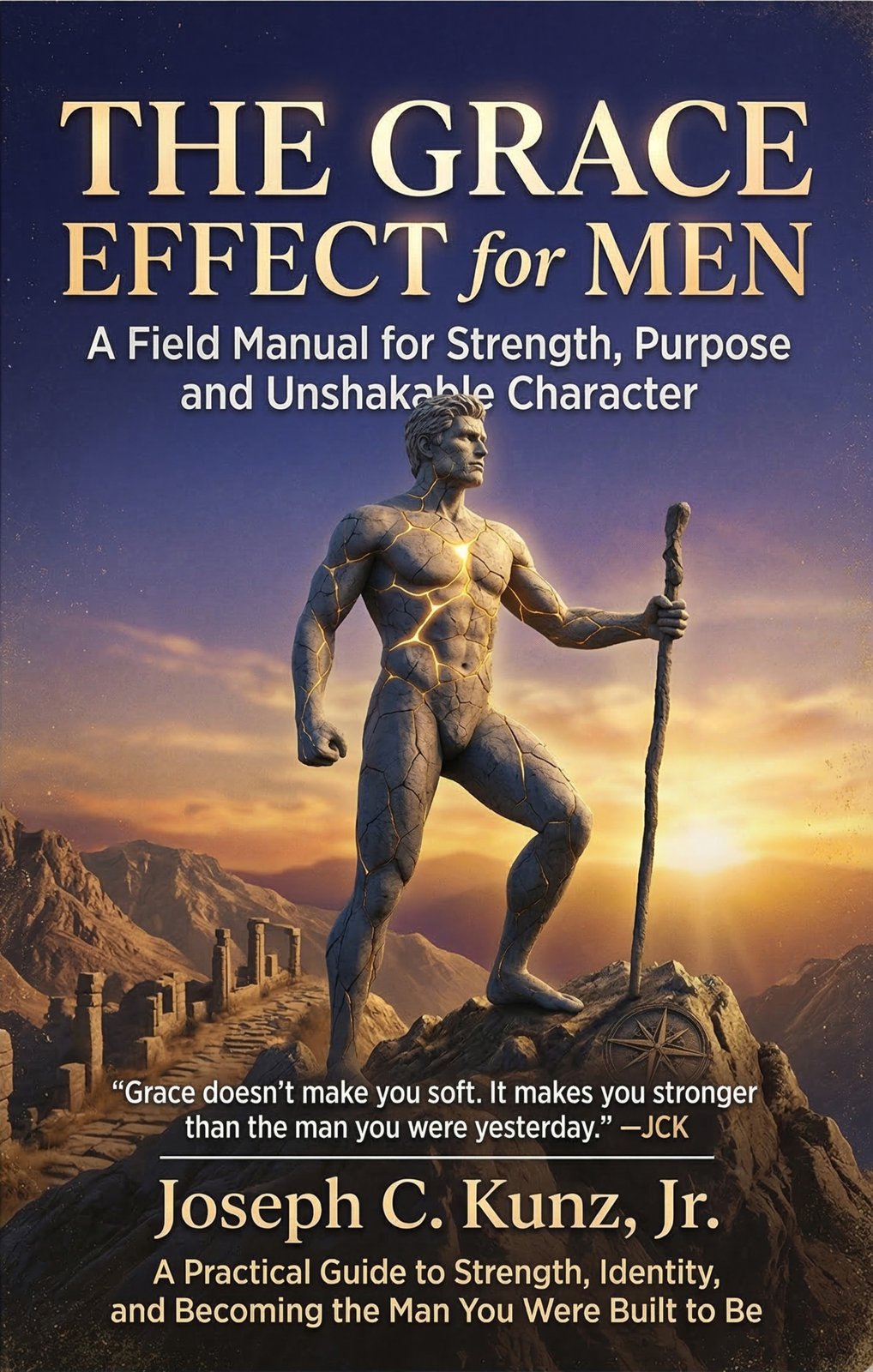
The Grace Effect for Men: A Field Manual for Strength, Purpose, and Unshakable Character
If You Felt This Essay, Good — That Tightness in Your Chest Is Your Calling Waking Up
You’re not reading this because life has been easy.
You’re here because something in you is tired of drifting, tired of excuses, tired of waiting for permission to be the man you were raised — and built — to become.
Here’s the truth most men never hear:
Life is heavy.
And you’re built to carry weight.
Not because you’re perfect.
Not because you’re fearless.
But because you were made to show up — with grit, grace, conviction, and a spine that doesn’t fold the moment life stops clapping.
If this essay hit you, that’s not an accident.
That’s direction.
That’s responsibility tugging on your shirt.
That’s God nudging you in the ribs saying:
Get up. I’m not done building you yet.
And if you’re ready for more than motivation…
If you’re ready for formation…
If you want to carry your strength with grace, not ego…
Then you need to dig deeper than internet wisdom and “grind culture” nonsense.
You need a framework that holds.
You need principles that don’t crack.
You need The Grace Effect for Men — a blueprint for becoming a man who is both strong and good, tough and loving, feared by chaos and trusted by everyone who depends on him.
Step into the book — The Grace Effect for Men
If this essay is a spark…
This book is the fire.
Because the world doesn’t need more loud men, soft men, or performative men.
It needs anchored men.
Men with weight.
Men who carry strength the way it was meant to be carried — with grace.
And if you’re still reading this?
Brother, you’re one of them.
Now build toward it.
Coming soon.