Faith That Fights: Standing Tall in a Culture That Kneels

In an age where conformity is demanded and truth is optional, real faith doesn’t kneel to culture’s idols—it stands tall, fights back, and anchors freedom itself. —Joseph C. Kunz, Jr.
When The Mob Kneels, Real Faith Stands Tall
By Joseph C. Kunz, Jr.
Synopsis
This is not an essay about being combative, chasing outrage, or turning faith into a political identity badge. In this essay, Joseph C. Kunz, Jr. confronts a deeper and more costly question: what does real faith look like in a culture that increasingly rewards surrender and punishes conviction? He argues that faith is not proven by how loudly it speaks when the crowd agrees, but by whether it can remain standing when compromise becomes more profitable, more comfortable, and more socially acceptable than truth.
Kunz makes the case that every age demands some form of kneeling. In earlier times, the idols were easier to identify. Today, they arrive dressed as compassion, tolerance, inclusion, safety, convenience, and progress. But beneath the changing language lies the same old demand: bow to the approved script, suppress what you know to be true, and call your surrender virtue. The essay explores the real cost of refusing that demand—not in abstract terms, but in lived ones: strained relationships, lost opportunities, social isolation, quiet mockery, and the exhausting pressure of standing firm when it would be easier to go silent. It also shows why the cost of kneeling is worse. A person who repeatedly bows against his conscience does not merely avoid conflict; he begins to hollow himself out.
The conclusion is simple: faith that fights is not faith that lashes out, but faith that refuses to kneel. It is the steady, disciplined, sometimes lonely strength to remain anchored in truth when the culture rewards drift. And without that kind of faith, families weaken, freedom erodes, and legacies collapse from the inside. But where that faith remains, even quietly, the line still holds.
Faith isn’t fragile—it’s the fire that keeps families strong, nations free, and legacies alive. —JCK
I. Introduction: Faith in a World That Demands Compliance
We live in an age that confuses surrender with virtue.
The pressure does not usually come dressed like tyranny. It comes dressed like approval. It arrives with a smile, a slogan, a policy memo, a corporate script, a school directive, a social expectation, or a cultural mood that tells you, gently at first, that keeping the peace matters more than telling the truth. It rarely says, deny what you believe. It says something softer and far more dangerous: just don’t make this difficult. Just don’t say that part out loud. Just be reasonable. Just go along.
That is how kneeling begins.
Not always through one dramatic betrayal, but through a hundred small surrenders. A man laughs at what he knows is wrong so he won’t look rigid. A parent stays quiet at a school meeting because speaking up will make life harder. A business owner softens the truth because honesty may cost a contract. A believer learns to hide his convictions behind vague language so he can remain acceptable to people who despise what he actually stands for.
And after enough of these compromises, he tells himself he is being wise, prudent, flexible, strategic. But what he is often becoming is trained. Trained to kneel. Trained to treat conscience as negotiable. Trained to confuse survival with integrity.
Faith that fights is the refusal to accept that training.
It is not loud for the sake of being loud. It is not angry for the sake of being angry. It does not seek conflict as a hobby. But it does refuse to bend where bending would require dishonesty, cowardice, or betrayal. It is a steady spine formed by allegiance to something higher than reputation, applause, convenience, or safety.
And in a culture where almost everyone is being taught to kneel, that kind of faith is no small thing. It is resistance. It is witness. It is freedom’s backbone.
II. Faith That Refuses to Kneel to Idols
Every age has idols.
In older times, they were easier to spot. They stood in temples, sat on altars, or were carved into physical form. Modern people flatter themselves by thinking they have outgrown such things. They have not. They have simply become more sophisticated idol-makers.
Today, the idols are ideological, emotional, and institutional. They are made of status, safety, approval, self-expression, political identity, therapeutic language, and moral vanity. They demand less incense and more compliance. They do not always ask you to worship in public. Often, they merely ask you to edit yourself. To soften the truth. To deny the obvious. To pretend confusion is wisdom. To call sin liberation. To call surrender compassion. To call cowardice nuance.
But the essential demand is unchanged: Bow—or pay.
Faith that fights begins with recognizing that demand for what it is.
It understands that not every cultural norm deserves respect, not every popular slogan deserves obedience, and not every emotional appeal deserves surrender. It knows that there are moments when going along is not kindness but complicity. It knows that refusing falsehood is not cruelty. It knows that truth must sometimes stand without apology, even when the crowd calls it dangerous.
This kind of faith does not need theatrics. It does not perform courage for applause. In fact, its strength is often quiet. It appears in the man who declines to repeat a lie everyone else has agreed to call progress. In the mother who teaches her children what is true even when the culture tells her she is behind the times. In the worker who refuses to celebrate what he knows is corrupt. In the Christian who will not trade eternal truth for temporary social ease.
Real faith does not ask, What will people think? before it decides what is true. It asks, What is true? and then accepts the cost.
That is why faith that fights matters. Because a culture does not become corrupt all at once. It becomes corrupt when enough people decide that avoiding discomfort matters more than refusing falsehood.
III. The Cost of Standing Tall
Let’s stop romanticizing this.
Standing tall sounds noble in a sentence. It feels heavier in real life.
The cost of conviction is not always martyrdom. More often, it is a steady drip of pressure that wears on the soul. It is being called rigid because you refuse to lie. It is being frozen out of conversations because you will not pretend confusion is clarity. It is watching people who once respected you grow uncomfortable because your presence reminds them of standards they no longer want to live by.
Sometimes the cost is professional. You lose a deal because you will not say what the room expects. You pass on an opportunity because it comes with a moral price tag you cannot justify. You realize that a system rewards compliance more than character, and suddenly your path becomes slower, narrower, and lonelier.
Sometimes the cost is relational. Friends stop calling. Family members grow irritated. People accuse you of becoming “too much,” when what they often mean is that you no longer help them feel comfortable in their own drift. Conviction has a way of disturbing people who want moral seriousness without moral obligation.
Sometimes the cost is internal. You wonder whether silence would be easier. You ask yourself whether speaking plainly is worth the friction. You get tired. You question whether standing firm is making any difference at all. That is where many people cave—not because they stopped believing, but because the emotional tax of conviction became too high.
This is where faith that fights either becomes real or collapses into slogan.
Because anyone can speak boldly when the cost is hypothetical. The test comes when the cost is social, financial, emotional, or personal. The test comes when the truth puts something at risk.
And yet the cost of kneeling is worse.
A man who repeatedly betrays what he knows to be true does not stay whole. Something in him starts to split. He may gain approval, but he loses solidity. He may keep comfort, but he loses peace. He may protect his image, but he diminishes his soul. He teaches himself, one compromise at a time, that conviction is disposable. And if he has children, students, employees, or anyone else watching him, he teaches them the same lesson: comfort outranks character.
That is how moral collapse becomes generational.
Faith that fights may cost popularity. But surrender costs identity. And identity is much harder to recover once you have spent years bargaining it away.
IV. Why Faith That Fights Builds Legacy
People are always teaching.
Even when they say nothing. Especially when pressure arrives.
Children watch more than they listen. Employees observe more than they are told. Families absorb what a household honors, excuses, fears, or avoids. A man may claim faith with his words for years, but when his children watch him cave to pressure, stay silent to protect himself, or kneel to the spirit of the age because the social consequences feel inconvenient, they learn the truth about what he actually believes.
That is why faith that fights is so deeply connected to legacy.
Legacy is not merely what you leave behind financially. It is what you normalize in the people attached to your life. It is the tone you set. The standards you keep. The example you embody when there is something to lose. It is the inherited posture your children and grandchildren receive from watching whether you stood or bowed.
When a child sees a father refuse to lie even when it would make life easier, that child learns that truth costs something—and is worth it. When a family watches a mother hold her ground with grace and firmness while the world mocks her convictions, they learn that courage is not male or female, loud or soft; it is moral steadiness under pressure. When a business owner chooses integrity over profit, the people around him learn that money is a tool, not a master.
These are not small lessons. They are civilizational lessons.
Because the decline of a culture is not merely institutional. It is inherited through example. And so is renewal.
A generation raised by adults who kneel to every fashionable lie will grow up morally disoriented, emotionally soft, and eager for approval. A generation raised by adults who stand in truth, even imperfectly, will inherit something steadier: a sense that there are things more important than fitting in, more valuable than applause, and more sacred than comfort.
History rarely remembers the compliant. It remembers the people who held the line when holding the line cost something.
Faith that fights does not just preserve personal integrity. It gives the next generation a pattern worth imitating.
V. What Faith That Fights Looks Like Today
Faith that fights is usually not cinematic.
It rarely looks like a dramatic speech in front of a crowd. It usually looks like ordinary obedience under pressure.
It looks like telling the truth in a meeting when every signal in the room says silence would be safer.
It looks like refusing to let your children be catechized by a culture that despises innocence, clarity, order, and restraint.
It looks like saying no to easy money because the deal requires moral compromise.
It looks like running a business honestly when deception would produce faster profits.
It looks like remaining faithful in marriage when the culture treats vows as temporary emotional arrangements.
It looks like practicing restraint in a world addicted to indulgence, excuses, self-display, and entitlement.
It looks like declining to participate in the ritual humiliations of the age—those little ceremonies of conformity where people are expected to deny what is obvious so they can prove they are compassionate enough to be trusted by the crowd.
It looks like prayer without performance. Work without complaint. Conviction without drama. Steadiness without applause.
And let’s be honest: that kind of life will not always look exciting to modern eyes. It may look narrow. It may look stubborn. It may look old-fashioned. It may look costly. That is because modern culture is trained to admire self-expression more than self-government, visibility more than virtue, and emotional affirmation more than moral formation.
But the lives that hold are rarely built by people chasing excitement. They are built by people who choose discipline over drift, truth over convenience, and duty over performance.
Faith that fights is durable because it is practiced in the daily arenas where a real life is built: in the home, in the workplace, in the marriage, in the habits, in the speech, in the hidden choices nobody sees but God.
That is where civilizations are either weakened or strengthened. Not first in Washington. Not first on television. Not first online. But in the small, repetitive, moral decisions where people either train themselves to stand—or train themselves to kneel.
VI. Conclusion: Faith as Freedom’s Backbone
Every generation is eventually asked the same question in different language:
Will you stand, or will you kneel?
The slogans change. The pressures shift. The idols dress themselves in new clothes. But the test remains. Will you remain anchored when truth becomes costly? Will you keep your footing when the crowd demands moral surrender in exchange for comfort, approval, and social peace? Will you hand your children a spine—or a script for compliance?
Because that is what is at stake here.
Faith that fights is not optional in a serious civilization. It is one of the few remaining forces strong enough to keep free people from becoming obedient subjects of every passing cultural mood. Without it, liberty becomes sentiment, family becomes instability, virtue becomes rhetoric, and truth becomes whatever the loudest faction can temporarily enforce.
With it, even a remnant can hold the line.
That is the part weak cultures never understand until it is too late. They think freedom is preserved by procedures alone. It is not. Freedom is preserved by people with enough moral substance to refuse lies, bear pressure, govern themselves, and remain faithful when compromise would be easier. A nation filled with people who kneel to every fashionable demand cannot remain free for long. It may remain wealthy for a while. It may remain loud. It may remain technologically advanced. But it will no longer possess the internal strength required for liberty.
Standing tall in a culture that kneels is not about ego. It is not about looking tougher than other people. It is not about playing the hero in your own imagination.
It is about refusing to betray what is true.
It is about loving God more than approval. Loving your family more than social ease. Loving freedom more than comfort. Loving truth more than applause.
And when the world demands that you bow to what you know is false, the answer cannot be confusion, camouflage, or polite surrender.
The answer must be clear.
I stand.
A culture that demands kneeling to lies becomes the proving ground for faith that stands firmly in truth. —JCK
Related Reading: For Those Who Refuse to Bow to the Crowd
If this essay lit a fire in you, these will fuel it into action.
1. Freedom Starts in Your Mind, Not Your Bank Account
Real freedom has little to do with dollars and everything to do with how you think—choosing discipline over drift, responsibility over blame, and courage over fear
Reader Comment: This essay reminded me that my biggest battle isn’t with the world—it’s with my own mindset.
2. Faith Isn’t a Crutch — It’s a Competitive Edge
Why faith makes you sharper, stronger, and more unstoppable in life and business.
Quote: Faith isn’t weakness—it’s raw fuel for clarity, resilience, and the strength to win where others stall out. —JCK
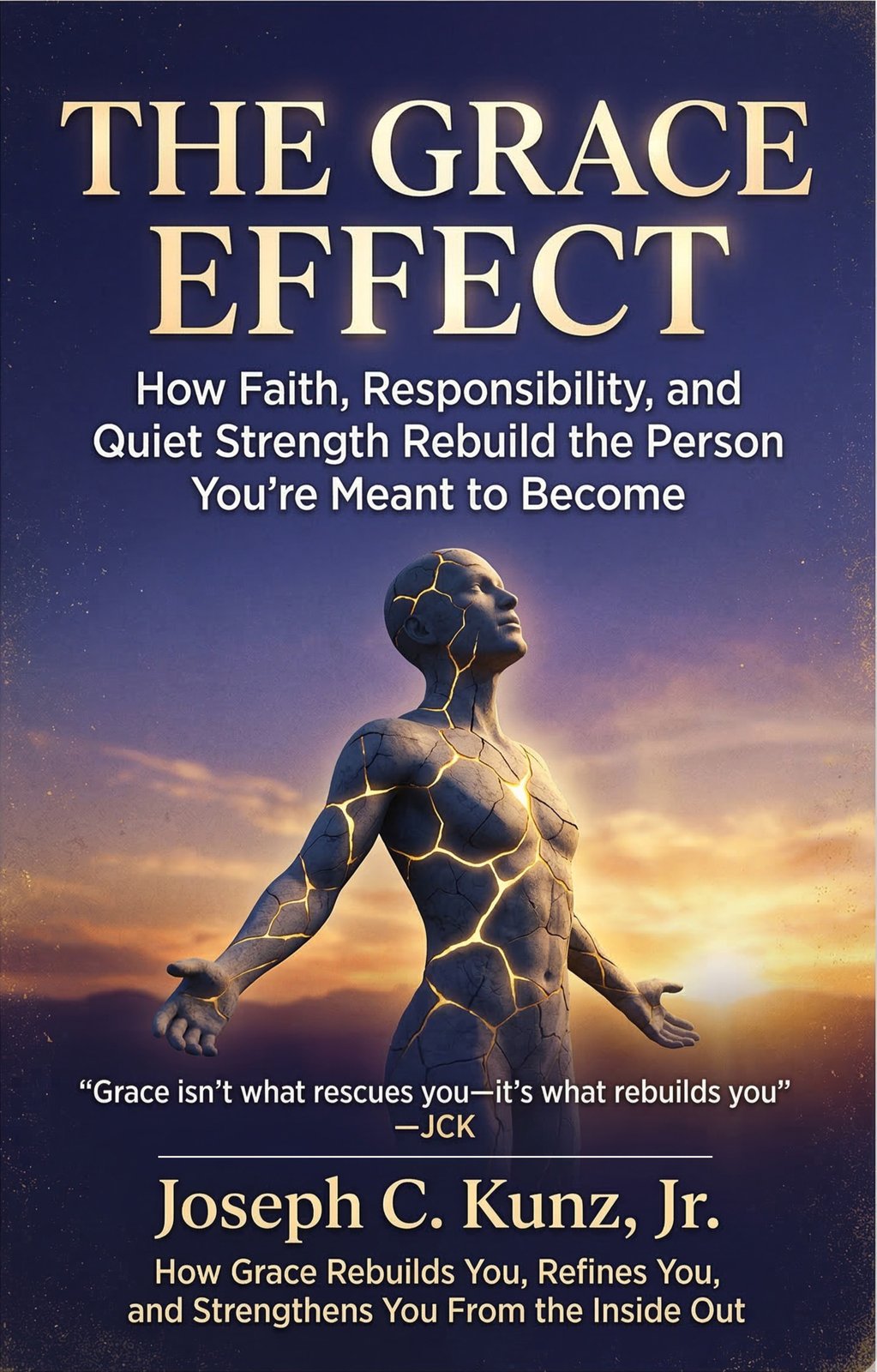
The Book Behind This Essay: Stop Kneeling. Start Living.
If you kneel to culture, you’ll hand your kids a world built on sand—shifting, shallow, and ready to collapse.
But if you stand in faith, you hand them bedrock: courage, clarity, and a backbone that no mob can snap.
That’s the difference between raising survivors of society and raising builders of legacies.
This isn’t about pride—it’s about love. Love of God. Love of freedom. Love of the generations who will remember whether you stood tall or bowed low.
Don’t flinch. Don’t cave. Don’t wait for permission.
Plant your feet, lift your head, and let the world see what unshakable faith looks like.
Because in a culture obsessed with kneeling, nothing shakes the ground harder than one man or woman who still dares to stand.
Want more? Read The Grace Effect and discover how faith reshapes families, strengthens freedom, and builds legacies that last.
Launch details on the way.