Connecting the Dots

The longer I live, the more clearly I see that faith, family, work, and freedom aren’t separate chapters—they’re the blueprint for a life of strength, purpose, and integrity. —Joseph C. Kunz, Jr.
The Long Way to Simple: Faith, Responsibility, Work, and Legacy — and the Freedom That Follows
By Joseph C. Kunz, Jr.
Synopsis
Most people live as if the big parts of life are separate compartments—faith in one lane, family in another, work in its own world, and “freedom” reduced to politics or personal preference. In this essay, Joseph C. Kunz, Jr. argues that those aren’t separate chapters at all—they’re a single blueprint. The quality of your life depends on whether you integrate them or keep them divided.
He explains why faith is the foundation that places moral authority above the self, why responsibility is the frame that makes self-government possible, why work is the engine where integrity is proven under pressure, and why legacy is built whether you mean to build it or not. Freedom, he argues, is not autonomy—it’s alignment: the result of a life where your inner convictions match your outer actions. Over decades of building, raising a family, taking losses, earning wins, and slowly learning what doesn’t hold, he came to see the pattern that was there all along. Meaning isn’t found by drifting—it’s built by connecting the dots, in the right order, on purpose.
The longer I live, the more clearly I see it: these aren’t separate chapters—they’re the blueprint for a life that holds. —JCK
I. Introduction: The Illusion of Disconnected Parts
For part of my life, I thought the big pieces—faith, family, work, and freedom—were separate lanes. Each important. Each demanding. But each isolated.
Faith belonged in church.
Family belonged at home.
Work happened in the trenches.
Freedom? That was political—bigger than me.
But real life doesn’t respect compartments.
Work pressure shows up at the dinner table.
Marriage tension affects how you lead at work.
A crisis exposes what you actually believe.
And freedom—real freedom—turns out to be less about what you can do and more about who you’ve become.
Here’s what took me too long to learn: you don’t get to live four separate lives and then stitch them together later. Life stitches them together for you—usually under pressure, and usually at a cost.
And this wasn’t a “one-year journey.” This was decades of building: making payroll when it was tight, keeping my word when it would’ve been easier to revise it, learning the difference between being competent and being clean, watching my children become adults, and realizing that my private habits were quietly becoming someone else’s inheritance.
In my Four Pillars language, the order is simple:
Faith is the foundation. Responsibility is the frame. Work is the engine. Legacy is the destination.
And freedom is the fruit—the result of living in alignment with that order.
The deeper truth underneath all of it is this: every man lives under an authority. The only question is whether he chose it—or surrendered to it.
Once I saw that, I couldn’t unsee it.
II. Faith: The First Dot That Anchors the Rest
Faith wasn’t just the first dot—it was the dot I didn’t even realize was holding the whole thing together.
It was quiet. Foundational. Always there.
Even when I wasn’t thinking about it, faith was shaping my conscience—not with fireworks, but with weight. With that interior resistance you feel when you’re about to do the thing you can justify, but can’t respect.
Here’s the intellectual truth most modern people miss: human beings don’t stop worshiping. If you don’t worship God, you don’t become neutral—you just worship something smaller. The self. The crowd. The state. Appetite. Status. Money. Control.
And those gods are cruel. They promise freedom and deliver chains.
A small scene I remember: a quiet morning before the day starts. No audience. No applause. Just you and your own mind. And the question that shows up when everything is still: Who’s in charge here—me, or God? That’s where faith stops being “identity” and becomes authority.
Because without an authority above the self, the self becomes sovereign. And a sovereign self doesn’t stay noble for long. Sooner or later it turns freedom into permission—permission to indulge, rationalize, drift, and call it maturity.
Faith anchors the rest because it puts moral law above mood. It makes right and wrong real. It gives human dignity weight. It forces accountability. And it keeps “success” from becoming a shiny mask over a corroding soul.
III. Responsibility: The Frame That Makes Freedom Possible
Freedom does not survive without self-government.
And self-government is responsibility in action.
Responsibility is the moment you stop blaming, stop drifting, and start building—because nothing in your life changes until you do.
This is where the emotional depth lives: responsibility is not a motivational quote. It’s the daily refusal to lie to yourself. It’s the decision to carry weight without making a performance out of it.
A builder’s moment: you’re tired. You’re irritated. You’re “right.” And you feel the temptation to say the sharp thing, to “win” the moment, to punish someone with your tone, to protect your ego with a sentence that lands like a blade.
Responsibility is the decision to govern yourself anyway—because you already know what happens if you don’t.
And I’ve had moments I’m not proud of—where my tone did damage, where I tried to win instead of lead, where I carried stress home and called it “just being tired.” And the cost wasn’t abstract. It showed up in faces I love. That’s when responsibility stops being a principle and becomes repentance.
If you want intellectual clarity here, it’s simple: ordered liberty requires ordered souls. A society can’t remain free if its citizens can’t govern themselves. And a man can’t govern himself if he’s constantly negotiating with impulse, resentment, fear, or appetite.
Responsibility is the frame that holds everything else in place.
IV. Family: The Place Where You Can’t Fake It
Family is where your virtues become visible—or your vices do.
At work, you can perform. At home, you’re revealed. The people closest to you don’t experience your intentions—they experience your tone, your consistency, your patience, and your ability to own your failures without turning them into excuses.
If you want to know what you really believe, look at what your family gets—not on your best day, but on your tired day.
This is why family is never just “one more dot.” It’s the arena where every dot gets tested.
V. Work: The Laboratory Where Integrity Gets Proven
Work has been more than a way to provide—it’s been a proving ground.
Not mainly for achievement. For character.
The marketplace has a way of exposing what’s real. Not because it’s holy, but because it’s honest. Results don’t care about your excuses. Customers don’t buy intentions. And money—whether people admit it or not—has a way of revealing what you truly love.
This is where capitalism, at its best, becomes more than profit. It becomes an arena for stewardship: create value, serve people, keep promises, earn trust, build something that works.
A builder’s scene: it’s late. You’re alone with a decision. Cash flow is tight. You can delay a payment. You can shade a number. You can rationalize a shortcut that “everyone takes.”
And the real question isn’t “Will this work?”
It’s “Will this stay clean in my own eyes?”
That’s not “business.” That’s moral formation. That’s faith getting pressure-tested. That’s responsibility either holding firm or quietly cracking. Because the habit you choose in private becomes the man your family lives with in public.
Work is where the blueprint either holds… or it doesn’t.
VI. Legacy: The Destination You’re Building Right Now
Legacy isn’t nostalgia. It’s not a speech at a funeral. It’s the ongoing evidence of what you practiced.
Most men underestimate this because legacy feels far away—until suddenly it doesn’t.
Legacy is what your children absorb without you teaching it.
It’s what they imitate without you noticing.
It’s what they believe “normal” is because they watched you live it for years.
And now, as a grandfather, I feel this in a sharper way: time is fast. And influence is real. The window to model strength, grace, discipline, and love is shorter than we think.
Here’s the emotional truth: you can’t delay legacy. You’re handing something down every day—your tone, your courage, your habits, your faithfulness, your temper, your generosity, your compromises, your honesty.
And the most sobering part is also the most hopeful: a man can change what he hands down—but only if he gets honest about what he’s been handing down.
Legacy is the destination, yes—but it’s being poured right now, one day at a time, into the people around you.
VII. Freedom: The Fruit of Alignment, Not Autonomy
For a long time, freedom sounded like control: my time, my money, my direction. On the surface, it still does.
But real freedom—lasting, soul-level freedom—comes from something deeper than I can do what I want.
It comes from alignment.
When your life is fractured—when you believe one thing, do another, and hide parts of yourself just to get through the week—freedom feels distant, even if you’re technically “free.”
You can own your calendar and still be enslaved to pride, fear, anger, addiction, impulse, or approval.
But when your inner life and outer life match—when your work reflects your values, your home reflects your priorities, your words match your conscience—that’s freedom.
Freedom is not the absence of limits.
It’s the presence of integrity.
And once you taste that kind of freedom, the counterfeit versions lose their appeal.
VIII. Writing: The Catalyst That Helped Me See the Pattern
Writing didn’t magically change my life.
It clarified it.
Writing slowed me down. It forced reflection. It made me name what I’d been living without always understanding it.
But the pattern began long before I ever published an essay. It showed up in conversations, in pressure, in quiet moments, in people who knew me well—people who trusted me because of consistency, not performance.
It wasn’t a thunderbolt. It was clarity earned over time.
And once I saw it, I realized something that applies to everyone: most people aren’t missing meaning. They’re missing integration. They already have dots. They just haven’t stepped back far enough to see the map.
IX. Conclusion: Start Connecting Your Own Dots
Life is too short to live it in disconnected pieces. Faith, responsibility, work, and legacy aren’t meant to be separate boxes. They’re meant to work together—to build something that lasts.
And sometimes, it takes the people around you to help you see it. The ones who know you well. The ones who’ve watched you lead, serve, endure, and rise. Pay attention to what they see in you. Because the roadmap you’ve been searching for might already be written in the life you’re quietly living.
Then take time to reflect. Write. Think. Pray. Connect the dots.
And here’s the good news: you don’t need a dramatic reinvention. You need honest attention—and the courage to build in the right order.
Here’s a simple “map” you can use this week:
• Faith: Where is your conscience trying to correct you right now?
• Responsibility: Where are you making excuses instead of taking ownership?
• Family: Where do you need humility instead of ego?
• Work: What corner are you tempted to cut—and what would “clean” look like instead?
• Freedom: What habit is quietly owning you—and what would alignment require?
• Legacy: What are you teaching—by example—without meaning to?
Start there.
Because the older I get, the more obvious it becomes: you don’t find the blueprint. You live into it—one clean decision at a time. —JCK
Related Reading: For the Reader Ready to Go Deeper
Want to explore how these values shape the man you become?
1. Becoming the Man You Needed as a Boy
Why strength, presence, and honor are more powerful than status.
Reader Comment: Reading this felt like someone finally naming the standard I’ve been trying to live up to but never had words for. It made me think less about success—and more about responsibility.
2. Why Rich People Think in Terms of Systems, Not Paychecks
A look at how integrated thinking changes your approach to wealth and work.
Reader Comment: This essay shifted how I see money entirely. It wasn’t about getting rich—it was about building a life that actually works over the long haul.
The Book Behind This Essay: Stop Pretending Life Is Random
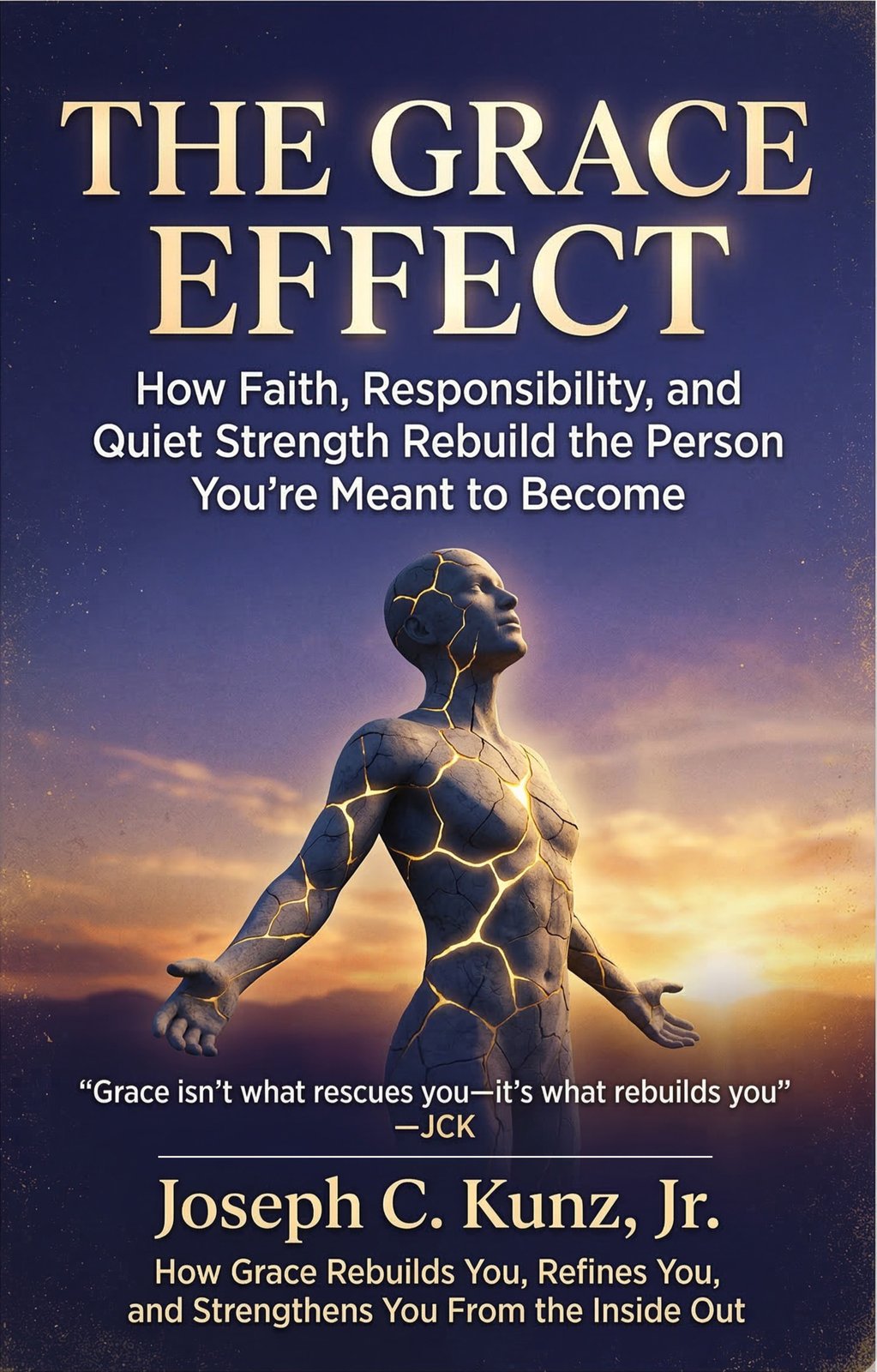
Here’s the truth: your life isn’t a mess of accidents—it’s a pattern waiting for you to own it. Every hardship, every scar, every “wrong turn” is a dot. And if you keep drifting, those dots will never connect to anything but regret.
That’s why I wrote The Grace Effect. Because grace isn’t some soft church word—it’s the force that stitches your failures, your faith, and your fight into something bigger than you.
This book is me grabbing you by the shoulders and saying: Wake up. Pay attention. Connect the dots. Or waste the only life you’ve got.
I poured everything into these pages—my scars, my grit, my faith—because I don’t want you to miss it. Don’t wait for life to make sense someday. Make it make sense now.
Grab The Grace Effect. Because the map of your life is already in front of you—and it’s time to stop staring and start walking.
More information shortly.